Sunday, September 6, 2026



News and Views from the Global South
ECONOMY: "Patching Up Bretton Woods Makes No Sense"
Haider Rizvi
- The world community must take immediate action to overhaul the current global financial system – that's what a vast majority of political leaders and policymakers from the developing world who are attending a three-day U.N. conference on the global economic crisis are saying.
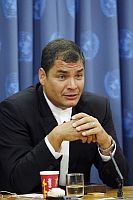
Ecuadorian President Rafael Correa Delgado thinks that the countries of the South must develop "their own financial architecture". Credit: UN Photo/Evan Schneider
In his hard-hitting speech, like many other leaders from the developing world, Correa held the International Monetary Fund (IMF) and the World Bank, as well as the rich countries of the North, responsible for the current economic meltdown that has had a devastating impact on poor nations.
"Patching up the Bretton Woods system, which we do not control, makes no sense for the countries of the South," he said. "This is our opportunity to consolidate our presence and to develop greater power of deliberation and decision in international fore to, finally, become the owners of our own destination."
Correa thinks that the countries of the South must develop "their own financial architecture" and that they should try to create a "coordinating entity of planetary proportions, based on a monetary council established with "clear representation and accountability criteria that endorses new foreign exchange commitments and regional institutional arrangements with an issuance of Special Drawing Rights (SDRs)." This issuance of SDRs, according to him, postponed for decades by the big powers of the North, "will contribute to break the monopoly in the provision of liquidity that guarantees the unipolarity of the U.S. dollar and the asymmetric decisions of the IMF."
Correa described the current global financial system as "unhinged by speculation and privilege" and blamed the U.S. financial industry for the plight of millions of poor who are suffering. "This financial crisis originated in U.S. financial markets. [But the] South, which had no responsibility, has become its main victim," he said.
At the conference South Africa’s minister of international relations and cooperation, Maite Nkoana-Mashabane expressed similar views.
"We need fundamental and far-reaching governance reforms at Bretton Woods institutions, inter alia by increasing the voice and participation in the decision making… for developing countries," he said.
In his view, the world needs interventions in four key areas in order to address the current financial crisis – balance of payments support in the case of a sudden stop of capital flows, investment in social equity, trade finance support to ensure the world trade does not dry up and increased aid for low-income countries.
According to Mashabane, about 90 million people are likely to loose their jobs due to the current economic crisis. Rising unemployment and declining wages and remittances, he said, would push "millions of people back into poverty in 2009." "The crisis has shown that the current structures and instruments of financial institutions are systemically fragile and largely inadequate to address the impact of the crisis on developed and developing countries," he said.
Studies show that that by the end of March this year, the U.S. economy shrank by more than six percent and its investment dropped by 38 percent. Similarly, among the most industrialised nations, Japan is likely to face a recession at the rate of three percent and the Eurozone is expected to see a fall of four percent of its GDP.
According to U.N. researchers, due to the current economic meltdown, about a billion people in the world are likely to go hungry. There are also projections about more violence and conflicts in many countries around the world as a result of unemployment and poverty.
At the conference, no industrialised nation has indicated any kind of willingness to endorse the developing nations’ demands to reform the Bretton Woods institutions, which impose often questionable conditions on loans and aid to developing countries.
In her speech, the U.S. envoy to the U.N., Susan Rice, said her country "is here to participate in this important conversation, to listen, to exchange, to work with you in a spirit of cooperation." However, she gave no sign of support for reforms at the IMF and World Bank.
Though seemingly concerned about the current financial crisis, representatives from the European Union (EU) also appeared to be indifferent on this subject.
"The EU is in favour of a key role for the U.N. in the effort to help developing countries tackle a variety of global social, economic, financial, and environmental challenges and foster sustainable development in all its dimensions," said Helena Bambasova, the deputy minister from the Czech Republic on behalf of the EU.
In their speeches, both U.N. Secretary General Ban Ki-moon and U.N. General Assembly president Miguel D’ Escoto were on the side of those pushing for revamping of the world’s financial institutions.
"The world institutions created generations ago must be made more accountable, more representative, and more effective," said Ban in a statement.
For his part, D’Escoto agreed with Ban and urged the world community to take collective action to prevent the "global crisis, with its myriad faces, from turning into a social, environmental and humanitarian tragedy."
Delegates at the conference are due to reach an agreement on Friday.
 Print
|
Print
|