Languages
Tuesday, November 10, 2026



News and Views from the Global South
Active Citizens
CHINA: Sympathy for Japan Drowns Out Historic Hate
Despite deep historic tensions between the two Asian powers, a surge of sympathy has emerged among Chinese toward victims of last week’s earthquake and resulting tsunami in northern Japan, which has left an estimated 10,000 dead or missing.Malawi Donor Funding Threatened by Rights, Governance Issues
Malawi is bracing itself for difficult economic times following a decision by the country’s main donors to withhold financial aid amounting to $400 million. Donors say they are responding to a range of governance and human rights issues in the country.
TAIWAN: Public Demands Safety Review of New Reactor
The unfolding disaster at Japan’s Fukushima Daiichi Nuclear Power Plant has reignited debate over Taiwan’s own nuclear power programme and the controversy over continuing construction of a fourth nuclear facility here.
CAMBODIA: Botched World Bank Project Leads to Thousands of Evictions
The World Bank botched the handling of an ambitious multi-million-dollar land- titling project in Cambodia and has done little to protect thousands of people in a lakeside slum from eviction.Japan’s Nuclear Nightmare Triggers Fears in France
Until the nuclear crisis started unfolding in Japan last week, most French citizens did not doubt that the country's 58 nuclear reactors were safe enough to continue operating for scores of years to come.
INDIA: Tech to the Rescue of School Lunch Model
Surrounded by lush green wheat and yellow flowering mustard fields at Ekdanta primary school, it is noon and the 57 children in two combined classes are fidgety - impatient for the school served midday meal.Sri Lanka: NGOs Face Funding Gap and Government Scrutiny
Lack of donor funding, state phobia against western NGOs, and restrictive work permits for foreign aid workers have together hit the operations of several dozen Sri Lankan NGOs and their foreign counterparts.Japan Atomic Woes Trigger Policy Review in Germany
The unfolding nuclear catastrophe in Japan, triggered by last Friday's massive earthquake and tsunami, followed by a chain of explosions in atomic power plants, has forced the German government to rethink its own nuclear energy policy.Japan Bracing For Nuclear Meltdown
Desperate efforts by the government to avoid the looming nightmare of a nuclear meltdown in tsunami damaged Fukushima Daiichi nuclear plants, 240 kilometres north of Tokyo, have brought no relief to the public who face the possibility of another explosion that could spew deadly radiation across the country.INDIA: Japan Quake Focuses Anti-Nuclear Message
Anti-nuclear campaigners in India see the earthquake that hit Japan last week, which threatens the meltdown of the Fukushima atomic power facility there, as a wakeup call for this country’s ambitious nuclear power programme.WOMEN’S DAY: Without Grassroots, the Tree Will Not Stand
Women from grassroots organisations all across the globe arrived in New York this week for a five-day summit dedicated to bolstering female and community- based representation at all levels of political decision making.Save Climate and Double Food Production With Eco-Farming
Eco-farming could double food production in entire regions within 10 years while mitigating climate change, according to a new U.N. report released Tuesday in Geneva.US: Fundamentalist Protest Is Protected
In a contentious free speech case, the nation’s highest court has ruled that the right of a fundamentalist church group to protest at military funerals is protected by the First Amendment free speech clause of the constitution when the protest takes place in public and addresses issues of public concern.Enthusiasm For 2012 Earth Summit Lagging
Timed to coincide with the 20th anniversary of the 1992 Rio de Janeiro Earth Summit, the Rio 2012 Summit hopes to recapture the optimism of that earlier era.
Q&A: Rural Women Need Concrete Actions
Burundi will put U.N. Resolution 1325 on Women, Peace and Security into practice with a National Action Plan (NAP) that is ready to be signed within the coming months.Expressions Of A Free Arab Cinema
At this year’s 61st edition of the Berlin International Film Festival Iranian filmmaker Asghar Farhadi took the highest prize.MALAWI: Women’s Voices to the Fore in New Development Policy
As Malawi works on its second development blueprint, the Malawi Development and Growth Strategy (MDGS II), the country’s women are hoping health and education will be prioritised and given proper attention in implementation.
AFRICA: ICC Justice a Dream Deferred
The African Union Summit drew to a close today in the Ethiopian capital, Addis Ababa. Among the headline decisions was the continental body's support for Kenya's planned request to defer prosecution by the International Criminal Court (ICC) of six suspects in post-election violence that claimed more than 1,200 lives in 2008.Collaring the Leopard
A first-of-its-kind satellite tracking project to monitor leopards may help the Indian government formulate a more effective wildlife policy, and prevent conflict between humans and wild animals.
Malawi Missing Its Local Government
An hour and fifteen minutes each day: Melina Kalunga has plenty of time to measure how long it takes to resolve a legal battle over Malawi's Electoral Commission.
KENYA: No Easy Path for Disabled Women with Political Dreams
"People living with disability face all sorts of discrimination. We are discriminated against at job interviews in schools. Everyday is a battle to remain positive in the face of a world that is too bent on dismissing those among us that do not meet the standard of what is normal", explains Mishi Juma, a disabled community leader from the Coast region.« Previous Page — Next Page »





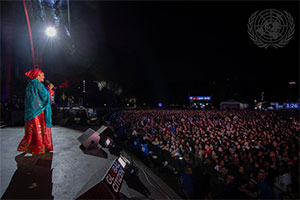 Global Citizen Festival in New York. Credit: UN Photo/Eskinder Debebe
Active citizens are committed to social change because they know that it is achievable. However, major political challenges face active citizens across the world. For example, in authoritarian regimes in Latin America where the hegemonic party has been in power for decades on end, protestors and human rights activists face enormous repression and struggle to materialize their advocacy into concrete results. The same can be said for Africans, where a shift towards elected government in recent decades has yet to translate into an effective voice in decision-making. Now, the Strengthening Citizen Demand for Good Governance, which uses evidence-based approaches – funded by DFID's Governance and Transparency Fund – seeks to raise their voices.
In 2025, the CIVICUS Monitor’s People Power Under Attack report revealed that civic freedoms are severely limited in 122 of 198 countries and territories, and only 7.2% of the global population now lives in countries where civic space is open. Through partnership with the Overseas Development Institute (ODI) and CIVICUS, IPS reporters across the continent will seek to define the extent and limits of state capability, government accountability and the responsiveness of leaders to the needs of citizens.

The Week with IPS

NEXT STOP - SDGs
Tracking global progress towards a sustainable world
Tracking global progress towards a sustainable world
