Languages
Thursday, October 8, 2026



News and Views from the Global South
Active Citizens

Rainwater Harvesting Eases Daily Struggle in Argentina’s Chaco Region
"I've been used to hauling water since I was eight years old. Today, at 63, I still do it," says Antolín Soraire, a tall peasant farmer with a face ravaged by the sun who lives in Los Blancos, a town of a few dozen houses and wide dirt roads in the province of Salta, in northern Argentina.
A “Crisis Point” for Human Rights Defenders
Globally, the people working to defend our human rights are increasingly under attack, reaching a “crisis point.”
Youth in Latin America Learn About Paths to Clean Energy
Young Peruvians plan to take advantage of the knowledge acquired in Brazil's semi-arid Northeast to bring water to segments of the population who suffer from shortages, after sharing experiences in that ecoregion on the multiple uses of renewable energies in communities affected by climatic phenomena.
African Union Makes Moves to Neutralise Africa’s Main Human Rights Body
For many African activists based on the continent, getting to a major human rights summit just underway in The Gambia is likely to have been a challenging exercise. The journey by air from many African countries to the capital, Banjul, for the 63rd Session of the African Commission on Human and People’s Rights (ACHPR), could have been prohibitively expensive, involved transiting through multiple cities and taken days.
An Ounce of Democracy
As the old adage goes: “An ounce of prevention is worth a pound of cure”. Nowhere is this more appropriate than when it comes to conflict. Violent conflict causes not only human suffering and destruction but robs entire societies of development and growth.
Honduran Migrant Caravan Moves Northwards, Defying all Obstacles
A long chain of people is winding its way along the highways of Chiapas, the southernmost Mexican state. It is moving fast, despite the fact that one-third of its ranks are made up of children, and it has managed to avoid the multiple obstacles that the governments of Honduras, Guatemala and now Mexico, under pressure from the United States, have thrown up in a vain effort to stop it.
Women as Liberia’s Guardians of Peace
Not long ago, images of child soldiers and the nation of Liberia were wedded in the minds of the international community. The country was struggling to end a horrific civil war, but military efforts were going nowhere.
Latin American Rural Women Call for Recognition and Policies
Rural women in Latin America play a key role with respect to attaining goals such as sustainable development in the countryside, food security and the reduction of hunger in the region. But they remain invisible and vulnerable and require recognition and public policies to overcome this neglect.
Farmers Generate Their Own Electricity in El Salvador
In Lilian Gómez’s house, nestled in the mountains of eastern El Salvador, the darkness of the night was barely relieved by the faint, trembling flames of a pair of candles, just like in the houses of her neighbours. Until now.
Cyber Attacks Growing Problem in Developing Nations
Few experiences undermine a digital financial services (DFS) customer’s finances and trust in DFS like becoming the victim of a cybercrime. This is especially true of low-income customers, who are least able to rebound from the losses, and of the newly banked, whose trust in financial services may be fragile.
G20 Women’s Summit Pushes for Rural Women’s Rights
Rural women play a key role in food production, but face discrimination when it comes to access to land or are subjected to child marriage, the so-called affinity group on gender parity within the G20 concluded during a meeting in the Argentine capital.
Maldives Envoy tells UN About Peaceful Transfer of Power
Maldives is currently going through a peaceful transfer of power to opposition leader Ibrahim Mohamed Solih, who was elected president last month, the nation's Permanent Representative Ali Naseer Mohamed assured the UN General Assembly (UNGA).
Local Communities in Mexico Show Ways to Fight Obesity
Manuel Villegas is one of the peasant farmers who decided to start planting amaranth in Mexico, to complement their corn and bean crops and thus expand production for sale and self-consumption and, ultimately, contribute to improving the nutrition of their communities.
In Argentina, Agriculture Ignores the Right to Food
In front of one of the busiest railway stations in the capital of Argentina, there are long lines to buy vegetables, which farmers themselves offer directly to consumers, at prices several times lower than those seen in stores.
Crisis Drives Nicaragua to an Economic and Social Precipice
Five months after the outbreak of mass protests in Nicaragua, in addition to the more than 300 deaths, the crisis has had visible consequences in terms of increased poverty and migration, as well as the international isolation of the government and a wave of repression that continues unabated.
Preservation of the Klamath River – a Life or Death Matter for the Yurok People
Fishermen are scarce in the Klamath River delta, unlike other fishing season, because climate change has driven up water temperatures which kills off the salmon, the flagship species of this region in northern California.
Equality and Territory: the Common Struggle of Indigenous Women in the Andes
"At the age of 18 I was the first female leader in my organisation, my grandfather who was a male chauvinist demanded that I be beaten because I was sitting among men," said Teresita Antazú, an indigenous leader of the Yanesha people in Peru's Amazon region.
Land, Water and Education, Priorities for Chile’s Mapuche People
The right to land and water, as well as to multicultural education, are the top priority demands of Mapuche leaders working with their communities in the Araucanía region and in Santiago, Chile’s capital.
Amid Chronic Violence, Millions of Afghans Face Risks of Drought Related Displacement
Amid a precarious security situation in Afghanistan, the worst drought in recent history, that hit two out of three provinces in Afghanistan in July, has destabilized the lives of tens of thousands of civilians, some of whom have already been displaced.
The Fight for the Right to Abortion Spreads in Latin America Despite Politicians
The Argentine Senate's rejection of a bill to legalise abortion did not stop a Latin American movement, which is on the streets and is expanding in an increasingly coordinated manner among women's organisations in the region with the most restrictive laws and policies against pregnant women's right to choose.
Q&A: A New Leader with a Vision to Redefine Human Rights
The human rights movement must be bigger, bolder, and more inclusive if we are to tackle today’s challenges, said Amnesty International’s first South African Secretary General.« Previous Page — Next Page »





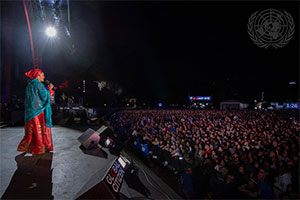 Global Citizen Festival in New York. Credit: UN Photo/Eskinder Debebe
Active citizens are committed to social change because they know that it is achievable. However, major political challenges face active citizens across the world. For example, in authoritarian regimes in Latin America where the hegemonic party has been in power for decades on end, protestors and human rights activists face enormous repression and struggle to materialize their advocacy into concrete results. The same can be said for Africans, where a shift towards elected government in recent decades has yet to translate into an effective voice in decision-making. Now, the Strengthening Citizen Demand for Good Governance, which uses evidence-based approaches – funded by DFID's Governance and Transparency Fund – seeks to raise their voices.
In 2025, the CIVICUS Monitor’s People Power Under Attack report revealed that civic freedoms are severely limited in 122 of 198 countries and territories, and only 7.2% of the global population now lives in countries where civic space is open. Through partnership with the Overseas Development Institute (ODI) and CIVICUS, IPS reporters across the continent will seek to define the extent and limits of state capability, government accountability and the responsiveness of leaders to the needs of citizens.

The Week with IPS

NEXT STOP - SDGs
Tracking global progress towards a sustainable world
Tracking global progress towards a sustainable world
