Languages
Tuesday, September 29, 2026



News and Views from the Global South
Conferences

Individual Empowerment Still Important in Leprosy Groups’ Strategies
The tragic tale of Thobias Alexander Manas’s personal experience with leprosy is all too typical.
Living with Leprosy on the Climate-Vulnerable Kiribati Island Atolls
Kurarenga Kaitire lives in Kiribati—one of the world’s most climate-vulnerable nations. Already vulnerable to nature, the 29-year-old mother of five has faced a series of vulnerabilities over the past decade, including facing social stigma and domestic abuse.
Building Successful Social Enterprises
 Marie Lisa Dacanay is the president of Manila–based Institute for Social Entrepreneurship in Asia. With 20 years of experience in development management, social entrepreneurship and enterprise development, Dacanay is also a university professor and an acclaimed author with several books on social entrepreneurship in Asia.
Leprosy Survivor Creates Hope and Support for Others Affected by Disease
When Ariel Lazarte from Quezon City, Philippines, was first diagnosed with leprosy in 2014, his life seemed as if it were falling apart. But now more than four years later Lazarte’s life is a huge contrast from the poverty and isolation he experienced as a person affected by leprosy.
Q& A: We Need a Holistic Approach to Eradicate Leprosy
Dr. Maria Francia Laxamana is the Assistant Secretary in the Philippines ministry of health. With nearly two decades of work both as a senior government official and also as an expert in several non-government organisations, Laxamana has deep insight into the issue of leprosy in this Southeast Asian nation and the challenges faced by those who are affected by the disease.
A Leprosy-free Philippines by 2020?
Dr Maria Francia Laxamana, assistant secretary of health in the Department of Health, Philippines outlines her recommendations for a leprosy country by 2020. 
Capacity Building the Key to Fighting Leprosy
Strengthening the participation of persons affected by leprosy, or SPP, has proven to be an effective strategy in reaching out to often isolated sufferers in local communities throughout Asia. A significant challenge to civil society organisations, however, is finding enough management talent to maintain and expand the programmes.
Leprosy Detection With a Personal Touch
Jennifer Quimno could put anyone at ease. So when she travels across the Philippines as part of peer to peer programme that helps identify new leprosy cases, people generally allow her to examine them.
First Asian Leprosy Assembly Calls for Greater Social Inclusion for the Affected
Growing up in Kathmandu, Nepal, Amar Bahadur Timalsina wasn’t allowed to attend school as a young boy because he was affected by leprosy. But decades later, after treatment and being able to re-integrate into his community, the boy who was once denied an education is now inspiringly the principal of a school of 400 students.
Taking the Lead in Fight Against Climate Change
As the grandchild of Jamaican citizens who moved to Great Britain, Monique Taffe says she inherited a tradition of recycling and learned not to be part of the “throwaway culture”, as some environmentalists have labelled consumerist societies.
Q&A: Suriname’s President Champions Preserving the World’s Forests
At the Bonn Climate Conference in 2017, Suriname announced its aspirations to maintain its forest coverage at 93 percent of the land area. For Suriname and other High Forest Cover and Low Deforestation (HFLD) nations, maintaining forest coverage is their contribution to saving the planet from the effects of climate change, something they did not cause.
‘Today, We Declare Our Love to Our Forests and Ecosystems’
High Forest Cover and Low Deforestation (HFLD) nations ended a major conference in Suriname on Thursday, with the Krutu of Paramaribo Joint Declaration on HFLD Climate Finance Mobilisation.
The Role Technology Can Play in Fighting Climate Change and Deforestation
At 51, Roberto Wong Loi Sing has spent nearly half of his life working in the field of engineering. But as he spends his days designing more efficient stormwater management systems, or water purification systems, for instance, the child in him comes alive as he combines his skills to find “win-win” solutions for the environment.
Our Forests Provide the World With Oxygen But We Need More Climate Change Finance – HFLD Countries
Suriname, the most forested country in the world, is this week hosting a major international conference on climate financing for High Forest Cover and Low Deforestation (HFLD) countries.
Making Communities Drought Resilient
The United Nations Convention to Combat Desertification (UNCCD’s) Drought Initiative is in full swing with dozens of countries signing up to plan their drought programme.
Billions of Dollars Available for Reducing and Reversing Land Degradation
The United Nations Convention to Combat Desertification (UNCCD) has debunked the notion that there is no funding available for countries to prevent, reduce or reverse land degradation.
The Silent, Invisible Crisis Destabilising Communities Could be a Subject of Hope
New data show that globally two billion hectares of land—roughly twice the size of China—have been degraded. And of this amount, 500 million hectares are abandoned agricultural lands.
COP24: A quick post-mortem
The Conference of the Parties 24 (COP24) of the UN Framework Convention on Climate Change (UNFCCC) has ended on December 15, with the usual extension of more than a day to complete the deliberations. Almost 25,000 delegates from the government, non-government, private sector and faith community attended the meeting, which was mandated to adopt the Rulebook for implementation of the Paris Agreement (PA). Analysis of the event is forthcoming yet, but based on my experience as a member of the Bangladesh delegation, I regard the ultimate outcome as not satisfactory, almost frustrating, but way better than the “Brokenhagen” of 2009.
Of Cockroaches and Humans
Rita Levi-Montalcini, the Italian Nobel laureate honoured for her work in neurobiology, once gave a splendid conference with the title “The imperfect brain”. There she explained that man has a brain that is not used completely, while the reverse is true for the cockroach.
Global Migration Compact May Help Combat the Myth that Migrants are Liabilities
In August 2018, French President Emmanuel Macron, German Chancellor Angela Merkel and British Prime Minister Theresa May visited countries in Africa, sparking hope of increased foreign direct investments (FDI) in the continent.
African Media Poorly Represented at the United Nations Climate Change Negotiations
As negotiations at the United Nations conference on climate change come to a close, the highest expectation is that finally, there will be a rulebook to guide countries on what should be done to slow down greenhouse gas emissions that make the earth warmer than necessary, and how countries can adapt to the impacts of climate change.« Previous Page — Next Page »


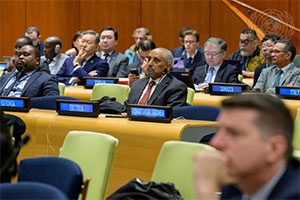 General Assembly Meets to Hear Briefing on UN80 Initiative. Credit: UN Photo/Manuel Elías
Global development conferences are continuing to produce critical frameworks for South-South cooperation and multilateral reform. In January of 2024, the 3rd Global South Nexus (GSN) International Conference was held in Odisha, India, with its theme being “Creating Responsible Professionals for Advancing SDGs: Inputs from Global North and South.” The 2025 UN SDG Report provided a midpoint assessment of the 2030 Agenda, with only 35% of targets on track and 18% having reversed. The 2025 UN Climate Change Conference (COP30) in Belém, Brazil, agreed to mobilize $1.3 trillion annually for climate action by 2035, operationalize the loss and damage fund, triple adaptation finance, and launched the Belém Mission to 1.5°C. In 2025, the Partnership for Economic Policy (PEP) convened its annual Policy Conference in Nairobi, Kenya, addressing the issue of “Financing and Inclusivity in Green Energy Transition in the Global South.” As the Global South advocates increasingly for a South-South framework alongside North-South cooperation, international conferences on sustainability aim to bridge economic and social divides between developed and developing countries in achieving the UN SDGs. Furthermore, to mark the UN’s 80th anniversary, the UN80 Initiative was launched to reshape how the UN system works so that every mandate, dollar, and decision creates greater impact for the global system.

The Week with IPS

NEXT STOP - SDGs
Tracking global progress towards a sustainable world
Tracking global progress towards a sustainable world
