Languages
Thursday, October 1, 2026



News and Views from the Global South
Conferences

There’s No Continent, No Country Not Impacted by Land Degradation
The coming decades will be crucial in shaping and implementing a transformative land agenda, according to a scientist at the United Nations Convention to Combat Desertification (UNCCD) framework for Land Degradation Neutrality (LDN).
Executive Director of the Geneva Centre received by the Chairman of the Caucasus Muslims Board His Virtue Sheikh-ul-Islam Allahshukur Pashazadeh
(Geneva Centre) - The Head of the Religious Community in Azerbaijan His Virtue Shaikh-ul Islam Allahshukur Pashazadeh invited the Executive Director of the Geneva Centre for Human Rights Advancement and Global Dialogue Ambassador Idriss Jazairy to a private audience in his residence in Baku.
Pakistan’s Battle Against Climate Change
Pakistan, which has been listed as the 7th most vulnerable country affected by climate change, is now seriously tackling the vagaries of weather, both at the official as well as non-official level. Pursuant to an initiative launched by the Pakistan Parliament’s Upper House, the Senate, which specially entrusted a sub-Committee of the Standing Committee on Climate Change to focus on “Green and Clean” Islamabad, media, civil society and students have taken up the cudgels on combating climate change.
Q&A: Achieving “Togetherness”
Increasingly facing restrictions and assault, civil society from around the world have come together to celebrate and promote people power.
Civil Society Under Attack in Name of Counterterrorism
Counterterrorism measures are not only affecting extremist groups, but are also impacting a crucial sector for peace and security in the world: civil society.
When Youth Take on The Fight to Defend Rights
Abraham M. Keita says he was nine years old when a girl of thirteen was sexually assaulted and strangled in his home community in Liberia.
No Story Worth Dying For?
“Stay safe. There’s no story worth dying for.” That’s the message to journalists from Nada Josimovic, programme coordinator of Amsterdam-based media rights organisation Free Press Unlimited.
Smears, Laws, Lack of Cooperation: Tools Against Activists
The murder of Brazilian politician and human rights activist Marielle Franco just over a year ago and attacks on other rights activists around the world have galvanised civil society organisations, with the United Nations heightening its own strategy to protect rights defenders.
Civil Society Leaders Meet Amid Protests, Attacks on Rights
Amid rising attacks on rights campaigners, and mass protests in countries such as France and Serbia, civil society groups are urging governments to ensure the protection of “democratic values” and freedom of expression.
The Amazon Seeks Alternatives that Could Revolutionise Energy Production
A large steel wheel, 14 meters in diameter and 1.3 meters wide, could be the energy solution of the near future, generating 3.5 megawatts - enough to supply a city of 30,000 people, according to a company in the capital city of the state of Amazonas in northwest Brazil.
South-South Cooperation: a Path to Implementing UN’s 2030 Agenda
I see five issues that will be central to implementing the Paris Agreement on climate change and achieving the 2030 Agenda for Sustainable Development. South-South Cooperation can offer solutions to all of them. First, rising inequality both between and within countries is eroding trust and deepening a sense of injustice. Globalization has enabled many people to escape poverty – but its benefits are not shared equitably and its costs fall disproportionately on the poor and vulnerable.
Communication, a Key Tool for South-South Cooperation
Communication can be a key tool for the development of cooperation among the countries of the global South, but the ever closer relations between them do not receive the attention they deserve from the media.
South-South Cooperation Now Triangulates with the North
It sounds like a contradictory play on words, but the countries of the industrialised North are currently the big supporters of South-South cooperation, as was demonstrated at the United Nations Second High-Level Conference on this subject, held in the Argentine capital.
People Affected by Leprosy in Latin America Unite for Their Rights and Their Voice
With the decision to found a regional coalition to promote rights and greater participation in national and international forums and decisions, the First Latin American and Caribbean Assembly of Organisations of People Affected by Hansen's disease, popularly known - and stigmatised - as leprosy, came to an end.
People Affected by Leprosy Still Face Stigma in Latin America
The First Latin American and Caribbean Meeting of Organisations of People Affected by Hansen's Disease, more widely known as leprosy, seeks to exorcise stigma and discrimination. The meeting has brought together around a hundred activists in Brazil.
Innovative Sustainable Business: A Three Trillion-Dollar Opportunity that UN Environment Wants People to Develop
In the East African region, communities around the continent’s largest water body, Lake Victoria, regard the water hyacinth as a great menace that clogs the lake and hampers their fishing activities. But in Lagos, Nigeria, some groups of women have learned how to convert the invasive weed into a resource, providing them with the raw material needed to make handicrafts.
Geneva Centre’s Executive Director presents the agenda of the 21 March “Celebration of diversity: beyond tolerance the path towards empathy” conference to African Group Ambassadors
On 7 March, the Geneva Centre’s Executive Director Ambassador Idriss Jazairy was invited by the Permanent Delegation of the African Union to an official meeting of all African Group Ambassadors in Geneva to present the rationale and purpose of the Geneva Centre’s forthcoming conference on “Celebration of diversity: beyond tolerance the path towards empathy.”
A Disease as Old as Time – Eliminated but Not Eradicated
 As the Executive Director of Sasakawa Memorial Health Foundation (SMHF), Takahiro Nanri has been working on the issue of leprosy since 2014. Over the past few years, he has traveled across the world visiting the large number of leprosy projects that SMHF has been supporting and meeting dozens of organisations led by leprosy-affected people.
Q&A: Important to Treat Anyone Suffering from Leprosy as an Equal Individual
Discrimination against women who are affected by leprosy or Hansen's Disease is a harsh reality, says Alice Cruz is the United Nations Special Rapporteur on the elimination of discrimination against persons affected by leprosy and their family members.
New Regional Secretariat to Advance Leprosy Advocacy in Asia
Organisations of people affected by leprosy in Asia have agreed to form a regional-level secretariat to support national advocacies and represent their collective agenda at a world conference to be held later this year.
Q&A: Leprosy-affected People Live Not at the Bottom, but Outside the Social Pyramid
Takahiro Nanri is the Executive Director of Sasakawa Memorial Health Foundation which has been supporting the global fight against leprosy for almost five decades. Since 2014, Nanri has been leading the foundation’s leprosy projects across the world and has deep insights into the challenges faced by the people affected by leprosy as well as the organisations that work with them.« Previous Page — Next Page »


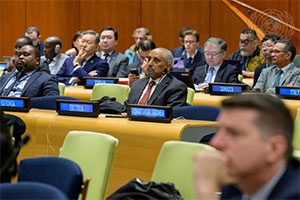 General Assembly Meets to Hear Briefing on UN80 Initiative. Credit: UN Photo/Manuel Elías
Global development conferences are continuing to produce critical frameworks for South-South cooperation and multilateral reform. In January of 2024, the 3rd Global South Nexus (GSN) International Conference was held in Odisha, India, with its theme being “Creating Responsible Professionals for Advancing SDGs: Inputs from Global North and South.” The 2025 UN SDG Report provided a midpoint assessment of the 2030 Agenda, with only 35% of targets on track and 18% having reversed. The 2025 UN Climate Change Conference (COP30) in Belém, Brazil, agreed to mobilize $1.3 trillion annually for climate action by 2035, operationalize the loss and damage fund, triple adaptation finance, and launched the Belém Mission to 1.5°C. In 2025, the Partnership for Economic Policy (PEP) convened its annual Policy Conference in Nairobi, Kenya, addressing the issue of “Financing and Inclusivity in Green Energy Transition in the Global South.” As the Global South advocates increasingly for a South-South framework alongside North-South cooperation, international conferences on sustainability aim to bridge economic and social divides between developed and developing countries in achieving the UN SDGs. Furthermore, to mark the UN’s 80th anniversary, the UN80 Initiative was launched to reshape how the UN system works so that every mandate, dollar, and decision creates greater impact for the global system.

The Week with IPS

NEXT STOP - SDGs
Tracking global progress towards a sustainable world
Tracking global progress towards a sustainable world
