Languages
Sunday, September 13, 2026



News and Views from the Global South
Conferences

‘Conference Emphasises Need for Partnerships to Create a World Without Leprosy’
Forty years ago, Yohei Sasakawa saw his father moved to tears after meeting and witnessing the suffering of people affected by leprosy – also known as Hansen’s disease. Not only did the patients have a physical illness, but they also suffered from social exclusion and discrimination. It made the young Sasakawa vow to work for the elimination of leprosy from the world – just as his father had been doing.
Nothing For Us, Without Us – Hansen’s Disease-Affected Tell International Gathering
Stronger government action to fight stigma and discrimination, more government funding for health and non-health support programmes, and a larger role for people’s organisations in developing policy towards Hansen's disease treatment and eradication are still needed for eliminating the disease.
The Emergence of a Global Voice for Hansen’s Disease Affected Persons
The Global Forum of People’s Organisations on Hansen’s Disease, which was attended by members of people’s organisations from 23 different countries, wrapped up in Manila, Philippines, today Sept. 10 after four days of discussion and deliberation. The main outcome was a set of recommendations, which included participants stating that those affected by the disease should have more inclusive roles in the global campaign against leprosy.
‘Join Me on this Journey’ to Eliminate Leprosy – WHO Ambassador
 Octogenarian Yohei Sasakawa has travelled to more than 90 countries across the globe; from areas of conflict, to the jungles of Brazil, shaking hands, hugging and washing the feet of Hansen’s disease-affected people. His message is simple: Stop stigmatisation and eliminate the disease.
India Promotes South-South Cooperation, but Key Questions Unaddressed
At his speech at the United Nations Convention to Combat Desertification (UNCCD) summit in Delhi, Prime Minister Narendra Modi emphasised South-South cooperation and technology solutions, but issues of land ownership dog the ongoing negotiations. As the second week of the UNCCD Conference of Parties (COP) kicked off in Delhi, Indian Prime Minister Narendra Modi highlighted South-South cooperation and issues of land degradation.
Awareness Should be the Priority in Public Health Efforts against Leprosy
Increasing awareness of the continuing existence of Hansen’s Disease (leprosy) is critical to sustaining effective public health efforts against the disease, eliminating the social stigma associated with it, and halting its transmission.
Litigation, a Mechanism to Ensure Justice and End Stigma for Hansen’s Disease
Professor Ai Kurosaka remembers the day she first interacted with a person affected by Hansen’s disease. It was 2003 and Kurosaka, then a graduate student of sociology at the Saitama University in Japan, had been assigned to interview ex-patients and their family members to document what kind of discrimination they faced. It was a very difficult task because nobody wanted to speak or identify themselves.
The Business of Social Enterprise
Organisations supporting people affected by Hansen’s disease (leprosy) have social rather than capitalist aims, but they need to take a business-minded approach to their work if they wish to be sustainable, experts at a global conference in Manila, Philippines said.
Global Network Key to Strengthening Leprosy Organisations
Organisations of people affected by Hansen’s Disease or leprosy agree that a global network of volunteer groups is key to eradicating the disease, but concrete steps need to be taken to move the idea from an often-discussed concept to a reality.
First Global Forum of Leprosy-Affected People’s Organisations Kicks off in Manila
Being part of a platform where leprosy-affected people from all over the world can freely interact, exchange and share opinions, ideas, experiences and strategies was always something Tasfaye Tadesse dreamt of.
A Global Forum to Encourage Dialogue and Share Solutions
Professor Takahiro Nanri is the executive director of the Sasakawa Health Foundation, co-organiser of the Global Forum of People’s Organisations on Hansen’s Disease, which will take place from Sept. 7 to 10 in the Philippines. 
Achieving Global Consensus on How to Slow Down Loss of Land
Expectations are high, perhaps too high, as the 14th Conference of the Parties (CoP 14) of the United Nations Convention to Combat Desertification (UNCCD), now into the third day of its two-week session, is being held outside the smog-filled Indian capital of New Delhi.
The Nairobi Summit – Towards a Watershed Moment
In 2019 a female scientist created an algorithm that gave the world the first ever images of a black hole. Working with a team of astronomers, physicists, mathematicians and engineers, a young woman led the development of a computer program that in her own words enabled them to “achieve something once thought impossible.”
Indigenous Rights Approach a Solution to Climate Change Crisis
The Global Landscapes Forum (GLF) was held in Bonn, Germany to rally behind a new approach to achieving a future that is more inclusive and sustainable than the present – through the establishment of secure and proper rights for all.
International conference in Vienna: Successful societies are those that manage diversity and stimulate empathy towards the Other
Societies must work together to build more tolerance, solidarity and peace within and between nations, said the Executive Director of the Geneva Centre for Human Rights Advancement and Global Dialogue, Ambassador Idriss Jazairy, during the 19 June international conference on "From Interfaith, Inter-Civilizational Cooperation to Human Solidarity.” He emphasized that all such societies are built on shared aspirations and not shared ethnicity.
International conference in Vienna: Executive Director of the Geneva Centre meets with officials of Azerbaijan and the United Arab Emirates, religious leaders and civil society representatives
Following the 19 June international conference on “From the Interfaith and Inter-Civilizational Cooperation to Human Security” held in Vienna, the Executive Director of the Geneva Centre for Human Rights Advancement and Global Dialogue Ambassador Idriss Jazairy concluded his visit to Austria with a series of meetings with government officials and decision makers.
There’s No Continent, No Country Not Impacted by Land Degradation
The coming decades will be crucial in shaping and implementing a transformative land agenda, according to a scientist at the United Nations Convention to Combat Desertification (UNCCD) framework for Land Degradation Neutrality (LDN).
Executive Director of the Geneva Centre received by the Chairman of the Caucasus Muslims Board His Virtue Sheikh-ul-Islam Allahshukur Pashazadeh
(Geneva Centre) - The Head of the Religious Community in Azerbaijan His Virtue Shaikh-ul Islam Allahshukur Pashazadeh invited the Executive Director of the Geneva Centre for Human Rights Advancement and Global Dialogue Ambassador Idriss Jazairy to a private audience in his residence in Baku.
Pakistan’s Battle Against Climate Change
Pakistan, which has been listed as the 7th most vulnerable country affected by climate change, is now seriously tackling the vagaries of weather, both at the official as well as non-official level. Pursuant to an initiative launched by the Pakistan Parliament’s Upper House, the Senate, which specially entrusted a sub-Committee of the Standing Committee on Climate Change to focus on “Green and Clean” Islamabad, media, civil society and students have taken up the cudgels on combating climate change.
Q&A: Achieving “Togetherness”
Increasingly facing restrictions and assault, civil society from around the world have come together to celebrate and promote people power.
Civil Society Under Attack in Name of Counterterrorism
Counterterrorism measures are not only affecting extremist groups, but are also impacting a crucial sector for peace and security in the world: civil society.« Previous Page — Next Page »


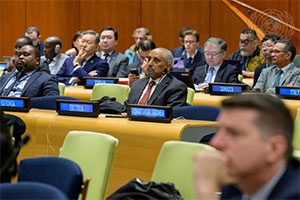 General Assembly Meets to Hear Briefing on UN80 Initiative. Credit: UN Photo/Manuel Elías
Global development conferences are continuing to produce critical frameworks for South-South cooperation and multilateral reform. In January of 2024, the 3rd Global South Nexus (GSN) International Conference was held in Odisha, India, with its theme being “Creating Responsible Professionals for Advancing SDGs: Inputs from Global North and South.” The 2025 UN SDG Report provided a midpoint assessment of the 2030 Agenda, with only 35% of targets on track and 18% having reversed. The 2025 UN Climate Change Conference (COP30) in Belém, Brazil, agreed to mobilize $1.3 trillion annually for climate action by 2035, operationalize the loss and damage fund, triple adaptation finance, and launched the Belém Mission to 1.5°C. In 2025, the Partnership for Economic Policy (PEP) convened its annual Policy Conference in Nairobi, Kenya, addressing the issue of “Financing and Inclusivity in Green Energy Transition in the Global South.” As the Global South advocates increasingly for a South-South framework alongside North-South cooperation, international conferences on sustainability aim to bridge economic and social divides between developed and developing countries in achieving the UN SDGs. Furthermore, to mark the UN’s 80th anniversary, the UN80 Initiative was launched to reshape how the UN system works so that every mandate, dollar, and decision creates greater impact for the global system.

The Week with IPS

NEXT STOP - SDGs
Tracking global progress towards a sustainable world
Tracking global progress towards a sustainable world
