Languages
Saturday, October 10, 2026



News and Views from the Global South
Conferences
Doha Faces an Indonesian Test
To most people, holes in the ozone layer or the melting of polar ice caps can sound like distant catastrophes. “But let's talk about concrete examples,” says an Indonesian director whose documentary film captures the lives of local farmers affected by a dramatically changing environment.
The Planet’s Thermostat Moves to Doha
The upcoming United Nations climate talks may have a renewed sense of urgency with a new World Bank report warning that the planet is on a dangerous path to four degrees Celsius of global warming by 2100.ASEAN Stumbles Again On South China Sea
Against the backdrop of growing territorial tensions in the South China Sea, inflamed by a more explicit Sino-American rivalry in the Pacific theatre, the recently-concluded ASEAN Summit in Cambodia represented the best chance at bolstering regional security through peaceful, multilateral mechanisms.
India Poised to Supply Free Drugs to 1.2 Billion People
As the northern Indian state of Rajasthan rolls out an ambitious universal healthcare plan, the discontent of the state’s doctors stands in stark contrast to the joys of the 68 million people who will benefit from the scheme.
Better Governance to Achieve Food Security
Despite a sudden increase in July this year, prices of cereals on world markets remained fairly stable. But there are no grounds for complacency, as cereals markets remain vulnerable to supply shocks and disruptive policy measures. In this context, the good harvests that are expected in the Southern Hemisphere are important.Uphill Struggle for Caribbean Financial Services Sector
In the 1980's, Caribbean countries wanted to shore up their prospects of social and economic development in the coming decades, so they looked to the financial services sector to spur employment and development. They managed to develop a robust industry, particularly in the Bahamas and the Cayman Islands.Women Using ICTs to Change the World
New technologies can transform society, and the role of women in using these tools to promote change was clearly seen at the first ICT Congress for Peace in this city in northern Spain.
Entrepreneurs and Women: Keys to Growth in Africa
The international financial crash of the late 2000s created more than a global economic recession: it accentuated popular doubts about the paradigms on which our economies are built and prompted a closer look at two crucial drivers of economic growth: women and entrepreneurship.
Worms, Termites, Microbes Offer Food Security
Worms and termites are not likely to win hearts and minds, but they, along with lichens and microbes, are vital to food security, say biodiversity specialists who attended this month’s United Nations conference on the Convention on Biological Diversity (CBD) in this south Indian city.
Q&A: “Developing Countries Are Doing Their Part for Biodiversity”
Developing countries are investing enormously in preserving biological diversity, and it is unimaginable that the wealthy nations will not fulfill their obligations to provide funding for these efforts, Brazilian environmental negotiator André Aranha Corrêa do Lago told Tierramérica*.
The Face of Food Security Is Female
In a major endorsement for investment in women - the bulk of food growers in the developing world - United Nations Secretary General Ban Ki-moon said food security could not be achieved without women, and that the world's hungry also needed leaders to prioritise actions.
‘Urban Planning Must Factor in Biodiversity’
“With more than 60 percent of the world projected to be urban by 2030 why not prepare for it and build cities that include biodiversity preservation into planning?” asks Kobie Brand of ICLEI Local Governments for Sustainability in Cape Town, South Africa.
Shadow Over Aichi Biodiversity Targets
With negotiations to mobilise resources for preservation of biodiversity at a major United Nations conference going nowhere, the Group of 77 and China have hinted at possible suspension of the ‘Aichi targets’ under the Nagoya Protocol.
India to Conserve Biodiversity at Grassroots
India’s National Biodiversity Authority (NBA) is actively promoting decentralised grassroots livelihoods as the best way to conserve biodiversity as mandated by the Nagoya Protocol on access and benefit sharing (ABS).
Asia: Saving Grace of Global Economy?
Developing countries – relegated to the sidelines of the West-led postwar expansion – have emerged as the saving grace of the global economy against a backdrop of calls for a new economic model that can ease the ravages of globalisation and address the lack of confidence in market-based systems.
Women Are the New ‘Emerging Market’
Empowering women in the business world is not only a smart political decision, but also makes good economic sense.
Cooperatives Summit Celebrates Power in Diversity
The migratory seeds of cooperatives were sown and first thrived in Europe, but have since adapted to the climate of nations worldwide.
India Ignoring Coastal Biodiversity – NGOs
Indian civil society organisations see in the 11th United Nations Conference of the Parties (COP11) to the Convention on Biodiversity (CBD), underway in this south Indian city, a rare opportunity to highlight alleged neglect of biodiversity along the country’s extensive coastal and marine areas.
Africa Seeks to Grow More, Buy Less
Africa can ensure food security by producing wheat. New research presented in Addis Ababa, Ethiopia this week shows that the continent has the potential to be self-sufficient.
Co-operatives Hold Their Own in Free Market Jungle
Cooperatives may face an immense challenge in garnering broader public recognition among consumers, but when it comes to chasing growth, they haven’t held back.
Q&A: Global Economy, Meet One Billion Co-op Members
The international rally to take the global cooperative movement to the next level is in full swing at the International Summit of Cooperatives here, which kicked off on Monday.« Previous Page — Next Page »





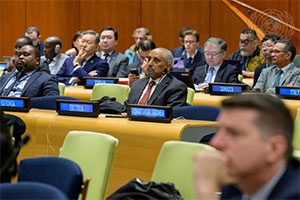 General Assembly Meets to Hear Briefing on UN80 Initiative. Credit: UN Photo/Manuel Elías
Global development conferences are continuing to produce critical frameworks for South-South cooperation and multilateral reform. In January of 2024, the 3rd Global South Nexus (GSN) International Conference was held in Odisha, India, with its theme being “Creating Responsible Professionals for Advancing SDGs: Inputs from Global North and South.” The 2025 UN SDG Report provided a midpoint assessment of the 2030 Agenda, with only 35% of targets on track and 18% having reversed. The 2025 UN Climate Change Conference (COP30) in Belém, Brazil, agreed to mobilize $1.3 trillion annually for climate action by 2035, operationalize the loss and damage fund, triple adaptation finance, and launched the Belém Mission to 1.5°C. In 2025, the Partnership for Economic Policy (PEP) convened its annual Policy Conference in Nairobi, Kenya, addressing the issue of “Financing and Inclusivity in Green Energy Transition in the Global South.” As the Global South advocates increasingly for a South-South framework alongside North-South cooperation, international conferences on sustainability aim to bridge economic and social divides between developed and developing countries in achieving the UN SDGs. Furthermore, to mark the UN’s 80th anniversary, the UN80 Initiative was launched to reshape how the UN system works so that every mandate, dollar, and decision creates greater impact for the global system.

The Week with IPS

NEXT STOP - SDGs
Tracking global progress towards a sustainable world
Tracking global progress towards a sustainable world
