Languages
Friday, October 9, 2026



News and Views from the Global South
Conferences
Funds Crunch Skews Aichi Targets on Biodiversity
The United Nations 11th Conference of the Parties to the Convention on Biological Biodiversity (COP 11 CBD), underway in this southern Indian city, is lost on where to garner the billions of dollars needed to implement the ‘Aichi targets,’ due to be met by 2020.
Co-ops Offer Ray of Hope for Youth Facing Bleak Job Market
Youth worldwide are facing limited job prospects in the traditional channels of employment, and in the midst of the job crunch, cooperatives are seeking ways to connect with this untapped pool of talent.
World Bank Refuses Call to Halt Land Deals
The World Bank has rejected a call to suspend its involvement in large scale agricultural land acquisition following the release of a major report by the international aid agency Oxfam on the negative impact of international land speculation in developing countries.
Cooperatives Champion Balance Between People and Profit
The banner year for the global cooperative movement is winding down into its last months, but its leaders have echoed a resounding message: cooperatives, a values-based business model, can usher a transition to a more socially responsible economy.As Conflict Spreads, Syrian Opposition Prepares for the Future
As the uprising in Syria becomes violently entangled with its neighbours, the expatriate opposition leadership is already formulating plans for a political transition following the fall of Syrian President Bashar al-Assad.
Q&A: ‘Mismatch Between Commitments and Action on Biodiversity’
The eleventh meeting of the Conference of the Parties to the Convention on Biological Diversity (COP 11 CBD) approaches amidst a hailstorm of public protest against the ‘tragedy of the commons’ – the rapid loss of biodiversity in forests, oceans and indigenous community farmlands.‘Elderly Can be Contributors, Not a Burden’
According to popular belief, the world’s rapidly ageing societies face the risk of poverty, dementia and loneliness. But not necessarily so, says a United Nations publication unveiled in Japan Monday. Better management by governments can support a better life for the elderly, and lead them to becoming important contributors to society, it says.

Delivering Promises to Africa’s Smallholder Farmers
Investment in rural infrastructure and support for Africa's millions of small-scale farmers have increased in the past decade. But as these farmers begin to see increased yields, the question of better access to markets comes to the fore.
Multilateralism is at a Crossroads
Multilateralism is at a crossroads. This is a crucial matter for environmental and sustainability issues, as we have seen in the Rio+20 Summit, and for trade and other economic matters. The G20 Summit in Los Cabos, Mexico, focused precisely on improving our collective response to the current economic turbulence, which is at the heart of developments in the European Union (EU) as well.
Arab Spring Teaches Food Security
African leaders should take note of the lessons learned from the Arab Spring and realise that ensuring good governance and food security will avoid crises on the continent, says Kofi Annan, chairman of the Africa Green Revolution Alliance.
Caribbean Islands Brace for Challenges of Climate Change
Prime Minister Dr. Denzil Douglas remembers how quiet - even uneventful – this tiny twin-island federation was for the first four decades of his life.
U.N. Women Demands End to Impunity for Wartime Rape and Violence
At a high-level event at the United Nations in New York on Tuesday, U.N. Women, the United Nations body for female empowerment and gender equality, called for stronger action from world leaders to prevent and punish sexual violence in conflict.South Invited to ‘De-Grow’
“We should find the way, with our small degrowth movement in the global North, to align ourselves with the environmental justice movement originating with indigenous peoples from the South,” Catalan ecological economist Juan Martinez-Alier said at the third international degrowth conference in Venice, Italy.Nobel Laureate Calls for Armed Intervention in Nigeria
On the International Day of Peace, Nobel Prize winner Wole Soyinka visited the United Nations - and called for armed intervention against the terrorist group Boko Haram in his home country of Nigeria.
Second Chance For an African Green Revolution
As the world searches desperately for ways to boost food production by at least 70 percent by 2050 to feed an increasingly hungry planet, many are looking to Africa as the place where a large part of this potential can be realised, mainly for its huge portion of arable land.
Involuntary Sterilisation Threatens Rights of Disabled Women
In 1996, Maria Mamerita Mestanza Chavez, a 33-year-old Peruvian mother of seven, was threatened with imprisonment if she did not comply with the government policy of undergoing sterilisation. After suffering post-operative complications for which she was refused treatment, Chavez died nine days later.
New Plans to Protect Nature
At the close of the ten-day World Conservation Congress that ran from Sept. 6-15 on the South Korean island of Jeju, members of the convening International Union for Conservation of Nature (IUCN) agreed on an ambitious four-year action plan for protecting global natural resources.
Companies Calculate Their Debt to Planet Earth
As ravenous consumers of natural resources, companies are beginning to recognise that they owe a monetary debt to the planet, and are sharpening their pencils to calculate it.
Saving the Top 100 Threatened Species – a Question of Valuing Life
The Red River Giant softshell turtle (Rafetus swinhoei) is the stuff of legend in Vietnam. The fabled turtle in Hanoi’s Hoan Kiem Lake is popularly known by the name Kim Qui or Golden Turtle God, and it made its first historical appearance in 250 BC.Small Islands Push for New Energy
Most islands are well endowed with one or more renewable energy source – rivers, waterfalls, wind, sunshine, biomass, wave power, geothermal deposits - yet virtually all remain heavily or entirely reliant on imported fossil fuels to produce electricity and power transport.
Rio Summit’s Legacy Still a Question Mark
Academics gathered in Washington on Wednesday suggested that the mixed experience at the U.N. Conference on Sustainable Development, held in Rio de Janeiro in June, has increased the importance of citizen engagement and consumer accountability in issues of environment, renewable energy and sustainability.« Previous Page — Next Page »





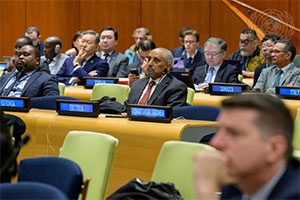 General Assembly Meets to Hear Briefing on UN80 Initiative. Credit: UN Photo/Manuel Elías
Global development conferences are continuing to produce critical frameworks for South-South cooperation and multilateral reform. In January of 2024, the 3rd Global South Nexus (GSN) International Conference was held in Odisha, India, with its theme being “Creating Responsible Professionals for Advancing SDGs: Inputs from Global North and South.” The 2025 UN SDG Report provided a midpoint assessment of the 2030 Agenda, with only 35% of targets on track and 18% having reversed. The 2025 UN Climate Change Conference (COP30) in Belém, Brazil, agreed to mobilize $1.3 trillion annually for climate action by 2035, operationalize the loss and damage fund, triple adaptation finance, and launched the Belém Mission to 1.5°C. In 2025, the Partnership for Economic Policy (PEP) convened its annual Policy Conference in Nairobi, Kenya, addressing the issue of “Financing and Inclusivity in Green Energy Transition in the Global South.” As the Global South advocates increasingly for a South-South framework alongside North-South cooperation, international conferences on sustainability aim to bridge economic and social divides between developed and developing countries in achieving the UN SDGs. Furthermore, to mark the UN’s 80th anniversary, the UN80 Initiative was launched to reshape how the UN system works so that every mandate, dollar, and decision creates greater impact for the global system.

The Week with IPS

NEXT STOP - SDGs
Tracking global progress towards a sustainable world
Tracking global progress towards a sustainable world
