Languages
Thursday, October 15, 2026



News and Views from the Global South
Conferences
‘Tsunami’ of Diseases Waiting to Hit
A tsunami is looming on the horizon and the world is unprepared for it. This one won’t be a massive wall of water but a tidal wave of disease – and experts say the international community needs to act fast to keep it from crashing.
World Social Forum Faces Criticism, Tragedy and the Arab Spring
The tragedy at the Kiss nightclub cast a dark shadow on proceedings at the Thematic Social Forum held in Porto Alegre, the southern Brazilian city renowned for hosting the first World Social Forum in 2001.
No Woman Should Die Giving Life
Every single day, 452 women in sub-Saharan Africa die from pregnancy-related causes; that’s 18 women every hour.Dubious Awards Presented at Davos
Only a stone's throw from the Davos World Economic Forum meeting, a group of non-governmental organisations presented the annual Public Eye Awards this week to Goldman Sachs and Royal Dutch Shell.
Can Europe and Latin America Meet as Equals?
The European Union's serious economic and financial crisis stands in stark contrast to the relative stability and decade-long growth enjoyed by Latin America and the Caribbean and could put the two blocs on equal footing, giving the Southern region more leverage to further its demands and economic growth.
Summit of the Peoples Demands Solidarity and Sovereignty
More than 400 social organisations from Europe and Latin America and the Caribbean will gather on Jan. 25-27 at a Summit of the Peoples called as an alternative to the bi-regional meeting of heads of state and government to be held at the same time in the Chilean capital.
Q&A: New Binding Treaty on Mercury Emissions is “Ambitious”
The international community has adopted a binding treaty for reducing emissions of mercury, a poisonous heavy metal that harms human health and the ecosystems on which life depends.Cancelation
The writer has just confirmed he had recorded the interview and taken notes of the conference, but he incurred in a regrettable error confusing António Soares (Toni Tcheca) with Emílio Krafft Kosta. This is of course completely unprofessional, and we have erased both versions of the story, in Spanish and English. Please accept our sincere apologies.
Are the Masdarians the new Jetsons?
 Back in 2006, when the government of Abu Dhabi — a Middle Eastern emirate that controls eight percent of the world's oil reserves — announced that it would build "the world's first zero-carbon city," skeptics took it with a pinch of salt. Few believed it would be possible.

Mideast Energy Crisis Looks For Light at the End of the Tunnel
When Jordan's Queen Rania Al Abdullah took the podium to address world political and business leaders at a back-to-back energy and water summit here, she said she was representing a country that relies on imports for over 90 percent of its energy needs.
Renewable Energy Alliance Stretches From Germany to Central America
A recent agreement between El Salvador and Germany, with the latter supporting two renewable energy projects that would increase installed capacity in the Central American country by 94.2 megawatts by 2013, points to a promising alliance for carbon-free energy.
India Looks to Diverse Strategy on Disability
Twenty-year-old Reshma, hailing from the village of Aryanad in the Thiruvananthapuram district of the South Indian state of Kerala, was forced to drop out of school early as a result of obsessive-compulsive disorder (OCD).
Colombian Landowners, Peasants Listen to Each Other
Colombia's large-scale agricultural producers and peasant farmers managed to listen to each other for the first time about the core cause of the decades-long armed conflict: the concentration of rural land ownership and the social and economic development of the countryside.
Occupation Can’t Stifle Innovation
Afnan Hamad stands proudly in front of a booth at the Ramallah Cultural Palace exhibition hall, three plastic bottles filled with discoloured liquid on the table in front of her.
Kashmiri Separatists Scrabble for Political Relevance
Amid growing scepticism among Kashmiri people that the separatist leadership has lost relevance in the region’s fast-changing political landscape, the All Parties Hurriyat (Freedom) Conference – an alliance of separatist political parties and religious and social groups - is making a Herculean effort to reclaim some relevance in this disputed region.
Brazil’s Economic Model Offers Ray of Hope
As governments struggle to find ways out of the persistent global financial crisis, Brazil’s development model offers an alternative path to recovery and growth, according to some economists and politicians.
Tunisia Gears Up to Host World Social Forum
Following in the wake of the wave of revolutions dubbed the ‘Arab Spring’, which originated here nearly two years ago, North Africa is gearing up to host the World Social Forum (WSF) for the first time.
Youth Call for ‘Change of Course’ to Solve Climate Crisis
While world leaders were wrapping up the United Nations conference on climate change (COP 18) in Doha, Qatar this past weekend with the annual vague promise to tackle the enormous crises brought on by extreme weather and global warming, a delegation of youth gathered far from the high-level conference halls to say “no” to advocacy without action.Rural Co-ops in Central America Speak Out on Climate Change
Brenda Salazar has her sights set on two things: a good organic cacao harvest for the cooperative she belongs to in northern Nicaragua, and for the governments of Central America to heed the ideas of peasant farmers who have organised to fight climate change.
From Doha to Dakar, Food Insecurity is the Norm
Qatar may be one of the richest countries in the world, but it has something in common with its African counterparts – food insecurity.

The Big Fight in Doha Is Over Climate Finance
The new Green Climate Fund to help developing countries cope with climate change may one day have a bigger budget than the World Bank. At the moment, however, the Fund is empty.« Previous Page — Next Page »





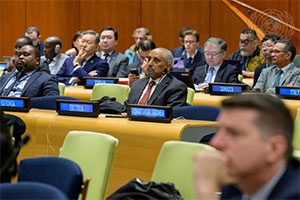 General Assembly Meets to Hear Briefing on UN80 Initiative. Credit: UN Photo/Manuel Elías
Global development conferences are continuing to produce critical frameworks for South-South cooperation and multilateral reform. In January of 2024, the 3rd Global South Nexus (GSN) International Conference was held in Odisha, India, with its theme being “Creating Responsible Professionals for Advancing SDGs: Inputs from Global North and South.” The 2025 UN SDG Report provided a midpoint assessment of the 2030 Agenda, with only 35% of targets on track and 18% having reversed. The 2025 UN Climate Change Conference (COP30) in Belém, Brazil, agreed to mobilize $1.3 trillion annually for climate action by 2035, operationalize the loss and damage fund, triple adaptation finance, and launched the Belém Mission to 1.5°C. In 2025, the Partnership for Economic Policy (PEP) convened its annual Policy Conference in Nairobi, Kenya, addressing the issue of “Financing and Inclusivity in Green Energy Transition in the Global South.” As the Global South advocates increasingly for a South-South framework alongside North-South cooperation, international conferences on sustainability aim to bridge economic and social divides between developed and developing countries in achieving the UN SDGs. Furthermore, to mark the UN’s 80th anniversary, the UN80 Initiative was launched to reshape how the UN system works so that every mandate, dollar, and decision creates greater impact for the global system.

The Week with IPS

NEXT STOP - SDGs
Tracking global progress towards a sustainable world
Tracking global progress towards a sustainable world
