Languages
Monday, October 19, 2026



News and Views from the Global South
Conferences

Environmentalists See Seeds as Key to Agricultural Reform
As the global agricultural sector is faced with ever-greater challenges, the question of how to reform and improve the sector is a controversial and difficult one. So Terra Futura, a three-day exhibition and conference on agricultural good practises held annually in Florence, brought the debate back to its roots: seeds.
Caribbean Scientist Warns of Climate Change Disaster
The Caribbean does not have the luxury of time for decisive action on climate change and global warming. In fact, it is on the brink of calamity, according to a prominent scientist.With Billions of Euros Pledged, Mali Risks Aid Overflow
International donors pledged yesterday to mobilise 3.25 billion Euros to rebuild Mali, a figure that surpassed all expectations. But experts warn that the country does not have the absorption capacity for so much aid, while others say donors should pressure the Malian government to stop ongoing human rights abuses.Women’s Rights Still Denied in Latin America
Latin American states are still failing to provide guarantees for women's educational, sexual and reproductive rights, according to activists from different regions of the world meeting in the Mexican capital.
Climate Change Adaptation: A Race Against Time
Adaptation and mitigation. Identified by the United Nations Framework Convention on Climate Change and by scientists as the two major responses to address the problem, these were also the twin preoccupations of a climate change conference held recently in Dhaka.
U.N. Task Force Purges Stigmas on Sexual Rights
Ishita Chaudhry spent the past 36 hours listening to U.N. delegates discuss population growth and development. She noticed that on “controversial” topics, such as sexual and reproductive rights, young people’s voices often get lost.Civil Society Raises Pressure Over NPT
As parties to the treaty on the Non-Proliferation of Nuclear Weapons (NPT) begin their second preparatory conference in Geneva on Monday, representatives of civil society and several countries have decided to bring the festering nuclear issue and its potential humanitarian consequences to the centre stage.
Learn From the Children
“Recall the face of the poorest and weakest man you have seen, and ask yourself if this step you contemplate is going to be any use to him.”Commodities Trade Haven Faces Protests
The powerful Swiss commodity sector is under fire here, as citizens fed up with government inaction on charges of corporate corruption, tax evasion and lack of transparency gear up for major protests.‘Money Wasted Without Policy’
As European Commission leaders make calls for EU countries to raise their spending on development aid for the world’s poor, groups working in underdeveloped states have warned that without more effective aid policies and networks, extra financing may be wasted.
OP-ED: The BRICS and the Rising South
On Tuesday, leaders of five large emerging economies – Brazil, Russia, India, China, and South Africa, known as the BRICS – will gather in Durban, South Africa to discuss harnessing their formidable resources on behalf of faster development progress in Africa and elsewhere.
Equal Chances for Women Critical in ‘Healthy, Productive Society’
In an effort to promote gender equality in workplaces and communities, business leaders, politicians and supporters came together during last week's fifth annual Women's Empowerment Principles Event to explore ways to ensure women are supported in their careers and life choices.
Transparency Could Tighten Drought Policy
Scientists gathered in Geneva for the first High-level Meeting on National Drought Policy (HMNDP) in over 30 years have identified data collection and sharing as some of the main challenges to effective prevention of drought. Clear goals and strong political will are vital to building policies at the national level, they say.Drought Hits Policies
Drought has dramatically increased as a consequence of climate change. Most countries react to it only after it has occurred, but don’t have national policies to prevent it. The high-level meeting on national drought policies in Geneva this week is trying to match scientific knowledge with political awareness.
India Strives to Become ‘Drought Proof’
In a country of 1.2 billion people, the threat of drought takes on epic proportions. Over a period of two centuries (between 1801 and 2002), India experienced 42 severe droughts, according to the Indian Space Research Organisation. One of these, in 1979, cut food grain production by 20 percent; another, in 1987, damaged 58.6 million hectares of cultivated land, affecting 285 million people.
Anti-Nuke Movement Goes to the Gulf
After a week of activities in Oslo during the Conference on the Humanitarian Impact of Nuclear Weapons, major anti-nuclear campaigners moved Monday to the Bahraini capital, Manama, in yet another step towards the abolition of atomic weapons.
Victims Want Voice and Vote in Colombia’s Peace Talks
Victims of crimes of the state want their recommendations to be taken into consideration by the peace talks between the Colombian government and the FARC guerrillas that are seeking to end half a century of armed conflict.
Q&A: ‘Alliance of Civilisations, a Need and a Challenge’
The fifth global forum of the United Nations Alliance of Civilisations (UNAOC), founded to promote intercultural understanding and dialogue to bring civilisations closer, came to a close Thursday after two days of talks, at which world leaders restated their commitment to the Alliance’s ideals and pledged to build on the foundations it had laid to expand its work.‘Media Needs an Alliance With Minorities’
Amid calls from world leaders for media diversity and plurality to be strengthened to combat a rising tide of extremism and intolerance, media experts have warned that change should not be expected overnight and that governments and states have a crucial role to play in the process.
Most Inhumane of Weapons
I believe that most of the world’s citizens would agree that nuclear weapons should be considered inhumane. It is encouraging to see that there is now a growing, if still nascent, movement to outlaw nuclear weapons based on this premise.
Indigenous Youth Step up to Protect Their Roots
Indigenous youth from some of the world's oldest living cultures are stepping forward to steer their communities past the threat of disappearance and into an age of coexistence with an increasingly globalised world.« Previous Page — Next Page »





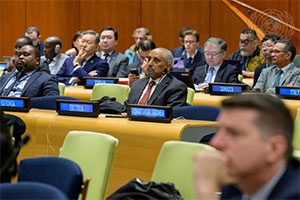 General Assembly Meets to Hear Briefing on UN80 Initiative. Credit: UN Photo/Manuel Elías
Global development conferences are continuing to produce critical frameworks for South-South cooperation and multilateral reform. In January of 2024, the 3rd Global South Nexus (GSN) International Conference was held in Odisha, India, with its theme being “Creating Responsible Professionals for Advancing SDGs: Inputs from Global North and South.” The 2025 UN SDG Report provided a midpoint assessment of the 2030 Agenda, with only 35% of targets on track and 18% having reversed. The 2025 UN Climate Change Conference (COP30) in Belém, Brazil, agreed to mobilize $1.3 trillion annually for climate action by 2035, operationalize the loss and damage fund, triple adaptation finance, and launched the Belém Mission to 1.5°C. In 2025, the Partnership for Economic Policy (PEP) convened its annual Policy Conference in Nairobi, Kenya, addressing the issue of “Financing and Inclusivity in Green Energy Transition in the Global South.” As the Global South advocates increasingly for a South-South framework alongside North-South cooperation, international conferences on sustainability aim to bridge economic and social divides between developed and developing countries in achieving the UN SDGs. Furthermore, to mark the UN’s 80th anniversary, the UN80 Initiative was launched to reshape how the UN system works so that every mandate, dollar, and decision creates greater impact for the global system.

The Week with IPS

NEXT STOP - SDGs
Tracking global progress towards a sustainable world
Tracking global progress towards a sustainable world
