Languages
Thursday, November 26, 2026



News and Views from the Global South
Civil Society
Q&A: “NGOs Are Here to Stay”
InterAction is the largest alliance of U.S.-based NGOs, with over 190 members. Its head, Sam Worthington, spoke recently with IPS about the role of NGOs in Haiti, the U.S. and throughout the world.HAITI: Patchwork of Aid Groups Coming into Focus
Half a year ago, non-governmental organisations (NGOs) from around the globe flocked to Haiti to help pick up the pieces after a 7.0 magnitude earthquake shattered the fragile Caribbean nation. Many have since left, but hundreds remain, as does the logistical challenge of their coordination.
Mexican Govt Turns a Blind Eye to Orphaned and Disabled Children
A baby hits the floor when his father, who was holding him in his arms, is murdered in Mexico. A two-year-old watches from her stroller as six drug addicts are killed in a rehabilitation centre, including her mother. The mother of another three-year-old never makes it to collect him from his nursery.
ZAMBIA: Calls for Political Parties to Field 50 Percent Female Candidates
With women having achieved little in terms of representation in decision-making positions in Zambia, a national women’s lobby group is hoping to change this in the 2011 general elections.
BRAZIL: Football Paves the Way to Masculinity Without Violence
It’s Friday night, and in a "favela" (shanty town) in this Brazilian city, a group of men relax with a beer after a hard week, while a song can be heard above the rowdy chatter.Canada Slowing Biodiversity Protocol’s Progress
The spirit of international negotiations in Montreal on a draft protocol on Access and Benefit Sharing (ABS) of natural resources were marred by Canada’s insistence on a decentralised approach to ABS, Peigi Wilson, a Métis lawyer present at the meeting in support of the Quebec Native Women, told IPS.HEALTH: To Fight AIDS, Fight Gender Inequality
Under the banner that gender inequality is one of the main drivers of the spread of AIDS, women from around the world are uniting to demand a stop to the epidemic among all females -- whether adults or girls.
ROMANIA: Digging Gold With a Cyanide Lining
Canadian company Gabriel Resources has managed to resurrect a cyanide-based gold exploitation project which had been declared illegal in courts, and is opposed by most Romanians.
Venezuela Starts Its Own “Zero Hunger” Programme
Standing between two wooden planks that shore up the front of her small makeshift house, 40-year-old Maribel Huerta talks about her family.
ENVIRONMENT-INDIA: Fighting Drought With Check Dams
Gazing out at the lush greenery that surrounds the village of Salaita in northern India, a smile of satisfaction appears on retired army general A.P.S. Chauhan's face.
INDIAN OCEAN ISLANDS: Women Join Forces for Political Equality
"Instead of moaning all the time, why don’t you create your own (political) party?" some men asked Brigitte Rabemanantsoa Rasamoelina, a female politician from Madagascar. She accepted the challenge and in February formed Ampela Mano Politika, a political party which started with only 22 female members and now has over 5,000 female members ... and 10 men.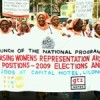
MALAWI: Women Candidates Desperate to Finance Freebies for Voters
Mable Malinda wants to contest the local government elections but the independent candidate who is using her life savings to fund her campaign only has 500 dollars left in her bank account. She has already spent three times as much buying handouts for voters – an unofficial requirement when contesting elections in Malawi.
Greenpeace Gets New Wind in its Sails
Exactly 25 years after French secret agents sank its flagship and killed one of its crew, Greenpeace has begun construction of a new Rainbow Warrior. The group’s leaders say its environmental campaigning is needed more than ever.Controversy Dogs Brazil’s Racial Equality Law
The Statute of Racial Equality, soon to be signed into law in Brazil, is at the centre of a controversy between those who consider it a historical achievement, like the abolition of slavery in 1888, and those who see it as failing to satisfy the demands of the black movement.MEXICO: Local Media in the Line of Fire
It is open season on local media in states and cities in the interior of Mexico, which are virtually unprotected against violent attack and have been the worst hit by the murders of at least eight journalists this year.
Afro-Brazilian Communities in the Shadow of Space Facility
A space launch centre built in their territory has altered the way of life that members of "quilombos" - village communities originally founded by runaway slaves - have maintained for a century and a half in this municipality in the Brazilian state of Maranhao.MEXICO: Autonomous Triqui Community Wary of New State Government
The autonomous indigenous Triqui community of San Juan Copala, in the southern Mexican state of Oaxaca, is maintaining a cautious attitude towards the state government to take power after winning Sunday's elections.AMERICAS: We Need Sustainable Development Banks, Say NGOs
Non-governmental organisations from across the Americas are demanding that the World Bank and the Inter-American Development Bank institute policies that favour sustainable energy and help mitigate climate change.
MEXICO: Conservation Can Be a Weapon Against Poverty
"I cut down all of that section," said Esteban Martínez as he pointed to a rectangle of land cleared of trees in the central Mexican state of Querétaro.MADAGASCAR: Calls for Equality to be Written into New Constitution
Madagascan female activists are asking that the right of women to participate directly in politics be included in a new draft of the country’s Constitution, so that there can be 30 percent of female politicians in parliament by 2012 and 50 percent by 2015.
HUMAN RIGHTS: Peru’s Past to Serve as Evidence in Spanish Judge’s Trial
Human rights crimes committed in Peru in the 1990s -- initially amnestied but later tried in court -- will be presented in the trial of Spanish magistrate Baltasar Garzón as evidence that crimes against humanity cannot be legally pardoned.« Previous Page — Next Page »


 Representatives of Civil Society, Sierra Leone. Credit: UN Photo/Eskinder Debebe
Civil society faces mounting threats worldwide, even as it remains essential for democratic accountability, especially in countries struggling with economic instability and social inequality. However, at the same time, nations with weak democratic governance structures also systemically suppress the power of civil society. Human rights activists across the Global South frequently challenge issues such as political persecution and gender oppression, but in return face state-sanctioned punishment for their advocacy. Imprisonment and exile are common mechanisms of punishment that seek to erode the strength of civil society. The 2026 World Press Freedom Index has reached its lowest level in 25 years, with more than half of the world’s countries now falling into the "difficult" or “very serious” category for press freedom. IPS seeks to highlight the work of civil society across the Global South as well as the challenges that they face.
Updated by Yilan Batista and Shuli Wong August 2026

The Week with IPS

NEXT STOP - SDGs
Tracking global progress towards a sustainable world
