Languages
Tuesday, October 6, 2026



News and Views from the Global South
Civil Society

Climate Justice is the Responsibility of the Wealthier Nations, Says Bangladesh Climate Envoy
Wealthier nations must deliver the finances so developing countries can adapt—the time for excuses is over, says Saber Hossain Chowdhury, Bangladesh's Special Envoy for Climate Change in the Prime Minister's Office.
Fashion Forward: Protect Africa from ‘Fagia’ Amid Alarming Global Stocktake
Thousands of bales of cheap, poor-quality secondhand clothing arrive on boats and ships docking on Africa’s extensive 26,000-kilometer-long coastline, dotted with at least 100 ports and harbors. From Nigeria, Zimbabwe, Madagascar, Uganda, and Kenya, Africa’s ecosystems are chocking with cheap, air-polluting, and emissions-producing low-quality clothing as they often contain plastic-based fibers.
Greening Education: Education Paying Highest Cost for Ongoing Climate Crisis
It is a global catastrophe of astounding proportions that millions of children are on the run today, forcibly displaced from their homes. As conflict and climate change increasingly become the most pressing challenges facing the world now, the number of displaced children has doubled in the last decade alone, reaching a record high of 43.3 million children.
COP28: Climate Migrants’ Rights, Risk-based Labor Polices Under the Spotlight
With COP28 underway, researchers and activists are pointing at the plight of climate migrants. On November 30, a few hours before the COP28 was officially inaugurated, long, serpentine queues could be seen outside Expo 2020, the venue of the COP28. Standing under the blazing sun, besides delegates and media personnel, were hundreds of migrant workers, a majority of whom were from Nepal and the Philippines.
Global Civil Society Launches Manifesto for Ethical AI
We, a global coalition of over 50 civil society and human rights organizations from over 30 countries have co-developed the "Civil Society Manifesto for Ethical AI", a groundbreaking initiative aiming to steer AI policies towards safeguarding rights and deconolonising AI discourse. We question, and we are not the only ones: whose voices, ideas and values matter in AI ?
Electrifying Cooking: Decarbonizing Africa’s Electricity Grid Towards Net Zero
Across the African continent, many first-born children in poor and vulnerable households do not go to school as they spend their school days collecting biomass fuel. The regional average of the amount of time spent collecting firewood is 2.1 hours, robbing women and girls in particular of hundreds of hours in a year and crippling their capacities to engage in learning and productive activities.
Taking Charge Against Plastic Pollution in India
Aditi Agarwal, a brilliant computer science engineer and Gold Medalist, once thrived in the tech world, contributing to innovations at Microsoft. However, she felt a calling to address real-world challenges, particularly those related to carbon emissions and plastic pollution. In pursuit of a nobler cause, she joined a company called Go Rewise, a youth-led initiative in India dedicated to recycling PET bottles through a circular economy approach.
The Intergenerational Impact of Nuclear Testing in Polynesian States
The language used in the Treaty of the Prohibition of Nuclear Weapons (TPNW) is unambiguous on its focus of the grave humanitarian impact of nuclear weapons. The TPNW also recognizes the influence of the public conscience “in the furthering of the principles of humanity as evidenced by the call for total elimination of nuclear weapons”.
A Climate Scientist’s View of COP 28
This year’s UN Climate Change Conference is taking place in Dubai from 30 November to 12 December. The so-called COP summits are organised every year and constitute a means for the global community to agree on ways to address the climate crisis, such as limiting global temperature rise to 1.5 degrees Celsius, supporting vulnerable communities to adapt to the effects of climate change, and achieving net-zero emissions by 2050.
UN Volunteers – and Their Over Reaching Mission
If there is an agency or program within the UN that I really admire and wish the best for, this is the United Nation Volunteers or UNV. Its overarching mission, mandate and key objectives are paramount for humanity.
Lawmakers Told: Plan From the Cradle For Healthy Aging
Lawmakers were reminded of the benefits of long-term planning and the benefits of evidence-based decision-making in policymaking while grappling with demographic trends, be they an aging population or one with significant growth in youth, like that of Uzbekistan.
ECW’s Emergency Appeal for Crises Impacted Children Facing Double Tragedies
Across the globe, the number of crisis-affected school-aged children facing climate shocks amplified by climate change keeps rising. The Somalia region of Ethiopia is facing the worst drought in 40 years. Last year in Pakistan, unprecedented flooding damaged more than 26,000 schools. Tropical Cyclone Tej recently made landfall in Yemen, affecting thousands of people.
Human Rights Crucial as Wealthy Nations Reap Energy Transition Benefits
As the world converges for COP 28, the urgency of addressing climate change has never been more palpable. In an exclusive interview with IPS, Yamide Dagnet, the Director for Climate Justice at Open Society Foundations, delves into the intricate details of this pivotal conference—from the unprecedented start to key challenges and opportunities in climate finance. She offers a comprehensive and nuanced perspective on global climate discourse.
Why is There Funding for War But Never for Climate Finance, Ask Feminists
The Feminist Green New Deal Coalition has highlighted feminist climate solutions and shared feminist policies and frameworks that are advancing just climate policies at the United Nations Framework Convention on Climate Change (UNFCCC) 27th session of the Conference of Parties (COP28) in Dubai. US-based Feminist Green New Deal Coalition shared at a press conference that to truly address the root causes, as well as the scope and scale of the climate crisis, feminist approaches and principles are necessary for a cross-cutting approach that combats historical oppression and uplifts the leadership of marginalized groups.
Mass Protests Send Message of Solidarity with Palestinian People
To mark the International Day of Solidarity with the Palestinian people condemning Israel’s war on Gaza, protests were held on Wednesday across the globe, from Tokyo to Manila, Tehran and Beirut, Stockholm and London, and in Harare, Johannesburg, Quezon City, and Milan.
Restoring Indigenous Trees: New Mission to Combat Climate Change in Rwanda
With the ongoing national tree-planting campaign, Rwanda seeks to replace its degraded forest resulting from charcoal production and firewood and increase the need for construction materials with new indigenous trees to combat climate change. By using the power of carbon markets to fight climate change, Rwanda aims to reduce 4.6 million metric tons of carbon emissions across different key sectors, including forest, through its ambitious climate action agenda that features a 38 percent reduction of greenhouse gas emissions compared to business-as-usual by 2030.
Salvadoran Rural Communities Face Climate Injustice
For decades, poor fishing and farming communities in southern El Salvador have paid the price for the electricity generated by one of the country's five dams, as constant and sometimes extreme rains cause the reservoir to release water that ends up flooding the low-lying area where the families live.
Right Here, Right Now: ECW’s USD 150 Million Climate Appeal to Save Children at Risk
A catastrophic surge in the frequency, intensity, and severity of extreme weather events has placed children on the frontlines of climate emergencies. Nearly half of the world’s children, or one billion, live in countries at extremely high risk from the effects of the climate crisis. Most of these children face multiple vulnerabilities.
Latin America Still Has a Long Way to Go to Eliminate Gender Violence
"The Latin American and Caribbean region has made many advances in the fight against gender violence, but now we are facing reactions that show that our rights are never secure and that we must always be on the alert to defend them," said Susana Chiarotti, a member of Mesecvi's Committee of Experts.
Africa Will Not Cope with Climate Change Without a Just, Inclusive Energy Transition
A just transition should be viewed as an opportunity to rectify some of the wrongs where women are not prioritised in the energy mix, yet their experience of the impact of climate change is massive, says Thandile Chinyavanhu, a young South African-based climate and energy campaigner with Greenpeace Africa.
Call for Rural Agriculture Investment, Less Food Wastage to Address Global Hunger
The politics of global food consumption remain contentious, with the upcoming COP28 taking place against the backdrop of worsening food deficits in the Global South.« Previous Page — Next Page »





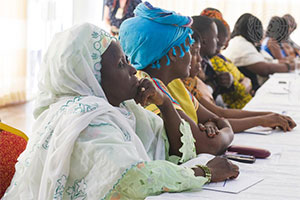 Representatives of Civil Society, Sierra Leone. Credit: UN Photo/Eskinder Debebe
Civil society faces mounting threats worldwide, even as it remains essential for democratic accountability, especially in countries struggling with economic instability and social inequality. However, at the same time, nations with weak democratic governance structures also systemically suppress the power of civil society. Human rights activists across the Global South frequently challenge issues such as political persecution and gender oppression, but in return face state-sanctioned punishment for their advocacy. Imprisonment and exile are common mechanisms of punishment that seek to erode the strength of civil society. The 2026 World Press Freedom Index has reached its lowest level in 25 years, with more than half of the world’s countries now falling into the "difficult" or “very serious” category for press freedom. IPS seeks to highlight the work of civil society across the Global South as well as the challenges that they face.
Updated by Yilan Batista and Shuli Wong August 2026

The Week with IPS

NEXT STOP - SDGs
Tracking global progress towards a sustainable world
Tracking global progress towards a sustainable world
