Languages
Wednesday, October 7, 2026



News and Views from the Global South
Civil Society

COP28: Climate Summit in Closed Civic Space
The need to act on the climate crisis has never been clearer. In 2023, heat records have been shattered around the world. Seemingly every day brings news of extreme weather, imperilling lives. In July, UN Secretary-General António Guterres grimly announced that ‘the era of global boiling has arrived’.
Pacific Games Channels Youth Aspirations in the Solomon Islands
The Pacific Games, the most prestigious sporting event in the Pacific Islands region, will open in the Solomon Islands in the southwest Pacific on 19 November. And it is set to shine a spotlight on the energy, hopes and aspirations of youths who comprise the majority of the country’s population.
Argentines Get Used to the Fact that Inflation Can Always Get Worse
People in Argentina have become accustomed to the fact that nothing costs the same today as it did the week before and they take price hikes in stride with resignation, says Mariano Cohen. "Almost nobody gets angry or complains anymore. They just don't buy something if they can't afford it," he explains in his disposable goods store in Villa Crespo, one of Buenos Aires' most commercial neighborhoods.
Smallholder Farmers Gain Least from International Climate Funding
Smallholder farmers from the Global South benefit from a grossly disproportionate 0.3% of international climate finance despite producing a third of the world's food and despite holding the key to climate-proofing food systems.
The Relentless Struggles of India’s Seawall Mammas
The sun is high in the noon sky—humidity unrelenting at 95 percent in this Indian sea-coast village. The monsoon has been deficient; rice paddies are yellowing on the edges from the salty surf misting in on them. Waves now break barely 200 metres from the farms and homes.
Argentina: Unpalatable Choices in Election Plagued with Uncertainty
For many of Argentina’s voters the choice in the 19 November presidential runoff is between the lesser of two evils: Sergio Massa, economy minister of a government that’s presiding over a once-in-a-generation economic meltdown with a whopping 140-per cent inflation rate, or Javier Milei, a far-right libertarian who admires Donald Trump, wants to shut down the Central Bank and wields a chainsaw in public as a symbol of his willingness to slash the state. Many will rue that it ever came to this.
Hurricane Otis and the Indifference Toward the Children of Acapulco
Acapulco is a paradise. A port of golden sunsets, toasted sand, and deep blue sea. Its dream beaches captivated the hearts of Elvis Presley and Elizabeth Taylor. US President John F. Kennedy chose its shores to spend his honeymoon with Jackie Kennedy. Its luxury hotels and the untamed sea made it the most famous tourist destination in Mexico.
Back to Nature to Avoid Water Collapse in the Capital of Chile
A return to nature is the main solution being promoted by communities and municipalities to avoid the water shortage that threatens to leave Santiago, the capital of Chile, home to more than 40 percent of the 19.5 million inhabitants of this South American country, without water.
Mauritius Begins to Correct a Historic Wrong Towards LGBTQI+ People
In response to lawsuits brought by LGBTQI+ activists, the Mauritius Supreme Court has issued two landmark judgments striking down the criminalisation of consensual sex between adult men as unconstitutional. Its reasoning turned upside down the argument used by anti-rights forces to attack LGBTQI+ activists in many African countries: it acknowledged that criminalisation is the foreign import rather than gay sex, and a relic of colonialism it’s high time to shake off.
Community Solutions Combat Water Shortages in Peru’s Highlands
The lack of water is so severe in Peru's highlands that farming families are forced to sell their livestock because they cannot feed them. "There is no grass or fodder to feed them," says Fermina Quispe, a Quechua farmer from a rural community located at 4,200 meters above sea level.
Gender Parity: Rise of Denmark and Downfall of Afghanistan
The UN agency, which advocates women’s rights and gender empowerment, has predicted that gender equality is “300 years away.” Addressing the UN Commission on the Status of Women last March, Secretary-General Antonio Guterres not only quoted the estimates provided by UN Women but also warned that progress toward gender equality is “vanishing before our eyes.”
How to Defend the Environment and Survive in the Attempt, as a Woman in Mexico
The defense of the right to water led Gema Pacheco to become involved in environmental struggles in the southern Mexican state of Oaxaca, an area threatened by drought, land degradation, megaprojects, mining and deforestation.
Brazil: A Step Forward for Indigenous Peoples’ Rights
Brazil’s Supreme Court has delivered a long-awaited ruling upholding Brazilian Indigenous peoples’ claims to their traditional land. It did so by rejecting the ‘Temporal Framework’ principle, which only allowed for the demarcation and titling of lands physically occupied by the Indigenous groups who claimed them by 5 October 1988, when the current constitution was adopted. This excluded the numerous Indigenous communities who’d been violently expelled from their ancestral lands before then, including under military dictatorship between 1964 and 1985.
Bringing the Piratininga Lagoon Back to Life in Brazil
Houses with balconies facing the street or the surrounding hills, when they are not hidden behind high walls, reflect a neighborhood where people live on the shore of a lagoon but reject the landscape it offers.
UN Chief Urged to Create Civil Society Envoy
When the United Nations commemorated the 75th anniversary of the UN Charter back in 2020, Secretary-General Antonio Guterres paid a supreme compliment to Civil Society Organizations (CSOs).
Housing in Cuba, a Problem with no Solution in Sight
To emigrate to the United States and fulfill her hopes for a better life, Ana Iraida sold almost all of her belongings, including the apartment that, until her departure, saved her from the uncertainty of living in rented housing in Cuba, a country with an unresolved housing crisis.
Silent Struggles: Unraveling Korea’s Startling Elderly Suicide Surge
Growing up in a culture that values respect for elders, I was acutely aware of the importance of caring for our aging population. However, my journey to understanding the gravity of this issue truly began with a personal anecdote. I watched my grandmother, a pillar of strength throughout my childhood, gradually withdraw from the vibrant world in which she once thrived. The cheerful twinkle in her eyes began to dim, replaced by an eerie sense of isolation.
Maldives Election: What Now for Civil Society?
Ahead of the presidential election, Solih faced accusations of irregularities in his party’s primary vote, in which he defeated former president Mohamed Nasheed. The Electoral Commission was accused of making it harder for rival parties to stand, including the Democrats, a breakaway party Naheed formed after the primary vote. The ruling party also appeared to be instrumentalising public media and state resources in its favour. Solih’s political alliances with conservative religious parties were in the spotlight, including with the Adhaalath Party, which has taken an increasingly intolerant stance on women’s and LGBTQI+ rights.
Mexico on the Rights Path
Mexico’s Supreme Court recently declared abortion bans unconstitutional, effectively decriminalising abortion throughout the vast federal country, so far characterised by a legislative patchwork. The ruling came in response to a lawsuit filed by a civil society organisation, Information Group on Reproductive Choice. It forces the Federal Congress to repeal the Federal Penal Code articles that criminalise abortion. Effective immediately, those seeking abortions and those providing them can no longer be punished for doing so. The ruling also enshrines the right to access abortion procedures in all institutions of the federal health system network, even in states where the crime of abortion remains on the books.
The Frogs Are Drying Up! Let’s Explore What We Can Do!
Have you ever seen a dried frog? We have, and it’s making us rethink our impact on the environment. Frogs are incredibly sensitive to dry conditions, and they are facing the threat of extinction due to global warming. Amphibians, like frogs, make up a significant portion of endangered species, with 41 percent vulnerable compared to only 25 percent for mammals like polar bears.
The Issue Preventing Female Students in Thailand from Flourishing: No, It’s Not Just the Poverty You’re Thinking Of
Four acrylic panels stood like soldiers around the perimeter of my body, bolted upright by the men who installed them, light proudly bouncing off the inherent gloss on those walls as I sat on the toilet.« Previous Page — Next Page »





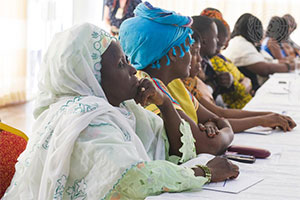 Representatives of Civil Society, Sierra Leone. Credit: UN Photo/Eskinder Debebe
Civil society faces mounting threats worldwide, even as it remains essential for democratic accountability, especially in countries struggling with economic instability and social inequality. However, at the same time, nations with weak democratic governance structures also systemically suppress the power of civil society. Human rights activists across the Global South frequently challenge issues such as political persecution and gender oppression, but in return face state-sanctioned punishment for their advocacy. Imprisonment and exile are common mechanisms of punishment that seek to erode the strength of civil society. The 2026 World Press Freedom Index has reached its lowest level in 25 years, with more than half of the world’s countries now falling into the "difficult" or “very serious” category for press freedom. IPS seeks to highlight the work of civil society across the Global South as well as the challenges that they face.
Updated by Yilan Batista and Shuli Wong August 2026

The Week with IPS

NEXT STOP - SDGs
Tracking global progress towards a sustainable world
Tracking global progress towards a sustainable world
