Languages
Friday, November 13, 2026



News and Views from the Global South
Civil Society

Deported Salvadoran Women Pin Their Hopes on Poultry Production
Salvadoran farmer Lorena Mejía opens an incubator and monitors the temperature of the eggs, which will soon provide her with more birds and eggs as the chickens hatch and grow up.
As Treaties Collapse, Can We Still Prevent a Nuclear Arms Race?
The United States last week officially announced it is walking away from the Intermediate Range Nuclear Forces (INF) Treaty, an agreement made between the USA and the Soviet Union in 1987 to eliminate a whole class of nuclear weapons that had been deployed in Europe and had put the continent on a trip-wire to nuclear war.
Fighting Machismo in Latin America: The Formula to Combat Femicides
Peru began the year with 11 femicides in January, despite progress made in laws and statutes and mass demonstrations against gender-based violence. This situation is also seen in other Latin American countries, raising the need to delve deeper into the causes of the phenomenon.
Bullets Against Pots and Pans in the Crackdown on Venezuela’s Protests
The protests in Venezuela demanding an end to the presidency of Nicolás Maduro in the last 10 days of January, whose soundtrack was the sound of banging on pots and pans in working-class neighbourhoods, had a high human cost: more than 40 deaths, dozens wounded and about a thousand detainees, including 100 women and 90 children under 18.
Making Communities Drought Resilient
The United Nations Convention to Combat Desertification (UNCCD’s) Drought Initiative is in full swing with dozens of countries signing up to plan their drought programme.
Mexican Village Wants to Turn Thermoelectric Plant into Solar Panel Factory
Social organisations in the central Mexican municipality of Yecapixtla managed to halt the construction of a large thermoelectric plant in the town and are now designing a project to convert the installation into a solar panel factory, which would bring the area socioeconomic and environmental dividends.
From Fake News to Enemy of the People: An Anatomy of Trump’s Tweets
Since announcing his candidacy in the 2016 presidential elections to the end of his second year in office, U.S. President Donald Trump has sent 1,339 tweets about the media that were critical, insinuating, condemning, or threatening.
People Power Will Bring Change — Not Davos
They said they cared about climate change but they flew in on private jets in record numbers. They said they cared about inequality but laughed off the idea of higher taxes for the rich. They spoke about democracy and human rights but they dined with a far-right populist. If there was ever any doubt about Davos representing the epitome of duplicity, then 2019 has firmly laid that to rest.
Billions of Dollars Available for Reducing and Reversing Land Degradation
The United Nations Convention to Combat Desertification (UNCCD) has debunked the notion that there is no funding available for countries to prevent, reduce or reverse land degradation.
The Silent, Invisible Crisis Destabilising Communities Could be a Subject of Hope
New data show that globally two billion hectares of land—roughly twice the size of China—have been degraded. And of this amount, 500 million hectares are abandoned agricultural lands.
Ending Poverty is Possible, but it Means Facing up to Inequality – Within & Between Countries
World leaders have committed to ending poverty everywhere for all people by 2030. Achieving this aim means facing up to the need for dramatic declines in inequalities – in income, in opportunity, in exposure to risk, across gender, between countries and within countries – over the next decade.
In Venezuela, Two Presidents Vie for Power
Venezuela entered a new and astonishing arena of political confrontation, with two presidents, Nicolás Maduro and Juan Guaidó, leading the forces vying for power, while Venezuelans once again are taking to the streets to demonstrate their weariness at the crisis, which has left them exhausted.
Protecting Your Security and Rights Online
On December 6, the Australian parliament rushed to pass a bill that could weaken security on the phones and software people rely on every day, in Australia and worldwide. The sweeping law could force tech companies to take vaguely described actions to access encrypted data.
Solar Energy Begins to Light Up Favelas in Rio de Janeiro
 “We can’t work just to pay the electric bill,” complained José Hilario dos Santos, president of the Residents Association of Morro de Santa Marta, a favela or shantytown embedded in Botafogo, a traditional middle-class neighborhood in Rio de Janeiro.

Family Farming Wages a Difficult Battle in Argentina
"Our philosophy is based on two principles: zero tolerance of pesticides or bosses," says Leandro Ladrú, while he puts tomatoes and carrots in the ecological bag held by a customer, in a large market in the Argentine capital, located between warehouses and rusty old railroad cars.
Davos, Inequality & the Climate Emergency
Four of the top five most impactful threats in this year’s World Economic Forum´s Global Risks report are related to climate change. The report warns that we are “sleepwalking to disaster” . But that is not true. The disaster is already here, it´s not something we are still walking towards. Climate change is no future threat, it´s a current one. We have entered a new phase, one in which the impacts are coming faster, with greater intensity.
Journalism in Nicaragua Under Siege
Eight months of social and political crisis in Nicaragua have hit the exercise of independent journalism in the country, with 712 cases of violations of the free exercise of journalism, one murdered reporter, two in prison and dozens fleeing into exile, in addition to several media outlets assaulted by the security forces.
Argentina’s Indigenous People Fight for Land Rights
Nancy López lives in a house made of clay, wood and corrugated metal sheets, on private land dedicated to agriculture. She is part of an indigenous community of 12 families in northern Argentina that, like almost all such communities, has no title to the land it occupies and lives under the constant threat of eviction.
Indigenous People, the First Victims of Brazil’s New Far-Right Government
"We have already been decimated and subjected, and we have been victims of the integrationist policy of governments and the national state," said indigenous leaders, as they rejected the new Brazilian government’s proposals and measures focusing on indigenous peoples.
Local Innovation Facilitates Solidarity-Based Biogas Networks in Cuba
Black plastic pipes, readily available on the mainly empty shelves of Cuba’s shops, distribute biogas to homes in the rural town of La Macuca, buried under the ground or running through the grass and stones in people’s yards.
Solar Energy Crowns Social Housing Programme in Brazil
"Solar energy makes my happiness complete," said Divina Cardoso dos Santos, owner of one of 740 houses with photovoltaic panels on the rooftops in a settlement on the outskirts of this central Brazilian city.« Previous Page — Next Page »


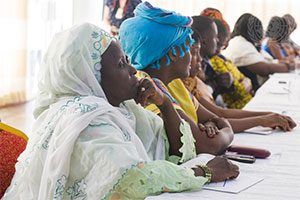 Representatives of Civil Society, Sierra Leone. Credit: UN Photo/Eskinder Debebe
Civil society faces mounting threats worldwide, even as it remains essential for democratic accountability, especially in countries struggling with economic instability and social inequality. However, at the same time, nations with weak democratic governance structures also systemically suppress the power of civil society. Human rights activists across the Global South frequently challenge issues such as political persecution and gender oppression, but in return face state-sanctioned punishment for their advocacy. Imprisonment and exile are common mechanisms of punishment that seek to erode the strength of civil society. The 2026 World Press Freedom Index has reached its lowest level in 25 years, with more than half of the world’s countries now falling into the "difficult" or “very serious” category for press freedom. IPS seeks to highlight the work of civil society across the Global South as well as the challenges that they face.
Updated by Yilan Batista and Shuli Wong August 2026

The Week with IPS

NEXT STOP - SDGs
Tracking global progress towards a sustainable world
Tracking global progress towards a sustainable world
