Languages
Friday, November 13, 2026



News and Views from the Global South
Civil Society

Leprosy Detection With a Personal Touch
Jennifer Quimno could put anyone at ease. So when she travels across the Philippines as part of peer to peer programme that helps identify new leprosy cases, people generally allow her to examine them.
First Asian Leprosy Assembly Calls for Greater Social Inclusion for the Affected
Growing up in Kathmandu, Nepal, Amar Bahadur Timalsina wasn’t allowed to attend school as a young boy because he was affected by leprosy. But decades later, after treatment and being able to re-integrate into his community, the boy who was once denied an education is now inspiringly the principal of a school of 400 students.
A Global Imperative: Empowering Women is Critical for World’s Economy & People
March 8 marks International Women’s Day, which provides a chance to reflect on the struggle for greater gender equality. The roots of this annual event reach back more than a century, yet its focus on respect and opportunities for women remains strikingly relevant today—from sexual harassment and violence to unequal laws and unfairness in the workplace, where women are too often underemployed, underpaid, and underpromoted.
Education Key to Gender Equality in Asia & the Pacific
Equal rights have been demanded and promised for generations, but last year a shift occurred in the women’s movement. Across Asia and the Pacific and around the world, women demonstrated to condemn a status quo which continues to deprive too many women and girls of respect and equal opportunity.
Mauritius Scores Win over Britain in Diego Garcia Decolonisation
Mauritius has scored a victory over Britain at the International Court of Justice (ICJ) in a case involving the decolonisation of the strategically important island of Diego Garcia that is home to a United States military base.
Why West Craves Materialism & East Sticks To Religion
My generation grew up at a time when colonial hang up was at its peak. Our older generation had been slaves and had a huge inferiority complex of the British. The school I went to was similar to all elite schools in Pakistan.
Taking the Lead in Fight Against Climate Change
As the grandchild of Jamaican citizens who moved to Great Britain, Monique Taffe says she inherited a tradition of recycling and learned not to be part of the “throwaway culture”, as some environmentalists have labelled consumerist societies.
Local School Is a Model for Energy and Water in Rapa Nui
A school in the capital of Easter Island (Rapa Nui, in the local indigenous tongue) gives an example of clean management with the use of solar energy, rainwater recovery and an organic vegetable garden, as well as rooms and spaces built with waste materials.
Maldives Reiterates Commitment to ‘Free, Open Indo-Pacific Region’ & Democracy
Maldives Foreign Minister Abdulla Shahid has reiterated his nation's commitment to a “free and open” Indo-Pacific region and to democracy. During his meeting with Secretary of State Michael Pompeo in Washington Feb 20, Shahid “underscored the importance of his government's reform efforts to (ensure) the vitality of Maldives' democracy,” the department's Deputy Spokesperson Robert Palladino said.
A World Party
I have been a member of the first international party: the Transnational Radical Party, founded in 1956 by Marco Pannella and Emma Bonino. Then in 1988, I was a witness of the large protest, in Berlin West, against the meeting of the International Monetary Fund and the World Bank, a precursor of the “Battle of Seattle” in 1988, where 40.000 protesters disrupted the annual meeting of the two world’s financial institutions. I was even detained for a day by the police, even if was just a witness: my condition of foreigner made me automatically suspect.
Attacks on Human Rights Defenders: A Daily Occurrence in Latin America
"We're in a very difficult situation. There is militarisation at a regional level, and gender-based violence. We are at risk, we cannot silence that," Aura Lolita Chávez, an indigenous woman from Guatemala, complained at a meeting of human rights defenders from Latin America held in the Mexican capital.
Mining Grabs Up Land, Deals Blow to Agriculture in Central America
Like an octopus, metals mining has been spreading its tentacles throughout Central America and dealing a blow to the region's agriculture and natural ecosystems, according to affected villagers, activists and a new report on the problem.
Kenya’s Marginalised Say Nothing For Us, Without Us
Julia Mutua is a resident of Kalawa ward in the semi-arid Makueni County in Eastern Kenya and a member of a women's farmers group that runs a poultry project.
International Aid Feeds Hope and Fuels Confrontation in Venezuela
The international food and medical aid awaiting entry into Venezuela from neighboring Colombia, Brazil and Curacao is at the crux of the struggle for power between President Nicolás Maduro and opposition leader Juan Guaidó, recognised as "legitimate president" by 50 governments.
Q&A: Suriname’s President Champions Preserving the World’s Forests
At the Bonn Climate Conference in 2017, Suriname announced its aspirations to maintain its forest coverage at 93 percent of the land area. For Suriname and other High Forest Cover and Low Deforestation (HFLD) nations, maintaining forest coverage is their contribution to saving the planet from the effects of climate change, something they did not cause.
‘Today, We Declare Our Love to Our Forests and Ecosystems’
High Forest Cover and Low Deforestation (HFLD) nations ended a major conference in Suriname on Thursday, with the Krutu of Paramaribo Joint Declaration on HFLD Climate Finance Mobilisation.
The Role Technology Can Play in Fighting Climate Change and Deforestation
At 51, Roberto Wong Loi Sing has spent nearly half of his life working in the field of engineering. But as he spends his days designing more efficient stormwater management systems, or water purification systems, for instance, the child in him comes alive as he combines his skills to find “win-win” solutions for the environment.
Rapa Nui’s Stone Statues and Marine Resources Face Threats from Climate Change
Social activists and local authorities in Rapa Nui or Easter Island are calling for urgent action to address rising sea temperatures, declining rainfall, and rising tides that threaten their fishing resources and their Moais, the mysterious volcanic stone monoliths.
Our Forests Provide the World With Oxygen But We Need More Climate Change Finance – HFLD Countries
Suriname, the most forested country in the world, is this week hosting a major international conference on climate financing for High Forest Cover and Low Deforestation (HFLD) countries.
Are Sustainable Development Goals Reaching Indigenous Peoples?
Life and death for whole communities hang in the balance of achieving the 17 Sustainable Development Goals (SDGs) that include eliminating poverty, conserving forests, and addressing climate change in a resolution adopted unanimously by the United Nations in 2015.
Ghana Won’t Have Press Freedom Without Accountability
Three bullets, fired at close range by two assassins on a black and blue Boxer motorbike on January 16, 2019, killed investigative journalist Ahmed Hussein-Suale Divela, according to Sammy Darko, a lawyer working on Divela's case.« Previous Page — Next Page »


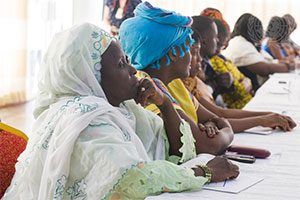 Representatives of Civil Society, Sierra Leone. Credit: UN Photo/Eskinder Debebe
Civil society faces mounting threats worldwide, even as it remains essential for democratic accountability, especially in countries struggling with economic instability and social inequality. However, at the same time, nations with weak democratic governance structures also systemically suppress the power of civil society. Human rights activists across the Global South frequently challenge issues such as political persecution and gender oppression, but in return face state-sanctioned punishment for their advocacy. Imprisonment and exile are common mechanisms of punishment that seek to erode the strength of civil society. The 2026 World Press Freedom Index has reached its lowest level in 25 years, with more than half of the world’s countries now falling into the "difficult" or “very serious” category for press freedom. IPS seeks to highlight the work of civil society across the Global South as well as the challenges that they face.
Updated by Yilan Batista and Shuli Wong August 2026

The Week with IPS

NEXT STOP - SDGs
Tracking global progress towards a sustainable world
Tracking global progress towards a sustainable world
