Languages
Monday, September 21, 2026



News and Views from the Global South
Aid

Do we Really Need a World Ranking to Measure Happiness?
The 10th edition of the World Happiness Report was recently published and once again the findings raised an array of mixed emotions with many questioning the real foundations underpinning the most discussed aspect of the Report, the World Happiness Ranking,
Afghanistan’s Girls’ Education is a Women’s Rights Issue
The late-night reversal of a decision by Taliban authorities in Afghanistan to allow girls from grades 7 to 12 to return to school has been met with distress from within the country and internationally – and fear that it could herald further restrictions.
Water & Sanitation, a Better Future for Girls & our Planet
At the World Water Forum this week (March 21-26), the international community will raise awareness of the 2 billion people worldwide who lack access to clean water and sanitation. Among them are millions of women and girls, who walk hundreds of miles each year to find water for their families and are blocked from education and economic empowerment also due to poor sanitation services.
Water & Sanitation Crisis Escalates as Yemenis Mark World Water Day
As Yemen enters its 8th year of an escalating conflict, 21.7 million of my fellow Yemenis are forced to rely on humanitarian assistance to survive. The conflict has left a trail of devastation in its wake – the country is in economic freefall, and families face intensified violence, hunger, and disease. As we also mark another World Water Day on March 22, within Women’s History Month, it is a time to reflect on the immense water and sanitation crisis that continues to take countless lives – and how it impacts women and girls so acutely. The destruction of the country’s health and water infrastructure has left Yemen acutely vulnerable to multiple epidemics including malaria, diphtheria, dengue, cholera, and COVID-19.
Cyclone Ana Floods Choke Malawi’s Water and Sanitation Goals
On the night of January 24, 2022, as Cyclone Ana-triggered rains incessantly rattled on the rusty roof of her house, amid intervals of gusty winds, a thud woke up Josephine Kumwanje from her sleep.
Call for Increased Global Efforts to Ease Africa’s Climate-Induced Water Crisis
When years ago warnings were sounded that future wars would be fought not over oil but water, the predictions were dismissed as alarmist.
Education Cannot Wait Interviews The Rt. Hon. Gordon Brown, UN Special Envoy for Global Education and Chair of ECW’s High-Level Steering Group
ECW: You played a critical role in establishing Education Cannot Wait just five years ago. As the Chair of ECW’s High-Level Steering Group, what are some of the key successes achieved by ECW over the last five years; and what needs to be done in the next five years as we approach the 2030 Agenda for Sustainable Development deadline?
Battle for Palestine: & the Day When David Felled Goliath with a Stone
When Israeli Ambassador Gilat Erdan made an unusual presentation before the Security Council last week displaying a large rock, which he claimed, was hurled at Israeli vehicles in the Occupied Territories, a reporter at a UN press conference asked whether Palestinians will be given the right of reply--- by displaying in the Security Council chamber an Uzi sub- machine gun or a bulldozer deployed by Israeli armed forces against civilian demonstrations.
Doubling Adaptation Finance can be an Opportunity for the World’s Poorest
Amid several disappointments of the 2021 UN climate conference in Glasgow, one sign of hope was the agreement on financing for adaptation to climate change. Developed countries agreed to double adaptation finance for poorer nations by 2025, from 2019 levels.
Open Letter to the Secretary General, Heads of UN Agencies & International Donor Community
We are former UN officials with decades of combined experience supporting international civil society and governments to advance the rights of women and girls.
Greed-Driven Pandemic Still Killing Millions
Failure to vaccinate most in poor countries sustains the COVID-19 pandemic. Rich country greed and patent monopolies block developing countries from affordably making the means to protect themselves. Mutant menace The SARS-CoV-2 virus has been mutating as it replicates. Numerous replications in hundreds of millions of hosts have generated many variants. Some mutations are more resilient than others, and better able to overcome human defences.
School Meals Coalition Hopes to Provide a Meal to Every Child
Meals at schools not only give each child a nutritious meal but increase enrolments, among other benefits.
Hunger, Desperation in Lebanon as Food Prices Rocket
On the streets of Beirut, Hadi Hassoun begs for a few pounds to feed his five children. He has little hope of a job, especially now that the economic crisis in Lebanon has destroyed wealth.
Mental Health Strategic Plan for Bangladesh: An Overview
Mental health and treating mental health conditions involves not only treating an individual’s ability to manage their thoughts, emotions, behaviors, and interactions with others, but also ensuring that the social, cultural, economic, political, and environmental conditions are in place through effective national policies, social protections, adequate living standards, working conditions, community social support, and a tiered system of care through a robust network of health services. In Bangladesh, the Mental Health Act 2018 and the National Mental Health Policy 2021 were developed with the above in mind.
Mental Health Achievements in Bangladesh
Mental health is a state of well-being when both your body and your mind are in balance, and you are able to deal with the difficulties and challenges that come your way and easily find joy, peace, and happiness once the challenge is overcome. For many people though, the challenges often remain for too long - the pain of losing someone you dearly loved, being diagnosed with a chronic disease like cancer or a heart condition, losing your family/home/job or feeling like you failed to meet expectations. All those things and more can trigger so much intense stress and maladjustment, that if it goes unchecked and untreated, it may lead to a chronic disease, a mental health disorder. WHO defines health as “a state of complete physical, mental and social well-being and not merely the absence of disease or infirmity”. The majority of people are able to cope and get back to life as normal, but for the many who cannot, they begin to experience intense detachment from reality (experiencing delusions, pervasive sadness, uncontrollable fears, intense anger and/or fantasies and hallucinations). For those individuals, there is limited help and treatment in every country in the world. Those who suffer from mental health disorders and the brave professionals who learn to treat them are chronically stigmatized, under-appreciated and under-paid.
Bleak Prospects for Least Developed Countries
“The outlook for LDCs is grim”. The latest United Nations (UN) assessment of prospects for the least developed countries (LDCs) notes recent setbacks without finding any silver lining on the horizon. Promises unkept Half a century ago, LDCs were first officially recognised by a UN General Assembly resolution. It built on research, analysis and advocacy by the UN Conference on Trade and Development (UNCTAD).
Guess Who’s Behind Paralysis on COVID19 in the UN Committee on World Food Security
‘COVID 19 has multiplied hunger and malnutrition challenges. We need transformative action!’ The first speaker at the UN Committee on World Food Security’s (CFS) 49th Plenary Session, the Secretary-General of the United Nations, turned the spotlight on the disastrous impacts of the pandemic that have afflicted communities around the world for close to two years.
World Food Day: Climate Change is Exacerbating Hunger & Conflict—it’s Time to Break the Cycle
Hunger, violent conflict and the visible impacts of climate change are all on the rise. World Food Day, October 16, is a reminder that we need to talk about the intricate ways that these challenges are connected—and how to tackle them together.
Where on Earth is a Water-Secure World?
It is not uncommon for a water-centric research, policy or development organization or network to declare its long-term vision of the “water-secure world”. It reads nicely and feels great.
Afghan Women – The Emerging Narrative and Why it is Wrong
The USA and its allies have repeatedly stated that promoting women’s rights was one of the key reasons they were in Afghanistan. The US military top brass, in a letter to marines stated that they were in Afghanistan “for the liberty of young Afghan girls, women, boys, and men who want the same individual freedoms we enjoy as Americans”.
The Plight of Haiti
I assume channel surfing and internet browsing contribute to a decrease in people’s attention span. I am not familiar with any scientific proof, though while working as a teacher I found that some students may be exhausted when five minutes of a lesson has passed and begin fingering on their smartphones. They might also complain if a text is longer than half a page, while finding it almost impossible to read a book.« Previous Page — Next Page »


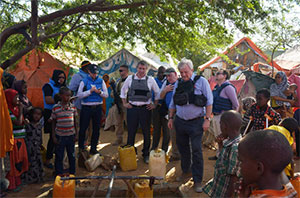 UN Emergency Relief Coordinator Visits Somalia. Credit: UN Photo/Tobin Jones
In recent years, conflicts have broken out across the world with no sign of slowing down or stopping. In times like this, millions of people globally are in dire need of humanitarian aid. Famine, warfare, natural disasters, and economic decline plague a host of nations, including Palestine, Sudan, Chad, Lebanon, and Haiti, to name a few. Humanitarian aid provides millions of people with critical services including healthcare, food, clean drinking water, psychosocial support, housing, and access to education. UN agencies such as the UNDP, UNICEF, the World Food Programme (WFP), UNHCR, UNRWA, and UNEP work with the UN Office for the Coordination of Humanitarian Aid (OCHA) and local organizations to come up with the best possible strategies to support affected communities. At the same time, humanitarian aid and those working on the frontlines are consistently threatened by both actors directly involved in conflict as well as those who are meant to contribute to the international humanitarian regime at large. The near-collapse of United States international aid structures in 2025, including the termination of 83% of USAID’s 6,300 global initiatives, has left millions of people without access to vital humanitarian assistance. 98 million people in 2025, only 65% of people targeted for humanitarian assistance, received the help they needed. In contrast, 123 million people received some form of humanitarian assistance in 2024, and OCHA’s 2026 Global Humanitarian Overview estimates that 239 million people are in need of assistance in 2026. IPS is well-positioned to discuss current initiatives to provide aid and relief through in-depth reporting and opinion content.

The Week with IPS

NEXT STOP - SDGs
Tracking global progress towards a sustainable world
Tracking global progress towards a sustainable world
