Languages
Saturday, October 10, 2026



News and Views from the Global South
Aid

Strangers in the Land: A Congolese Murder Case
I thought about this song by Paul Simon while I in 2011 spent a few weeks in Kinshasa. I was a foreign man in a strange world, surrounded by sights and sounds, completely dependent on my new-found Congolese friends. When our taxi got stuck in a traffic jam and we had to walk to our destination I was stopped by a group of heavily armed youngsters, lead by a man who claimed to be a policeman, charging me with an exaggerated high fine for taking photos within a restricted area.
Davos, Inequality & the Climate Emergency
Four of the top five most impactful threats in this year’s World Economic Forum´s Global Risks report are related to climate change. The report warns that we are “sleepwalking to disaster” . But that is not true. The disaster is already here, it´s not something we are still walking towards. Climate change is no future threat, it´s a current one. We have entered a new phase, one in which the impacts are coming faster, with greater intensity.
Acts of Terror Will Not Undermine Our Resolve
On 15 January 2019, terror struck Nairobi's 14 Riverside Drive. Kenya is in mourning following a senseless act on innocent and defenseless civilians by individuals preoccupied with contemptible and misplaced ideology; who hope to intimidate others through violent acts of terror. Like in their other past attempts, they have failed, and Kenya remains unbowed.
We Are All DukDukDiya: Humming Bird with One Drop of Water at a Time
There is a Quechan fable about a hummingbird named Dukdukdiya. During a fierce forest fire, while all other animals stood in stunned fear, Dukdukdiya alone took action by repeatedly carrying a single drop of water in her beak to the flames. When asked why she bothered with such paltry efforts, she replied that she was simply doing everything in her power to stop the fire.
Climate Change: Complex Challenges for Agriculture
The unusually hot summer of 2018 showed that climate change affects a central part of our lives: agriculture. The severe drought in Liechtenstein led to large losses in the hay harvest.
Global Warming: Severe Consequences for Africa
Record global greenhouse gas emissions are putting the world on a path toward unacceptable warming, with serious implications for development prospects in Africa. “Limiting warming to 1.5° C is possible within the laws of chemistry and physics, but doing so would require unprecedented changes,” said Jim Skea, cochair of the Intergovernmental Panel on Climate Change (IPCC) Working Group III.
Veterans of the Global Financial Crisis Pass their Wisdom on to the Next Generation
It happened again and again in a career punctuated by upheavals: the peso crisis of 1994, the Asian crisis of 1997, and finally, the big one—the global financial crisis of 2008.
From Mali: A Lesson in Tolerance
We all adhere to generalizations. For example, while reading and speaking about Muslims and Christians, sweeping opinions might easily become prejudices, particularily if we do not know any individual behind the labels. When I some years ago was working for a Malian NGO, I met a marabout and a Christian who proved that devotees to different religions might find mutual support in their individual beliefs.
The Dark Shadows of Christmas
Christmas is expected to be a peaceful celebration of the birth of Jesus. A time to express love and care for one another. Jesus preached love and compassion, but also told us to be suspicious of imposters: “Beware of the false prophets, who come to you in sheep´s clothing, but inwardly are ravenous wolves”. Wolves are predators who disregard the suffering of their victims. A human wolf is an egomaniac ready to maim and murder, either to please himself or his master, often deluding himself by imagining he serves a higher purpose.
The Movement Fighting Inequality is Growing
The world’s political and economic elites, that will once again gather at the Swiss mountain resort of Davos for the annual World Economic Forum (WEF) 22-25 January, have become all too predictable. It's not difficult to predict what they will say, because they always say what's in their interests.
As Climate Change Pummels Agriculture, Irrigation Offers the Best Protection
The changing climate and extreme weather events are affecting agricultural productivity in Africa to such an extent that a panel of experts are urging governments to prioritise and invest in irrigation to ensure food security.
“No One Listened to Us!” The Ixiles of Guatemala
According to the Mexican Interior Ministry more than 7,000 Central American migrants have during the last month arrived at the US-Mexico border. Despite warnings by officials that they will face arrests, prosecution and deportation if they enter US territory, migrants state they intend to do so anyway, since they are fleeing persecution, poverty and violence. This is not new, in 1995 I visited Ixil and Ixcan, two Guatemalan areas mainly inhabited by Ixiles. My task was to analyse the impact of a regional development programme aimed at supporting post-conflict indigenous communities. United Nations has estimated that between 1960 and 1996 more than 245,000 people (mostly civilians) had been killed, or "disappeared" during Guatemalan internal conflicts, the vast majority of the killings were attributed to the army, or paramilitary groups.
Q&A: Many African Countries Already Live the Future of 2°C Warmer
As the United Nations climate conference nears an end, all eyes are on the negotiators who have been working day and night for the past two weeks to come up with a Rulebook for implementation of the Paris Agreement.
Decoding Article 6 of the COP24 Climate Negotiations
It is close to curtain call for the United Nations’ Climate Conference in Katowice, Poland, with ministers from around the world negotiating the text for a “rulebook” to implement the historic 2015 Paris Agreement for climate action. Amidst the various issues being debated, one of the most technical and complicated is Article 6 of the agreement, which focuses on the country plans for climate action.
Bamboo — the Magic Bullet to Rapid Carbon Sequestration?
As thousands of environmental technocrats, policy makers and academics work round the clock to come up with strategies for mitigation and adaptation to climate change at the United Nations’ conference in Katowice, Poland, one scientist is asking Parties to consider massive bamboo farming as a simple but rapid way of sequestering carbon from the atmosphere.
70 Years since the Universal Declaration on Human Rights – Hope Against Hope
“Save the Children estimates that 84,701 children under five have died in Yemen from untreated cases of severe acute malnutrition between April 2015 and October 2018.” “The grim analysis of United Nations data comes as intense fighting has again erupted in Yemen's strategic port city of Hodeidah.”
Poor Progress and No Finance Commitments at COP24 in Katowice
Implementation of the Paris Agreement on climate change is in limbo as developed countries remain noncommittal to financial obligations at the ongoing negotiations in Katowice, Poland.
The Revolution of Renewable Energy Needs Political Leadership
The cost of renewable energy is low, and at times, less than fossil fuels. What are the barriers to switching to renewables? Where current energy systems exist, they will need to be upgraded to be able to draw power from modern renewables and to exploit storage solutions that they require.
Q&A: Creating an African Bamboo Industry as Large as China’s
The bamboo industry in China currently comprises up to 10 million people who make a living out of production of the grass. But while the Asian nation has significant resources of bamboo — three million hectares of plantation and three million hectares of natural forests — the continent of Africa is recorded to have an estimated three and a half million hectares of plantations, excluding conservation areas.
African Countries Deserve an Enhanced Climate Ambition
African countries have been at the climate-change negotiating table for more than 20 years. The continent faces some of the most severe impacts of climate change, but questions remain over its adaptive capacity despite this engagement.
Fostering Green, Made-In-Africa Innovations
Over 1000 policy makers, experts, investors and financial specialists from across Africa are gathered this week in Kigali, at a week-long Africa Green Growth Forum 2018 to discuss how to foster green, made-in-Africa innovations to meet the needs of the continent.« Previous Page — Next Page »





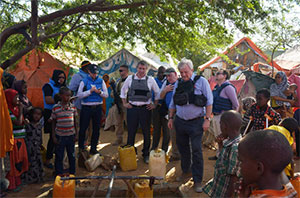 UN Emergency Relief Coordinator Visits Somalia. Credit: UN Photo/Tobin Jones
In recent years, conflicts have broken out across the world with no sign of slowing down or stopping. In times like this, millions of people globally are in dire need of humanitarian aid. Famine, warfare, natural disasters, and economic decline plague a host of nations, including Palestine, Sudan, Chad, Lebanon, and Haiti, to name a few. Humanitarian aid provides millions of people with critical services including healthcare, food, clean drinking water, psychosocial support, housing, and access to education. UN agencies such as the UNDP, UNICEF, the World Food Programme (WFP), UNHCR, UNRWA, and UNEP work with the UN Office for the Coordination of Humanitarian Aid (OCHA) and local organizations to come up with the best possible strategies to support affected communities. At the same time, humanitarian aid and those working on the frontlines are consistently threatened by both actors directly involved in conflict as well as those who are meant to contribute to the international humanitarian regime at large. The near-collapse of United States international aid structures in 2025, including the termination of 83% of USAID’s 6,300 global initiatives, has left millions of people without access to vital humanitarian assistance. 98 million people in 2025, only 65% of people targeted for humanitarian assistance, received the help they needed. In contrast, 123 million people received some form of humanitarian assistance in 2024, and OCHA’s 2026 Global Humanitarian Overview estimates that 239 million people are in need of assistance in 2026. IPS is well-positioned to discuss current initiatives to provide aid and relief through in-depth reporting and opinion content.

The Week with IPS

NEXT STOP - SDGs
Tracking global progress towards a sustainable world
Tracking global progress towards a sustainable world
