Languages
Saturday, October 10, 2026



News and Views from the Global South
Aid

Island Women Take the Lead in Peatland Restoration
Eluminada Roca has lived all her life next to the Leyte Sab-a Basin peatlands. The grandmother from of San Isidro village in Philippines’ Leyte island grew up looking at the green hills that feed water to the peatland, she harvested tikog—a peatland grass to weave mats—and ate the delicious fish that was once in abundant in the waters. But today, the land is losing its water, the grass is disappearing and the fish stock has drastically decreased.
Q&A: Important to Treat Anyone Suffering from Leprosy as an Equal Individual
Discrimination against women who are affected by leprosy or Hansen's Disease is a harsh reality, says Alice Cruz is the United Nations Special Rapporteur on the elimination of discrimination against persons affected by leprosy and their family members.
Q&A: Leprosy-affected People Live Not at the Bottom, but Outside the Social Pyramid
Takahiro Nanri is the Executive Director of Sasakawa Memorial Health Foundation which has been supporting the global fight against leprosy for almost five decades. Since 2014, Nanri has been leading the foundation’s leprosy projects across the world and has deep insights into the challenges faced by the people affected by leprosy as well as the organisations that work with them.
Q& A: We Need a Holistic Approach to Eradicate Leprosy
Dr. Maria Francia Laxamana is the Assistant Secretary in the Philippines ministry of health. With nearly two decades of work both as a senior government official and also as an expert in several non-government organisations, Laxamana has deep insight into the issue of leprosy in this Southeast Asian nation and the challenges faced by those who are affected by the disease.
Leprosy Detection With a Personal Touch
Jennifer Quimno could put anyone at ease. So when she travels across the Philippines as part of peer to peer programme that helps identify new leprosy cases, people generally allow her to examine them.
Accelerating the Caribbean’s Climate Resilience
The Caribbean Climate Smart Accelerator launched last year June with the backing of Virgin’s Richard Branson has given itself five years to help the region become climate resilient.
The Unwanted People of Myanmar: A Tropical Srebrenica in the Land of the Golden Pagodas
The massacre of Srebrenica will enter human history as one of our darkest chapters. From 11 to 22 July 1995, Bosnian Serb military forces massacred approximately 8,000 Muslim Bosniaks. It became the largest massacre committed on European soil since the end of the Second World War. In November last year, the Bosnian Serb military commander Ratko Mladic was convicted of war crimes and of genocide. This constituted relief for the victims of the Srebrenica genocide and a victory for international justice after 22 years.
DRC’s First Peaceful Transition of Power Was At Expense of Women
When Felix Tshisekedi, the 55 year old son of the former opposition leader, won the recent presidential election in the Democratic Republic of Congo, it should have felt like a new dawn for many of us living here.
International Aid Feeds Hope and Fuels Confrontation in Venezuela
The international food and medical aid awaiting entry into Venezuela from neighboring Colombia, Brazil and Curacao is at the crux of the struggle for power between President Nicolás Maduro and opposition leader Juan Guaidó, recognised as "legitimate president" by 50 governments.
‘Today, We Declare Our Love to Our Forests and Ecosystems’
High Forest Cover and Low Deforestation (HFLD) nations ended a major conference in Suriname on Thursday, with the Krutu of Paramaribo Joint Declaration on HFLD Climate Finance Mobilisation.
Q&A: What of the Carbon Neutral Countries?
As High Forest Cover and Low Deforestation (HFLD) nations meet in Suriname at a major conference, it is obvious that the decision made by these countries to preserve their forests has been a difficult but good one.
The Hidden Economic Costs of Displacement
While the impacts of displacement on wellbeing are well-known, one group has pointed to the equally burdensome economic costs for those displaced as well as host communities.
Q&A: We Are Helping the World Mitigate Climate Change, Now it’s Time to Help Us
The Caribbean nation of Suriname may be one of the most forested countries in the world, with some 93 percent of the country’s surface area being covered in forests, but it is also the most threatened as it struggles with the impacts of climate change.
Our Forests Provide the World With Oxygen But We Need More Climate Change Finance – HFLD Countries
Suriname, the most forested country in the world, is this week hosting a major international conference on climate financing for High Forest Cover and Low Deforestation (HFLD) countries.
Are Sustainable Development Goals Reaching Indigenous Peoples?
Life and death for whole communities hang in the balance of achieving the 17 Sustainable Development Goals (SDGs) that include eliminating poverty, conserving forests, and addressing climate change in a resolution adopted unanimously by the United Nations in 2015.
Billions of Swedish Krona Supported the Struggle against Apartheid
Between 1982 and 1988 Birgitta Karlström Dorph was on a secret mission in South Africa. "Why didn't they stop us? Probably they were not aware of the scope of the operation. The money was transferred through so many different channels. We were clever, " Karlström Dorph says.
A Truly Global Effort is Needed to Eradicate FGM by 2030
According to official data on the global prevalence of Female Genital Mutilation (FGM) released by UNICEF there are 200 million women and girls in the world who have been cut. Shocking though this statistic is, it seriously underestimates the nature and scale of the problem.
People Power Will Bring Change — Not Davos
They said they cared about climate change but they flew in on private jets in record numbers. They said they cared about inequality but laughed off the idea of higher taxes for the rich. They spoke about democracy and human rights but they dined with a far-right populist. If there was ever any doubt about Davos representing the epitome of duplicity, then 2019 has firmly laid that to rest.
Billions of Dollars Available for Reducing and Reversing Land Degradation
The United Nations Convention to Combat Desertification (UNCCD) has debunked the notion that there is no funding available for countries to prevent, reduce or reverse land degradation.
Ending Poverty is Possible, but it Means Facing up to Inequality – Within & Between Countries
World leaders have committed to ending poverty everywhere for all people by 2030. Achieving this aim means facing up to the need for dramatic declines in inequalities – in income, in opportunity, in exposure to risk, across gender, between countries and within countries – over the next decade.
COP24: Sum and Substance of Climate Diplomacy
As I was attending the 24th Conference of Parties to the United Nations Framework Convention on Climate Change—to create a rulebook to operationalise the Paris Agreement—in Katowice, Poland, it dawned on me, like never before, that the negotiations were taking place in a make-believe world.« Previous Page — Next Page »





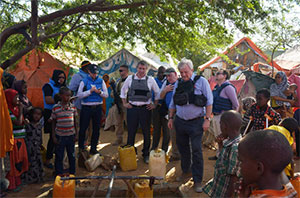 UN Emergency Relief Coordinator Visits Somalia. Credit: UN Photo/Tobin Jones
In recent years, conflicts have broken out across the world with no sign of slowing down or stopping. In times like this, millions of people globally are in dire need of humanitarian aid. Famine, warfare, natural disasters, and economic decline plague a host of nations, including Palestine, Sudan, Chad, Lebanon, and Haiti, to name a few. Humanitarian aid provides millions of people with critical services including healthcare, food, clean drinking water, psychosocial support, housing, and access to education. UN agencies such as the UNDP, UNICEF, the World Food Programme (WFP), UNHCR, UNRWA, and UNEP work with the UN Office for the Coordination of Humanitarian Aid (OCHA) and local organizations to come up with the best possible strategies to support affected communities. At the same time, humanitarian aid and those working on the frontlines are consistently threatened by both actors directly involved in conflict as well as those who are meant to contribute to the international humanitarian regime at large. The near-collapse of United States international aid structures in 2025, including the termination of 83% of USAID’s 6,300 global initiatives, has left millions of people without access to vital humanitarian assistance. 98 million people in 2025, only 65% of people targeted for humanitarian assistance, received the help they needed. In contrast, 123 million people received some form of humanitarian assistance in 2024, and OCHA’s 2026 Global Humanitarian Overview estimates that 239 million people are in need of assistance in 2026. IPS is well-positioned to discuss current initiatives to provide aid and relief through in-depth reporting and opinion content.

The Week with IPS

NEXT STOP - SDGs
Tracking global progress towards a sustainable world
Tracking global progress towards a sustainable world
