Languages
Sunday, November 8, 2026



News and Views from the Global South
Education
PHILIPPINES: Children Worst Hit by Economic Crisis
"I get an allowance of 50 pesos (about one U.S. dollar) a day, of which 20 pesos (40 U.S. cents) is for fare," says 17-year-old Dana Jane Estrada.
CAMBODIA: Global Crisis Mostly Bypassing the Young – For Now
Mey Chamnan has learned the hard way about the global economic crisis. Both she and her husband were fired from their 50 U.S.-dollar a month jobs in a local garment factory after declining overseas orders caused huge job losses across Cambodia's garment industry.
PAKISTAN: Students Want Schools to Remain Open Amid Attacks
Tiny Spogmay, a Grade 1 student in one of the biggest schools in the violence-wracked North West Frontier Province (NWFP), is deeply disturbed by the government’s decision to shut down educational institutions all over the country in the wake of renewed terrorist attacks, forcing her to stay home.SPAIN: A Princely Prize for Creators of Email, Cell-Phones
U.S. engineers Martin Cooper and Raymond Tomlinson, considered the fathers of the mobile phone and email, respectively, received Spain's prestigious Prince of Asturias Award for Technical and Scientific Research from Crown Prince Felipe on Friday.UGANDA: Lifting Silence on Menstruation to Keep Girls in School
More than half of Ugandan girls who enrol in grade one drop out before sitting for their primary school-leaving examinations.CHINA: Too Many Graduates, Very Few Jobs
Feng Danya studied foreign languages. She had hoped to be part of a growing local company and grow with them, she says. But her timing was wrong. She graduated in the summer of uncertainty for the global economy and many Chinese start-ups.ECONOMY: ‘It’s Smart to Invest in Girls’
Sending more girls to school may help poor countries get out of the economic slump faster, the NGO Plan International says in a new report. Just a one percent rise in the number of girls attending secondary school boosts a country's annual per capita income growth by 0.3 percent.
AFRICA: Uneven Progress on Development Goals
The Millennium Goals cannot be achieved at the United Nations. The U.N. can create a platform for governments to make commitments but cannot force compliance by member states.EL SALVADOR: An Indigenous Language That Refuses to Die
"Yek shiajfikan" reads a sign hanging above the gate of the "Dr. Mario Calvo Marroquín" elementary school in the Salvadoran town of Izalco, welcoming pupils in Nawat, the language that was spoken by the area’s native communities.
SWITZERLAND: Undocumented Migrants Run Their Own School
Switzerland is a tough place for asylum-seekers and undocumented migrants. In Zurich, they have been running a remarkable campaign for the past year, challenging the canton's asylum policy. Now, they have opened their own school.EDUCATION-ZIMBABWE: Students Quit Classes – and Country – As Crisis Deepens
Schooling is increasingly becoming a privilege of the rich, , Zimbabwean parents and teachers' unions complain.SENEGAL: Scrambling to Keep Up With Education For All
In Diohine, a village of some 3,000 inhabitants in the Fatick region of central Senegal, real progress has been made towards educating all children, in spite of a lack of infrastructure.
ZAMBIA: 'Clear Lack of Commitment to HIV'
A United Nations mid-point review of Zambia's efforts towards reaching the Millennium Development Goals (MDGs), released in September, has revealed that HIV/AIDS might prevent the southern African country from meeting the targets.MALAWI: Pre-school Education A Luxury
Less than a third of Malawi's children attend pre-school; the others will lag behind their peers for their entire school careers.
ZIMBABWE: Board Gives School System Failing Marks
Primary and secondary school education in Zimbabwe has "fallen woefully behind" other southern African countries due to shortages of textbooks and other materials as well as deteriorating working conditions and resultant low morale for teachers.
MADAGASCAR: Poverty Forces 2 Million Children into Hard Labour
Poverty has increased dramatically in Madagascar since January, when a national protest movement to end the regime of former president Marc Ravalomanana plunged the country into a socio-economic crisis. Since then, the number of child labourers has risen by a whopping 25 percent.BRAZIL: Getting Beyond the Taboo to Fight STDs
Although Brazil has the reputation of being more sexually liberal than its Spanish-speaking neighbours, Brazilians suffer their own fears of stigma when it comes to sexually transmitted diseases (STDs) – the target of a new public health campaign.MIDEAST: Textbooks Become a Dream
A chronic shortage of school supplies, and severely overcrowded classrooms are crippling Gaza's educational system as tens of thousands of children begin a new school year.
SWAZILAND: Educating Angels
It is not a typical classroom setup where pupils sit in rows facing the front with a teacher lecturing before them.POPULATION: 'Time to Shelve the ICPD Plan of Action’
At least 1.5 billion people aged 10 to 25 — the largest generation of young people in history — will need sexual and reproductive health services, says the United Nations Population Fund (UNFPA).
EDUCATION-BRAZIL: Public Schools Fend Off Invasion of New Ideas
Two non-governmental initiatives managed to penetrate the walls around public education in Brazil, temporarily assuming responsibility for the administration of schools where they left their seeds planted. But ultimately they discovered how resistant the school system is to innovation.« Previous Page — Next Page »





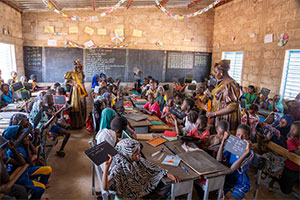 Two teachers work in a classroom in Forces Vives School in Dori, Burkina Faso. Credit: UNICEF/UNI978361
Safe and uninterrupted education is a fundamental right for all children. Education is paramount to global development, as it has been proven that investing in education – especially for girls and children – contributes significantly to economic growth and prosperity. Although more than 1 billion children go to school, many are subjected to conditions that are not conducive to a proper learning environment, including makeshift facilities, a lack of supplies, violence in classrooms, inadequate sanitation, untrained instructors, and widespread school closures. Since 2015, there have been immense gains in education with an increase of 109 million children in school. However, as of 2023, 272 million children are still out of school.
High poverty levels in developing countries also impede children’s access to a proper education. For example, from the early to mid 2000s, Sub-Saharan African nations witnessed a dramatic decline in trained teachers due to inadequate funding in the education sector. Furthermore, major cuts to United States international aid threaten an estimated 23 million additional children's access to education, as USAID‑funded school programmes across Africa and Asia face closure.
Various other factors contribute to the decline of education, notably hunger, which has increased as conflict and climate change interfere with global food production and dissemination. Meanwhile, certain social and cultural practices also impede children’s access to education, with gender inequality, discrimination, child labour, and child marriages preventing millions of children from attending school. Economic conditions such as the inaccessibility of higher education also affect disenfranchised communities across the world. In extreme situations, such as warfare where educational facilities are destroyed in their totality, notably in Gaza and Sudan, entire generations of children might grow up without access to education. Rebuilding educational infrastructure is a long and arduous process, especially when violence persists across generations, and this significantly stunts the development of societal prosperity and stability.
IPS is dedicated to telling the shocking truths about worldwide education through impassioned opinion pieces and comprehensive articles, highlighting global issues that impede worldwide education and the courses of action being taken by organizations such as UNICEF and Education Cannot Wait.

The Week with IPS

NEXT STOP - SDGs
Tracking global progress towards a sustainable world
Tracking global progress towards a sustainable world
