Languages
Sunday, November 8, 2026



News and Views from the Global South
Education
GUATEMALA: A Tax Code by and for the Oligarchs?
Taxation and government spending are the targets of a new report on Guatemala that argues the government is failing in its fiscal commitments to food, health and education.POLITICS: Thai-Cambodia Tension Gives Rise to Schools with Bunkers
Children at the largest school in this village close to the Thai-Cambodian border have a new regimen to follow besides books and sports. They have drills, practising evacuation, in case their school comes under an artillery attack.SOUTH SUDAN: Media Give Us a Fair Deal – Women
The guns have gone silent – except for sporadic conflict in parts of the vast South Sudan region, such as the Eastern Equatoria State. It may not be the absolute end of the conflict in the region, but it is a reason for renewed hope.Q&A: “What is Important is to Give Equal Opportunity” – Part 2
Although women have long made major contributions to science, their efforts have often been overlooked. For the past 12 years, the United Nations Educational, Scientific and Cultural Organisation (UNESCO) has teamed up with cosmetics giant L'Oréal to highlight the achievements of female scientists.GENDER: Women in Science Face Discrimination in India – Part 1
Just 10 of the 443 Indian scientists who received the prestigious Shanti Swarup Bhatnagar (SSB) award in the last 50 years were women.HEALTH-EGYPT: Over the Top With Anti-Swine Flu Steps
As authorities consider suspending a whole academic year to check the spread of swine flu among school children there is a feeling that measures to contain the H1N1 virus - known to be less dangerous than the one responsible for seasonal flu - are going over the top.EDUCATION: Foreign Students Flock Back to U.S
The number of international students attending colleges and universities in the United States has reached an all-time high of 671,616, largely bolstered by an increasing number of undergraduate students from China, while U.S. students are also studying abroad in higher numbers.LATIN AMERICA: Community-Based Social Innovation Wins Prizes
Community control of public funds will no longer be just an effective local idea, put into practice by social activists and community leaders in a town in southern Brazil. Now that it has won first prize in ECLAC's fifth Social Innovation Contest, it is likely to spread throughout Latin America.
POLITICS-NAMIBIA: The Struggle Does So Not Continue
They are called the "born frees", the children of Namibia’s Independence, and they will vote for the first time this month. Struggle credentials mean zip to them, and they have a serious beef with politicians.
MIDEAST: Gaza Graduates Search for Vitamin W
"We fast a long time," says Gaza graduate Mona Ismail, 23. "Only to break our fast on a piece of onion."PAKISTAN: Military Vs Militancy Does Not Equal Peace
As militant attacks in Pakistan continue unabated, there are increasing calls for the government to rethink its strategy—and look deep within.ARGENTINA: ‘Grandma, Will You Read to Me?’
"Moving," "rewarding," "therapeutic" are some of the terms used to describe their volunteer work by some of the women taking part in the Storytelling Grandmothers Programme aimed at awakening a love of reading among youngsters from poor families in Argentina.SIERRA LEONE: Claims Presidency Interferes with Judiciary
It may be seven years after the country’s civil war, but Sierra Leone is still battling to obtain an independent judiciary.
Q&A: It’s Time Students Learned Beyond the Classroom
An increasing number of universities and colleges across Asia today are running a programme called "service-learning," a teaching and learning strategy that has become synonymous with precisely what its name stands for.SWEDEN: ‘Freemovers’ Get Trapped
After a spell of sleeping rough at the railway station, Farid has a roof over his head, by way of a small room he shares with five other students.EDUCATION-URUGUAY: Literacy Starts at Home
"At first I was embarrassed and had a hard time getting involved, but then I started relaxing. I like it a lot, because it helps me share different things with my kids," says María José Jara, a young mother from a poor neighbourhood in this Uruguayan city, referring to an innovative and successful family literacy project.HAITI: A Year After School Collapse, Parents Seek Justice
On the morning of Nov. 7, 2008 shortly after 10 a.m. as the second period was beginning, College La Promesse Evangelique, a three-storey cinderblock school in the Nerette neighbourhood of Petionville, fell in on itself.
LESOTHO: AIDS Orphans get Helping Hand
Fifteen-year-old Ntsebeng Tlokotsi* sighs with relief as she is given 140 dollars. Along with it she receives a bag of maize meal and cooking oil. It is a government handout, and she qualifies for this only because both her parents are dead.
RIGHTS: Palestinian Women Suffer as Israel Violates CEDAW
Palestinian women continue to suffer abuse and denial of basic human rights at the hands of Israeli settlers and soldiers in the Occupied Palestinian Territories.RIGHTS-MALAWI: Blame Game While Children Suffer
Every morning 12-year-old Thomson Genti and his seven-year-old brother, Chifundo, emerge dirty and wretched from the squalor of their hideout behind the crowded shops in the commercial town of Limbe. It is the start of a day of begging, beatings from the older street boys and insults from passers-by.
CHILE: Teen Pregnancy, a Problem That Won’t Go Away
Chile currently stands out for its spectacular progress in a number of health indicators, including maternal and child mortality and chronic malnutrition. But these successes obscure an acute social problem that refuses to yield: the steady rise in the number of teenage mothers.« Previous Page — Next Page »





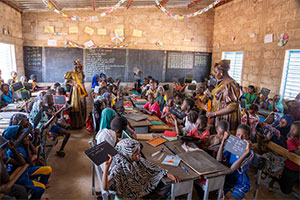 Two teachers work in a classroom in Forces Vives School in Dori, Burkina Faso. Credit: UNICEF/UNI978361
Safe and uninterrupted education is a fundamental right for all children. Education is paramount to global development, as it has been proven that investing in education – especially for girls and children – contributes significantly to economic growth and prosperity. Although more than 1 billion children go to school, many are subjected to conditions that are not conducive to a proper learning environment, including makeshift facilities, a lack of supplies, violence in classrooms, inadequate sanitation, untrained instructors, and widespread school closures. Since 2015, there have been immense gains in education with an increase of 109 million children in school. However, as of 2023, 272 million children are still out of school.
High poverty levels in developing countries also impede children’s access to a proper education. For example, from the early to mid 2000s, Sub-Saharan African nations witnessed a dramatic decline in trained teachers due to inadequate funding in the education sector. Furthermore, major cuts to United States international aid threaten an estimated 23 million additional children's access to education, as USAID‑funded school programmes across Africa and Asia face closure.
Various other factors contribute to the decline of education, notably hunger, which has increased as conflict and climate change interfere with global food production and dissemination. Meanwhile, certain social and cultural practices also impede children’s access to education, with gender inequality, discrimination, child labour, and child marriages preventing millions of children from attending school. Economic conditions such as the inaccessibility of higher education also affect disenfranchised communities across the world. In extreme situations, such as warfare where educational facilities are destroyed in their totality, notably in Gaza and Sudan, entire generations of children might grow up without access to education. Rebuilding educational infrastructure is a long and arduous process, especially when violence persists across generations, and this significantly stunts the development of societal prosperity and stability.
IPS is dedicated to telling the shocking truths about worldwide education through impassioned opinion pieces and comprehensive articles, highlighting global issues that impede worldwide education and the courses of action being taken by organizations such as UNICEF and Education Cannot Wait.

The Week with IPS

NEXT STOP - SDGs
Tracking global progress towards a sustainable world
Tracking global progress towards a sustainable world
