Languages
Sunday, November 8, 2026



News and Views from the Global South
Education

NIGERIA: Investment in Primary Education Must Include Teachers
Nigeria has over the past 10 years recorded high enrolment and completion rates in primary school education.
BRAZIL: Artistic Energy as Antidote to Exclusion
Putting the power of art to the test in extreme situations has become an unintended but necessary task for the Axé Project, a Brazilian non-governmental organisation (NGO) aimed at creating the conditions for street kids and other at-risk children to overcome educational, family and community exclusion.
BRAZIL: From Learning Circle to Flights of Artistic Imagination
Slender, small and long-haired, 11-year-old Higor Fonseca sounds much older when he talks. He has a great deal to tell, in spite of living in this small, sleepy town in the interior of Brazil, where most workers are employed as seasonal migrant labourers in other parts of the country.
BRAZIL: Changing Lives Through the Power of Dance
"My family’s lives changed," said Maria Erilma da Silva, a mother of three girls and a teenage boy, listing a whole series of transformations, from changes in eating and personal hygiene habits to "the security of knowing where my daughters are" and even an end to her husband’s frequent drinking binges.EDUCATION-ZAMBIA: Bicycles Help Girls Go Further
Nine kilometres each way, rain or shine: That's how far Suzanne Chisulo has to travel to school each day.
MUSIC-BRAZIL: A School Without Teachers
The participation of renowned professional musicians as instructors and special guests at workshops, instead of academic professors, is what sets Brazil’s Bituca University of Popular Music apart, and is earning it a reputation as a model of experimentation and excellence in music education.
BRAZIL: Music Education Opens Doors to Social Inclusion
"It takes us an hour and 20 minutes to get there. We have to walk, because we can't afford the 30-minute bus ride. But the girls never miss their music classes, not even when they have to go without lunch because they don't have time to eat after school," says their mother, Maria da Cruz.ZIMBABWE: Women’s Rights Activists Lobby to ‘Engender’ Constitution
Zimbabwe’s latest constitutional reform process has generated strong interest among activists in strengthening protection for women's rights. The early signs are that the drafting of a new constitution will not prioritise correcting legal, social and economic discrimination against women.NICARAGUA: Literacy Goal Met – Further Education Planned
After an intense two-year literacy campaign, Nicaragua has managed to reduce the number of people who cannot read and write to below four percent of the adult population, from nearly 21 percent.
RIGHTS-SRI LANKA: Young Girl’s Suicide Ignites Public Debate
By all accounts, 14-year-old student Anuthara Jayawardene was an unobtrusive child. But her death, by hanging herself inside a toilet in her school premises on July 22, has brought her right into the middle of media attention. Her name and the circumstances surrounding her death are now at the centre of a public dust storm.EDUCATION-SIERRA LEONE: Schools in Crisis as Thousands of Teachers go Unpaid
Government’s refusal to pay the salaries of thousands teachers, while looking to recruit thousands more, has plunged the schooling system into crisis.
Q&A: ‘Young People Should Not Be Sitting in Classrooms’
Having shaken up the conventions of banking by arguing that credit is a fundamental right to help the poor in his native Bangladesh get loans for small business ventures, Muhammad Yunus has set his sights on another shake-up: university education.
ANGOLA: Teenage School Programme Gives Drop Outs Second Chance at Education
Free primary education for all is an Angolan government policy, but unfortunately this has not translated into a reality that sees all children receiving education.
MIDEAST: Children Have a Way With Miracles
Call it that choice between looking at the half-full or half-empty part of the results. And it is almost half; 55 percent of schoolchildren passed their exams in Gaza this year.
DEVELOPMENT-AFRICA: Women in Pursuit of Knowledge
While Africa is still far from having adequate capacity for scientific innovation, women are more and more present in the field of research for the continent's sustainable development.CUBA: Compulsory Rural Boarding School on the Way Out
Without fanfare or major explanations, the Cuban government has begun to dismantle the system of mandatory rural boarding school for students in the last three years of high school – one of various reforms aimed at improving the quality of education that will start to be implemented at the start of the next school year in September.CUBA: Fullest Possible Social Inclusion for the Disabled
Arnoldo Ramón Virgilio’s legs are of little use to him, but he has a way with words that more than makes up for any physical limitations. He’s one of the outpatients at the "América Labadí Arce" Medical and Education Centre, which provides health care and rehabilitation for the disabled in this city in eastern Cuba.EDUCATION: Liberty, e-Quality, Humanity
This city of 100,000 people in the southernmost Brazilian state of Rio Grande do Sul is named after the leader of the 1835-1845 Revoluçao Farroupilha (Ragged Revolution), which under the slogan "Liberty, Equality, Humanity" resulted in the independence of the state from the Brazilian empire. At an international conference here today, peaceful revolutionaries are furthering similar ideals.
URUGUAY: Schoolgirls Access Computers but Can’t Shake Gender Stereotypes
The girls who attend the school of Villa García, a township on the outskirts of the Uruguayan capital, are still playing dolls and dress up - only now they do it on their laptop computers.
U.S.: Das Camp-ital – Kids Overthrow Bosses on ‘Capitalism Day’
Workers at a munitions factory in Almosnino walked out last Wednesday, joining an anti-war protest nearby. The combined strikers and protesters later stormed the factory after a scuffle with police who were trying to arrest a crowd that was blocking a truck from leaving the factory.
BRAZIL: Agricultural School Cultivates Pride in Family Farming
"Here you get an education for the country and not for the city, which is not where I live, and that’s why I can relate to this school," says Israel Santos, 16, currently enrolled in the second year of secondary school studies at an agricultural school in the municipality of Independencia, in northeastern Brazil.« Previous Page — Next Page »





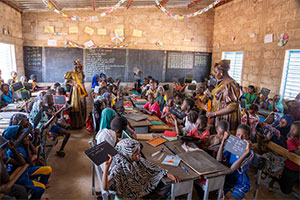 Two teachers work in a classroom in Forces Vives School in Dori, Burkina Faso. Credit: UNICEF/UNI978361
Safe and uninterrupted education is a fundamental right for all children. Education is paramount to global development, as it has been proven that investing in education – especially for girls and children – contributes significantly to economic growth and prosperity. Although more than 1 billion children go to school, many are subjected to conditions that are not conducive to a proper learning environment, including makeshift facilities, a lack of supplies, violence in classrooms, inadequate sanitation, untrained instructors, and widespread school closures. Since 2015, there have been immense gains in education with an increase of 109 million children in school. However, as of 2023, 272 million children are still out of school.
High poverty levels in developing countries also impede children’s access to a proper education. For example, from the early to mid 2000s, Sub-Saharan African nations witnessed a dramatic decline in trained teachers due to inadequate funding in the education sector. Furthermore, major cuts to United States international aid threaten an estimated 23 million additional children's access to education, as USAID‑funded school programmes across Africa and Asia face closure.
Various other factors contribute to the decline of education, notably hunger, which has increased as conflict and climate change interfere with global food production and dissemination. Meanwhile, certain social and cultural practices also impede children’s access to education, with gender inequality, discrimination, child labour, and child marriages preventing millions of children from attending school. Economic conditions such as the inaccessibility of higher education also affect disenfranchised communities across the world. In extreme situations, such as warfare where educational facilities are destroyed in their totality, notably in Gaza and Sudan, entire generations of children might grow up without access to education. Rebuilding educational infrastructure is a long and arduous process, especially when violence persists across generations, and this significantly stunts the development of societal prosperity and stability.
IPS is dedicated to telling the shocking truths about worldwide education through impassioned opinion pieces and comprehensive articles, highlighting global issues that impede worldwide education and the courses of action being taken by organizations such as UNICEF and Education Cannot Wait.

The Week with IPS

NEXT STOP - SDGs
Tracking global progress towards a sustainable world
Tracking global progress towards a sustainable world
