Languages
Sunday, November 8, 2026



News and Views from the Global South
Education
IRAQ: Professionals Made a Particular Target
The call from his mother changed Dr. Harb Zakko's life. "Someone has been calling me to open the door, saying he has something for you," his mother said.COLOMBIA: Music Can Tame the Wildest – Even in Medellin
Ten years ago, even falling in love was dangerous in this city, the industrial capital of Colombia. A romance could mean death if one of the members of the couple belonged to a rival gang or neighbourhood.EDUCATION-BRAZIL: ‘Inclusive’ Schools – Bar Some
A popular soap opera that portrays a mother in search of a school that will accept her daughter as just another student has sparked a public debate in Brazil on whether or not children with Down's syndrome should be enrolled in standard schools.COTE D’IVOIRE: A New Approach to HIV/AIDS in the Blackboard Jungle
Education officials in Côte d'Ivoire are revising how children are taught about the dangers of HIV/AIDS in the West African country, this as statistics from June 2006 show prevalence in schools to be at four percent.GERMANY: Higher Education Sinks Low
German universities, pre-eminent in the natural sciences, social sciences and humanities in the early part of the 20th century, no longer rank among the world's most elite. The nation's seats of higher learning find themselves buffeted by cost pressures and declining standards - but amid recent hopes of some revival.EDUCATION-CAMEROON: Poverty and Culture Conspire to Deny Girls Schooling
Of the 71 pupils in Daouda Soulé's class, only 18 are girls. "Last year there were about 20 girls, but even some...who were promoted to the next grade dropped out and are at home, although primary school is free," the teacher at the Central Public School in Garoua, northern Cameroon, told IPS.IRAQ: Education Under Siege
The recent kidnapping of scores of academics in Baghdad highlights the desperate situation of the educational system in occupied Iraq.HEALTH: Chip’n Cola Diets Causing Diabetes in Asian Kids?
Ahead of World Diabetes Day, marked on Nov. 14, a leading British medical journal has issued a grim warning to Asian countries. Type-2 diabetes among the region's children has reached ‘'epidemic levels,'' says a paper published in ‘The Lancet.'HAITI/DOMINICAN REPUBLIC: Early Sex Initiation and AIDS
Early sexual initiation and a lack of prevention policies are sowing the seeds of AIDS proliferation, warns a UNICEF study carried out at locations straddling the border between the Dominican Republic and Haiti.EDUCATION-JAPAN: Patriotism as Remedy for Bullying, School Ills?
A spate of new cases of student bullying and other school scandals have boosted Prime Minister Shinzo Abe's plans to revise Japan's controversial Fundamental Education Reform Bill, which aims to inculcate patriotism in children.DEVELOPMENT: U.S. Teens Take a Virtual Journey to Haiti
Brooklyn's South Shore High School is no walk in the park. Low test scores combined with periodic stabbings, beatings and theft have made it one of New York's most troubled schools. All but two percent of the more than 2,000 students are minority. Many are low-income and almost half never graduate.RIGHTS-NIGERIA: “People Always See Us As Health Hazards”
"When I go home, I often notice that as soon as I come, all the towels, soaps and sponges that were in the bathroom will disappear," says Isaiah Ojeabulu. He chairs the Human Rights Association of Persons Affected by Leprosy, an organisation in Nigeria, and has himself suffered from leprosy.POLITICS-INDIA: Gov’t Report Shakes Claims to Pluralism
India, which has long prided itself as a shining example of democracy and religious-cultural pluralism, is being forced to contend with an unpleasant truth: the foundations of its claim to religious integration and harmony may be far shakier than earlier believed.CAMBODIA: Visit Angkor Wat, Educate a Child
For thousands of daily visitors to the sprawling 12th century Buddhist monument of Angkor Wat, it is a hassle avoiding touts attempting to selling souvenirs and postcards. But most are happy to see the saffron-clad monks and pose with them for photographs.MEXICO: How Many Deaths Is the Oaxaca Governor Worth?
The governor of the southern Mexican state of Oaxaca is clinging to his post, bringing the months-long local conflict to boiling point. More than 15 people are dead, 5,000 police are unsuccessfully trying to quell the social protest, and political rancour simmers nationwide.BOTSWANA: Unemployment Surges as Government Plans Fail to Take Off
Botswana is still widely cited as Africa's economic success story, but fears are emerging of a reversal because of soaring unemployment and the sluggish implementation of government plans.ZIMBABWE: Government Accused of Persistent Human Rights Abuses
"I was arrested a dozen times," notes Tapera Kapuya, a student leader at the University of Zimbabwe between 2001 and 2002, who says he was the target of both police and the Southern African country's intelligence agents.MEXICO: Tense and Only Relative Calm after Police Crackdown
The Mexican government justified on Monday the violent storming by federal police of social protests in the capital of the southern state of Oaxaca, saying it had restored peace and order. But the evidence tells a different story.DEVELOPMENT-AFRICA: Think Global, Eat Local
It's certainly a logical suggestion: in an effort to make cocoa-producing countries in Africa less dependent on consumers abroad, why not increase domestic consumption of cocoa products?LATIN AMERICA: Leading the Developing World in Preschool Education
Latin America is the developing region that has made the most progress in early childhood education, although improvement has been uneven, says the new global monitoring report on Education for All (EFA) 2007.COTE D’IVOIRE: Reconciliation Through Education
Four years after a military and political crisis divided the education system of Cote d'Ivoire, the country has finally found a way to make all schools begin their academic year at the same time again.« Previous Page — Next Page »





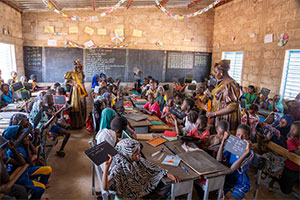 Two teachers work in a classroom in Forces Vives School in Dori, Burkina Faso. Credit: UNICEF/UNI978361
Safe and uninterrupted education is a fundamental right for all children. Education is paramount to global development, as it has been proven that investing in education – especially for girls and children – contributes significantly to economic growth and prosperity. Although more than 1 billion children go to school, many are subjected to conditions that are not conducive to a proper learning environment, including makeshift facilities, a lack of supplies, violence in classrooms, inadequate sanitation, untrained instructors, and widespread school closures. Since 2015, there have been immense gains in education with an increase of 109 million children in school. However, as of 2023, 272 million children are still out of school.
High poverty levels in developing countries also impede children’s access to a proper education. For example, from the early to mid 2000s, Sub-Saharan African nations witnessed a dramatic decline in trained teachers due to inadequate funding in the education sector. Furthermore, major cuts to United States international aid threaten an estimated 23 million additional children's access to education, as USAID‑funded school programmes across Africa and Asia face closure.
Various other factors contribute to the decline of education, notably hunger, which has increased as conflict and climate change interfere with global food production and dissemination. Meanwhile, certain social and cultural practices also impede children’s access to education, with gender inequality, discrimination, child labour, and child marriages preventing millions of children from attending school. Economic conditions such as the inaccessibility of higher education also affect disenfranchised communities across the world. In extreme situations, such as warfare where educational facilities are destroyed in their totality, notably in Gaza and Sudan, entire generations of children might grow up without access to education. Rebuilding educational infrastructure is a long and arduous process, especially when violence persists across generations, and this significantly stunts the development of societal prosperity and stability.
IPS is dedicated to telling the shocking truths about worldwide education through impassioned opinion pieces and comprehensive articles, highlighting global issues that impede worldwide education and the courses of action being taken by organizations such as UNICEF and Education Cannot Wait.

The Week with IPS

NEXT STOP - SDGs
Tracking global progress towards a sustainable world
Tracking global progress towards a sustainable world
