Languages
Monday, October 19, 2026



News and Views from the Global South
Education

Female Genital Mutilation and Cutting in Asia Remain a Neglected Problem
Significant advances have been made in Africa towards ending female genital mutilation/cutting (FGM/C). Unfortunately, the same cannot be said for Asia, where FGM/C occurs in at least ten countries, but governments across the region are failing to take effective action. Women’s rights organizations are calling for states to introduce much-needed laws to criminalize FGM, provide national data on the extent and nature of the practice, and adequately fund efforts to tackle this regionally neglected problem.
In-Depth Interview with Yasmine Sherif, Executive Director, Education Cannot Wait: Getting to Know Her
Counsel Hope Yasmine Sherif is the Executive Director of Education Cannot Wait (ECW). A lawyer specialized in International Humanitarian Law and Human Rights Law (LL.M), she has over 30 years of experience with the United Nations and international NGOs.
Higher Education in Central America: Poor Quality and Unaffordable for the Poor
Decades of civil wars and a lack of long-term public education policies, among other problems, have made higher education in Central America precarious and costly in general. In this region, made up of Belize, Costa Rica, El Salvador, Guatemala, Honduras, Nicaragua, and Panama, home to some 50 million inhabitants, the quality of education offered by public and private universities is poor, while costs are high even for those who can afford them.
Learning for a Lasting Peace
Education is the bedrock of peace, the foundation of strong societies, and the building block for a better world. This year, as we celebrate the Sixth International Day of Education under the theme of ‘learning for a lasting peace’, we call on world leaders to end wars and armed conflicts and focus on our common humanity to embrace the vast potential learning offers in uniting our world.
Hindu Woman Doctor Confident of Election In Pakistan Polls
A woman medical graduate from the Hindu community is making waves, as she is the first minority woman to contest the Pakistan Parliamentary election for a general seat, and she does so in the face of deep-rooted religious traditions and wealthy political opponents. Dr Saveera Parkash, a nominee of the Pakistan People’s Party (PPP) for the February 8 polls, is sure of her victory despite her religion.
Assessing Public Debt Sustainability with a Long-Term View
When students from poor families in developing countries are offered places at prestigious universities, they are often faced with a tough choice. One option is to accept the offer and create more debt, likely through borrowing from a loan shark, to pay for tuition fees. Another option is to forgo this opportunity, which could be the first in family generations, and start working as low-wage workers.
Cooperative Farming Makes Bangladesh’s Coastal Women Farmers Climate-Resilient
In the past, Salma Begum, 40, lost her crops every year due to natural disasters. She lives with her five-member family in Ashabaria village under Rangabali upazila, a remote coastal island in Patuakhali district. “We did not have enough livelihood options in the coastal area where we live. Cyclones, coastal floods, and tidal surges have been having adverse impacts on agriculture, making it difficult for my wage-laborer husband to find work regularly,” she said.
Amidst a Horrendous 2023, Civil Society is Fighting Back Society
The year 2023 has brought so much tragedy, with incomprehensible loss of lives, whether from wars or devastating ‘natural’ disasters, while our planet has seen yet more records broken as our climate catastrophe worsens. And so as the clock ticks towards the (mostly western) New Year, readers are traditionally subjected by media outlets like ours to the 'yearender'—usually a roundup of main events over the previous 12 months, one horror often overshadowed by the next.
Myanmar Refugees Build Schools, Cafes and Hope in Mae Sot
The typical image of a refugee is a poor person with their hands out asking for aid. The Burmese refugees in Mae Sot on the Thai-Myanmar border defy that stereotype. Many are middle-class, educated urbanites with skills and plenty of initiative. After standing up to the Burmese military and suffering for it, they left everything and fled for their lives to Mae Sot where they continued their struggle. Despite intimidation, exploitation by some Thai authorities, and living in fear without documentation, they have achieved a lot in under two years. Their purpose is to support their community and the revolution in a variety of ways through their resilience, commitment, ability and innovation. Some refugees have set up businesses such as cafes, restaurants, bars, shops, hairdressers, a farm and cross-border trade. While they are for-profit, they also provide employment for other refugees and donate to the most vulnerable. One café owner said, “If I am lucky, I break even but the café gives refugees employment, keeps them occupied and is a place where Burmese can meet and relax.” [caption id="attachment_183577" align="alignleft" width="630"]Paul Greening is an ex-UN senior staff officer with over 20 years of experience in six Asian countries working for six UN agencies and four INGOs. He worked in Sittwe, Rakhine State for the International Organization for Migration (IOM) from 2017 to 2020 and has been living in Mae Sot for two years. First published by Myanmar news outlet Irrawady
The Solutions to Child Poverty Must Reach the Most Vulnerable Communities
Child poverty persists even in some of the world’s richest countries, new findings from a UNICEF report reveal.
Freedom, Equality and Justice Lead to Peace
Today we mark a milestone in history: the 75th anniversary of the Universal Declaration of Human Rights. As people around the world commemorate Human Rights Day, we must also deeply reflect on the meaning of this historic document and what it takes to achieve peace in the world.
Greening Education: Education Paying Highest Cost for Ongoing Climate Crisis
It is a global catastrophe of astounding proportions that millions of children are on the run today, forcibly displaced from their homes. As conflict and climate change increasingly become the most pressing challenges facing the world now, the number of displaced children has doubled in the last decade alone, reaching a record high of 43.3 million children.
For Africans, the Climate Debate Around the Role of Livestock Misses the Mark
Africa is contending with a climate crisis it did not create without sufficient recognition for the unique rights and needs of the world’s youngest and fastest-growing population. Not only is the continent least responsible for reducing greenhouse gas emissions, having historically produced just a tiny fraction, but it is also disproportionately impacted by the consequences of emissions generated elsewhere.
Art and Climate Change
A dark cloud is hovering above human existence. It is a fairly illusory cloud haunting our minds and wellbeing, but also an actual, menacing, mostly invisible cloud that covers the Earth’s entire atmosphere. Saturated by greenhouse gases, this global threat increases with every year, threatening all life on Earth, causing increased flooding, extreme heat, draught, wild fires, rising sea levels, food and water scarcity, as well as diseases and mounting economic loss. This misery, caused by human greed, thoughtlessness, and self-aggrandizement, trigger human migration and armed conflicts.
Big Cons: How Consultancy Firms Undermine Governments
Greater government reliance on consulting companies has greatly enriched them while also undermining state capacities, capabilities, national economies, progress, governance and legitimacy.
The Climate Crisis is an Education Crisis
“The one international language the world understands” wrote Eglantyne Jebb, founder of Save the Children, “is the cry of a child,” and the evidence is accumulating that children are not only the innocent victims of conflict whose pleas need to be heard, but also the most vulnerable victims of climate change.
Netherlands Latest Country to Tilt to the Right
The Netherlands is the latest country to lurch to the right amid the global cost of living crisis. Its November election saw maverick far-right populist Geert Wilders and his Party for Freedom (PVV) come first. A hardline Islamophobe who’s called for the Quran to be banned could be the next prime minister.
ECW’s Emergency Appeal for Crises Impacted Children Facing Double Tragedies
Across the globe, the number of crisis-affected school-aged children facing climate shocks amplified by climate change keeps rising. The Somalia region of Ethiopia is facing the worst drought in 40 years. Last year in Pakistan, unprecedented flooding damaged more than 26,000 schools. Tropical Cyclone Tej recently made landfall in Yemen, affecting thousands of people.
Right Here, Right Now: ECW’s USD 150 Million Climate Appeal to Save Children at Risk
A catastrophic surge in the frequency, intensity, and severity of extreme weather events has placed children on the frontlines of climate emergencies. Nearly half of the world’s children, or one billion, live in countries at extremely high risk from the effects of the climate crisis. Most of these children face multiple vulnerabilities.
A Crisis of Humanity
The UN Secretary-General has defined the crisis in Gaza not just as a humanitarian crisis, but rather as a crisis of humanity. According to UN Secretary-General António Guterres: “Gaza is becoming a graveyard for children. Hundreds of girls and boys are reportedly being killed or injured every day.” This continued trend of violence and disregard for international humanitarian law and human life has enveloped our world.
ECW Interviews France’s Minister of State for Development and International Partnerships Chrysoula Zacharopoulou
Chrysoula Zacharopoulou is a medical doctor. Born in Sparta (Greece) in 1976, she holds both French and Greek nationalities and is a graduate of Sapienza University in Rome, as well as holding a PhD on endometriosis. She arrived in France in 2007, practicing as a gynaecological surgeon at Bégin Military Hospital.
« Previous Page — Next Page »





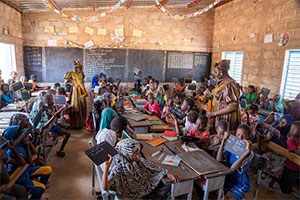 Two teachers work in a classroom in Forces Vives School in Dori, Burkina Faso. Credit: UNICEF/UNI978361
Safe and uninterrupted education is a fundamental right for all children. Education is paramount to global development, as it has been proven that investing in education – especially for girls and children – contributes significantly to economic growth and prosperity. Although more than 1 billion children go to school, many are subjected to conditions that are not conducive to a proper learning environment, including makeshift facilities, a lack of supplies, violence in classrooms, inadequate sanitation, untrained instructors, and widespread school closures. Since 2015, there have been immense gains in education with an increase of 109 million children in school. However, as of 2023, 272 million children are still out of school.
High poverty levels in developing countries also impede children’s access to a proper education. For example, from the early to mid 2000s, Sub-Saharan African nations witnessed a dramatic decline in trained teachers due to inadequate funding in the education sector. Furthermore, major cuts to United States international aid threaten an estimated 23 million additional children's access to education, as USAID‑funded school programmes across Africa and Asia face closure.
Various other factors contribute to the decline of education, notably hunger, which has increased as conflict and climate change interfere with global food production and dissemination. Meanwhile, certain social and cultural practices also impede children’s access to education, with gender inequality, discrimination, child labour, and child marriages preventing millions of children from attending school. Economic conditions such as the inaccessibility of higher education also affect disenfranchised communities across the world. In extreme situations, such as warfare where educational facilities are destroyed in their totality, notably in Gaza and Sudan, entire generations of children might grow up without access to education. Rebuilding educational infrastructure is a long and arduous process, especially when violence persists across generations, and this significantly stunts the development of societal prosperity and stability.
IPS is dedicated to telling the shocking truths about worldwide education through impassioned opinion pieces and comprehensive articles, highlighting global issues that impede worldwide education and the courses of action being taken by organizations such as UNICEF and Education Cannot Wait.

The Week with IPS

NEXT STOP - SDGs
Tracking global progress towards a sustainable world
Tracking global progress towards a sustainable world
