Languages
Sunday, October 18, 2026



News and Views from the Global South
Education

For Every Child, Every Right—Delivering Psychosocial Support for Crisis Impacted Children
As the global community marks World Children's Day, every child should be guaranteed their rights, including those in the Gaza Strip, where heavy bombardment and military operations by Israel have killed more than 11,000 people, 40 percent of them children.
PPPs Fiscal Hoax Is a Blank Financial Silver Bullet
Public-private partnerships (PPPs) for infrastructure and service provision are both costly and risky. Worse, PPPs typically fail to ensure universal, let alone fair access to public amenities.
Commonwealth Civil Society Offers Ministers Crucial Recommendations for Gender Equality Advancement
On August 22, 2023, Women's Affairs Ministers from the Commonwealth huddled in a room at the Atlantis Resort in the Bahamas. For the first time since the COVID-19 pandemic, they were meeting in person.
Can Creativity Change the World?
It all fits into an off-road vehicle that can reach even the most remote parts of Southern Africa to bring cinema where the essentials are lacking, where there's no electricity to power a projector, and where perhaps no one has ever sat in front of a screen to watch a movie. With just the sun and a solar panel, a theater can be set up in areas where people struggle to access food and water and make a decent living. But what it truly requires is the courage to not view creativity as a luxury. Sydelle and Rowand, the founders of Sunshine Cinema, a network of mobile movie theaters, are not just entertaining people; they are crossing a bridge.
COVID-19 Vaccine Hesitancy: Sharing ‘Real-Time’ Data, Consistent, Simple Messaging Helps
After months of warding off appeals from his employers to get vaccinated for the COVID-19 disease, Mohammad Yusuf, 24, working as a live-in domestic worker in Karachi’s Clifton area, finally relented and got his first shot.
The Power of Humanity
Today, as we commemorate United Nations Day, more than 224 million children and adolescents are in need of quality education, and the hope, protection and opportunity it provides. Their numbers are increasing by the day. From Afghanistan and Sudan to Ukraine; from South Sudan, Latin America and across sub-Saharan Africa; and in Gaza, where 50% of the total population of 2.2 million are children under siege.
Working to Relieve the Trauma of Syrian Earthquake Orphans
Seven-year-old Salim al-Bakkar was orphaned in the earthquake that struck southern Turkey and northern Syria on February 6, 2023. Saved by members of the civil defense team who pulled him from the rubble, doctors had to amputate his left leg – which had been crushed in the 7.7 magnitude quake that killed more than 55,000 people and destroyed at least 230,000 buildings.
Turning Trash into Education: Lagos Children Benefit from Plastic Waste School
 Ijora Badia, a slum in Lagos, was swimming in plastic waste. Now children pay their school fees in plastic bottles, and these are used to build classrooms.
The Frogs Are Drying Up! Let’s Explore What We Can Do!
Have you ever seen a dried frog? We have, and it’s making us rethink our impact on the environment. Frogs are incredibly sensitive to dry conditions, and they are facing the threat of extinction due to global warming. Amphibians, like frogs, make up a significant portion of endangered species, with 41 percent vulnerable compared to only 25 percent for mammals like polar bears.
To End Child Marriage in Southern & East Africa, Governments Need to Strengthen Laws & Implementation
Almost one third (32%) of women aged 20 to 24 in Eastern and Southern Africa - around 50 million – were married before 18 years old. To address this pervasive problem, the Southern African Development Community (SADC) Parliamentary Forum has adopted the SADC Model Law on Eradicating Child Marriage and Protecting Children Already in Marriage, a legal framework providing a comprehensive, integrated approach to ending child marriage and protecting children already married.
Afghan Women Speak Out About Life and Resistance Two Years After the Taliban Takeover
The Taliban takeover of Afghanistan on 15 August 2021 has devastated millions of Afghans. But women and girls have been particularly affected by progressively restrictive decrees that have created a virtual system of gender apartheid.
Our Teachers, Our Heroes
We are in a race to deliver on our global promise of education for all by 2030 – especially for the 224 million girls and boys impacted by armed conflict, climate change, forced displacement and other protracted crises who so urgently need our support. At the frontlines of this movement are the inspiring, caring, brilliant teachers who work tirelessly to educate future generations.
Wanted: Teachers For Change!
Once a year, on October 5, we celebrate World Teachers’ Day. Why is it so important to have a closer look on the teaching profession? What is so special about being a teacher nowadays?
With Hope and Courage, They Inspire Us
“My dream is to become a teacher,” says 13-year-old Alia. A small glimmer of hope can be traced in her beautiful, almond-shaped, brown eyes. Together with her mother, siblings and aunt, Alia has fled the conflict in Sudan to Chad. With extraordinary courage to survive, she made the harrowing journey at night across checkpoints, threatened by guns and militia roaming around in the dark. While her eyes are still hollow from the flight, I see that sparkle for a split second: she still has hope.
The Taliban Can Reverse the Unacceptable Ban on Girls’ Education
Today, we mark the second anniversary of the ban on secondary school girls’ education in Afghanistan and join the world in calling for it to be lifted now.
The Case for Afghan Women and Girls: How an International Criminal Court Investigation Could Expand Human Rights
Two years have passed since the Taliban re-assumed power in Afghanistan, and women and girls have yet to return to work or school. Can the international justice system now come to their defense? Experts say a case for Afghan women and girls has the potential to change the way the legal community thinks about human rights abuses. Will it?
We Must Act to Bridge the Gap Between Words and Deeds
In today's increasingly interconnected world, marked by grave economic, environmental, and security crises that transcend global boundaries, it's abundantly clear that our interdependence is an undeniable reality.
Multilingual #AfghanGirlsVoices Campaign to Return Millions Back to School
A Taliban edict is rolling back time in Afghanistan after access to education for all Afghan girls over the age of 12 was indefinitely suspended on September 18, 2021. Afghanistan is the only country in the world where girls are forbidden from attending school beyond the primary level, leaving more than 1.1 million girls and young women without access to formal education.
The Vast Potential of the Human Spirit
With hope and courage, we must rise to the challenges before us. We must rise to the challenge of a world set afire by climate change, forced displacement, armed conflicts and human rights abuses. We must rise to the challenge of girls being denied their right to an education in Afghanistan. We must rise to the challenge of a global refugee crisis that is disrupting development gains the world over. We must rise to the challenge of brutal and unconscionable wars in places like Sudan and Ukraine that are putting millions of children at risk every day.
Human Trafficking: Women Lured by Promise of Jobs, Sold as Brides
It has been over a decade since 32-year-old Rafiqa (not her real name) was sold to a villager after being lured by the promise that she would be employed in the handicrafts industry of Indian-administered Kashmir.
ECW’s New Report Shows Successful Education Funding Model for Crises-Impacted Children
In a world set on fire by climate change and brutal conflict, millions of children in emergencies and protracted crises need educational support. Children in 48 out of 49 African countries are at high or extremely high risk of the impacts of climate change, particularly in the Central African Republic, Chad, Nigeria, Guinea, Somalia, and Guinea Bissau.« Previous Page — Next Page »





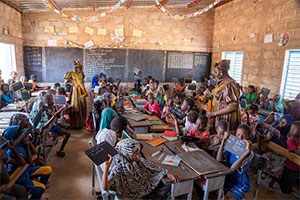 Two teachers work in a classroom in Forces Vives School in Dori, Burkina Faso. Credit: UNICEF/UNI978361
Safe and uninterrupted education is a fundamental right for all children. Education is paramount to global development, as it has been proven that investing in education – especially for girls and children – contributes significantly to economic growth and prosperity. Although more than 1 billion children go to school, many are subjected to conditions that are not conducive to a proper learning environment, including makeshift facilities, a lack of supplies, violence in classrooms, inadequate sanitation, untrained instructors, and widespread school closures. Since 2015, there have been immense gains in education with an increase of 109 million children in school. However, as of 2023, 272 million children are still out of school.
High poverty levels in developing countries also impede children’s access to a proper education. For example, from the early to mid 2000s, Sub-Saharan African nations witnessed a dramatic decline in trained teachers due to inadequate funding in the education sector. Furthermore, major cuts to United States international aid threaten an estimated 23 million additional children's access to education, as USAID‑funded school programmes across Africa and Asia face closure.
Various other factors contribute to the decline of education, notably hunger, which has increased as conflict and climate change interfere with global food production and dissemination. Meanwhile, certain social and cultural practices also impede children’s access to education, with gender inequality, discrimination, child labour, and child marriages preventing millions of children from attending school. Economic conditions such as the inaccessibility of higher education also affect disenfranchised communities across the world. In extreme situations, such as warfare where educational facilities are destroyed in their totality, notably in Gaza and Sudan, entire generations of children might grow up without access to education. Rebuilding educational infrastructure is a long and arduous process, especially when violence persists across generations, and this significantly stunts the development of societal prosperity and stability.
IPS is dedicated to telling the shocking truths about worldwide education through impassioned opinion pieces and comprehensive articles, highlighting global issues that impede worldwide education and the courses of action being taken by organizations such as UNICEF and Education Cannot Wait.

The Week with IPS

NEXT STOP - SDGs
Tracking global progress towards a sustainable world
Tracking global progress towards a sustainable world
