Languages
Monday, September 21, 2026



News and Views from the Global South
Education

Taliban: The Return of Misogynistic Gynophobes in Afghanistan
 Gynophobia is defined as an intense and irrational fear of women or hatred of women, it may be characterized as a form of specific phobias, which involves a fear that is centered on a specific trigger or situation, which in the case of gynophobia is women.

Bilingual Intercultural Education, an Endangered Indigenous Right in Peru
"I always express myself in Quechua and I don't feel I’m less of a person," said Elías Ccollatupa, 47, who has been a bilingual intercultural teacher for more than two decades in the Chinchaypujio district, one of the nine that make up the province of Anta, in the department of Cuzco, in the southern Andean region of Peru.
Education Cannot Wait Interviews UNICEF Executive Director Catherine M. Russell
Catherine M. Russell became UNICEF’s eighth Executive Director on 1 February 2022. Ms. Russell brings to the role decades of experience in developing innovative policy that empowers underserved communities around the world, including high-impact programmes that protect women and girls, including in humanitarian crises. She has extensive experience building, elevating and managing diverse workforces and mobilizing resources and political support for a broad range of initiatives.

Developing countries and the Perfect Storm
Part II: What Developing Countries Need to Do
Developing countries are facing a combination of crises that are unprecedented in recent times. Over the last three years they have had to face the COVID-19 crisis, the food crisis, the energy crisis, the climate change crisis, the debt crisis and, on top of all this, a global recession. The crises have overlapped, and each has added to the problems created by the previous ones.
Ukraine Points Up the Threat to Education During War
Conflict has taken a horrific toll on civilians in Ukraine over the past three months with many families struggling to meet even their most basic needs, including education. Over 1,800 schools and universities have been damaged or destroyed since Russia’s invasion on February 24, according to Ukraine’s Education Ministry. Russian forces have shelled and bombed numerous schools. Both sides have used schools as military bases or for storing weapons.
Developing Countries and the Perfect Storm
Part I: What Should Developed Countries Do?
Developing countries – in Africa, in Asia, in Latin America and in the Middle East - are facing a combination of crises that are unprecedented in recent times. Over the last three years they have had to face the COVID-19 crisis, the food crisis, the energy crisis, the climate change crisis, the debt crisis and, on top of all this, a global recession. The crises have overlapped, and each has added to the problems created by the previous ones.

All Africa Student Leader says Political Will, Collective Action, Education and Social Packages Can End Child Labour
Samuel Sasu Adonteng, programme officer for the All-Africa Students Union (AASU), believes that the recent 5th Global Conference on the Elimination of Child Labour has taken us closer to ending child labour for the first time because the voices of those affected were heard.
Private Sector Needed as Addressing Education in Emergencies is Everyone’s Business
Against a backdrop of ongoing social changes, education is becoming increasingly important for success in life. But with disasters, pandemics, armed conflicts, and political crises forcing children out of school, a future of success is often placed far out of reach.
Those Who Dare: Feminist Movements in Sudan, Lebanon & Syria
The year 2019 was not just a time before the world saw the global pandemic, but also a time when the world saw mass political uprisings with women at the forefront. The MENA region in a way led this force, in Sudan women played as drivers of the revolution, protesting decades of corruption, socioeconomic grievances and gendered violence. Nubian queen became the symbol of the revolution in Sudan which finally saw the overthrow of the dictatorship in 2019.
Reclaiming Our Future
The Asia-Pacific region is at a crossroads today – to further breakdown or breakthrough to a greener, better, safer future. Since the Economic and Social Commission for Asia and the Pacific (ESCAP) was established in 1947, the region has made extraordinary progress, emerging as a pacesetter of global economic growth that has lifted millions out of poverty.
Call to Invest ‘Serious Resources’ in Education, to Stem Tide of Child Labour
"Education is the most powerful weapon you can use to eliminate child labour." So said Dennis Sinyolo, Director of Education International's African Regional Office in Accra, Ghana adapting liberation icon and late South African president Nelson Mandela's famous quote about how education can change the world.
From Child Laborer to Activist, Tara Banjara Asks World to Pledge to End the Scourge
Tara Banjara was four and a half years old when her parents put her to work on the roads, cleaning the garbage and rubble out of potholes to prepare for construction in Nemdi village, Rajasthan, India. She worked in the wind, cold, and rain with her mother, day in and day out, year in and year out. She would return home shattered, too exhausted to eat before falling asleep each night.
Youths’ Strident Voices Demand an End to Child Labour
Children's voices took centre stage at the 5th Global Conference on the Elimination of Child Labour, which kicked off in Durban, South Africa, on May 15, 2022. Their voices resonated with the saying: "Nothing about us without us."
Alarm Bells for Africa, Child Labour in Agriculture Requires Urgent Action
The Global Estimate on Child Labour estimates 160 million children are in child labour worldwide – an increase of 8.4 million children in the last four years – with millions more at risk due to the impacts of COVID-19.
Call to Freedom for Millions of Children Trapped in Child Labour as Global Conference Comes to Africa
Children washing clothes in rivers, begging on the streets, hawking, walking for kilometres in search of water and firewood, their tiny hands competing with older, experienced hands to pick coffee or tea, or as child soldiers are familiar sights in Africa and Asia.
India: Hijab Row the Latest Show of Hindu Nationalism
- In an election season, India’s ruling party has again resorted to the right-wing populist playbook, stirring up divisions for political gain. This time it is the turn of Muslim women, caught in the crossfire of a backlash against both the rights of religious minorities and women’s rights. The controversy over the wearing of the hijab in schools is just the latest chapter in the saga starring Prime Minister Narendra Modi and his Hindu nationalist party in their quest to consolidate power. Their attempts will continue, as will civil society resistance and struggles for rights.

Those Who Dare: Voices of Women in the MENA Region
When it comes to gender equality and development, the Middle East, North Africa (MENA) and the Arab States region continues to be in a paradoxical situation. While within the region, several laws, policies and programming focused on gender equality are growing, women’s representation in government jobs, corporate roles, and national programming seem to be dismissed. Healthcare, education have seen improvement, most countries have become tech inclusive as well, but access to hospitals and educational institutions –at times due to social programming or gender-related policies continues to prevent women from accessing them and using them.
Education Cannot Wait Expands First Emergency Response in Northern Ethiopia with Additional US$2 Million Grant, Bringing ECW Ongoing Investments in Ethiopia to over $30 Million
Conflicts in Northern Ethiopia’s regions of Afar, Amhara and Tigray, have pushed children and adolescents out of school and are fueling humanitarian needs in the region. In response to this crisis, Education Cannot Wait (ECW) announced today a US$2 million First Emergency Response Grant that will reach more than 20,000 refugee and displaced, as well as host community children and adolescents. This brings ECW ongoing investments in Ethiopia to over $30 million.
Today is the Time for Transformation
“I first think about my children. They are why we were forced to leave - because our children are always our first concern.” These are the moving words of Victoria, who fled the brutal war in Ukraine with her two daughters. Her eyes welling up with tears, she recalled their dangerous journey from Ukraine. She and her two school-aged daughters were forced to leave behind everything they have ever known.
Education Cannot Wait Interviews Leonardo Garnier, Special Adviser of the UN Secretary-General for the Transforming Education Summit
ECW: Congratulations on your appointment by United Nations Secretary-General António Guterres as the Special Adviser for the Transforming Education Summit. What do you hope to achieve through the Summit and why is it so critical that the world comes together to address the global education crisis around this September’s UN General Assembly?

More Students on the Move in an Increasingly Complex World: Podcast
 This is our third episode on the ongoing movements of people around the world. You can listen to the previous ones, the first about climate migrants and the second on remittances, on any podcast app.
 « Previous Page — Next Page »


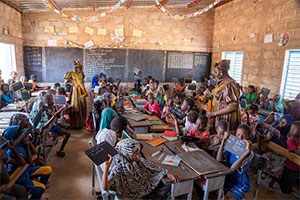 Two teachers work in a classroom in Forces Vives School in Dori, Burkina Faso. Credit: UNICEF/UNI978361
Safe and uninterrupted education is a fundamental right for all children. Education is paramount to global development, as it has been proven that investing in education – especially for girls and children – contributes significantly to economic growth and prosperity. Although more than 1 billion children go to school, many are subjected to conditions that are not conducive to a proper learning environment, including makeshift facilities, a lack of supplies, violence in classrooms, inadequate sanitation, untrained instructors, and widespread school closures. Since 2015, there have been immense gains in education with an increase of 109 million children in school. However, as of 2023, 272 million children are still out of school.
High poverty levels in developing countries also impede children’s access to a proper education. For example, from the early to mid 2000s, Sub-Saharan African nations witnessed a dramatic decline in trained teachers due to inadequate funding in the education sector. Furthermore, major cuts to United States international aid threaten an estimated 23 million additional children's access to education, as USAID‑funded school programmes across Africa and Asia face closure.
Various other factors contribute to the decline of education, notably hunger, which has increased as conflict and climate change interfere with global food production and dissemination. Meanwhile, certain social and cultural practices also impede children’s access to education, with gender inequality, discrimination, child labour, and child marriages preventing millions of children from attending school. Economic conditions such as the inaccessibility of higher education also affect disenfranchised communities across the world. In extreme situations, such as warfare where educational facilities are destroyed in their totality, notably in Gaza and Sudan, entire generations of children might grow up without access to education. Rebuilding educational infrastructure is a long and arduous process, especially when violence persists across generations, and this significantly stunts the development of societal prosperity and stability.
IPS is dedicated to telling the shocking truths about worldwide education through impassioned opinion pieces and comprehensive articles, highlighting global issues that impede worldwide education and the courses of action being taken by organizations such as UNICEF and Education Cannot Wait.

The Week with IPS

NEXT STOP - SDGs
Tracking global progress towards a sustainable world
Tracking global progress towards a sustainable world
