Languages
Sunday, November 8, 2026



News and Views from the Global South
Energy
BRAZIL: Ethanol Divides Agribusiness
The expansion of sugarcane farming to produce more ethanol in Brazil has run into unexpected resistance in Rio Verde, a prosperous town in the central state of Goiás, and it is coming from agribusiness leaders.ENERGY: World Bank in Bid to Light Off-Grid Africa
The World Bank hopes to bring modern lighting to one-fourth of Africa's people by developing markets for products not hostage to fossil fuels or the continent's lamentable electricity grid.SOUTHERN AFRICA: Plans to Dam the Cunene River Are Shelved Again
Political interests and specialist lobby groups appear once again to have stalled plans to dam the Cunene River where it forms the border between Angola and Namibia. After years of negotiations, several expensive feasibility studies and considerable political rhetoric, the proposed Epupa Dam on the Cunene River is not even close to the beginning of a construction phase.
ENERGY: Billions Up in Flames as Oil Firms Burn Gas
Energy producers waste about 40 billion dollars every year by burning off gas released at oil fields, says a new study commissioned by the World Bank.HEALTH-GHANA: Boreholes That Proved a Lifeline Have Come at a Cost
Ask people to list the causes of tooth discolouration and they may mention tobacco chewing, or one too many cups of coffee a day. Pose the question in Ghana's northern Nayorigo village, however, and someone might answer: desertification.ECONOMY-IRAN: Headless Oil Industry Faces Crisis
Iran’s key oil industry could plunge into crisis, oil experts have warned, if President Mahmoud Ahmadinejad does not urgently appoint a replacement for Seyed Kazem Vaziri Hamaneh who was sacked as oil minister two weeks ago in a major cabinet reshuffle.POLITICS-INDIA: Ruling Coalition Rift Over US Nuke Deal Continues
Confronted with stiff opposition to the United States-India nuclear cooperation deal from the supporting parties of the Left, Manmohan Singh’s minority government has initiated talks with communist leaders to create a 'mechanism' to resolve mutual differences.EUROPE: Russian Gas May Escape Politics
Many European politicians look desperately for alternatives to Russian gas, but while concerns over excessive dependency on one source are legitimate, many have missed the point that in the big energy game economic considerations weigh more heavily than political ideology.ECONOMY-BURMA: A People Running on Empty
For over a week, Burmese civilians in and around Rangoon have been forced to make a tough choice - stay at home and starve or go to work and labour on near-empty stomachs.POLITICS-AUSTRALIA: Uranium for India – Business or Strategy?
Leading Australian academics say that while the United States’ nuclear deal with India may be part of the Bush administration’s "contain China" policy, Australia’s own agreement to provide uranium to the South Asian giant is based more on economic gain.ECUADOR: Support Grows for Letting Sleeping Amazon Oil Lie
The innovative offer by the government of Ecuador to refrain from exploiting its largest oil reserve, in exchange for international compensation for nature conservation, is attracting increasing support.POLITICS-IRAN: Ahmadinejad Held to Election Promises
President Mahmoud Ahmadinejad who came to power two years ago, winning 62 percent of the popular vote, is rapidly losing popularity for failure to make good on election promises to improve the lives of ordinary people by sharing Iran's vast oil revenues with them and respect their private lives.TRADE: Greek Energy Agenda Promises Business to Egypt
Greece and Egypt are now making good on a two-year-old cooperation agreement to diversify trade relations that could reduce Greece's dependence on traditional - but tenuous - energy supplies from European suppliers like Russia.ENVIRONMENT-MEXICO: High Voltage Conflict Over Dam
Campesinos in the southern Mexican state of Guerrero have been blocking access to an area where the government wants to build a huge dam and hydroelecric station, since 2003.ENERGY: Biofuel Seen as Boost for Poor Farmers
The world's rural poor could benefit from a boom in fuel wrung from crops, despite worries that an accompanying surge in food prices could result in more hunger, say environmental and food experts.KOREAS: 'Bilateral Summit – Wrong Place, Wrong Time'
If you try to please your host too much you risk being snubbed. This could be the advice that South Korean President Roh Moo-Hyun gets from his mentor and predecessor in office, Kim Dae-Jung, as he prepares to fly to Pyongyang for a bilateral summit this month.ENVIRONMENT-COTE D’IVOIRE: Acacias Come to the Service of Mangroves
Mangroves, it could be said, have perfected the art of multi-tasking. Found along tropical coastlines, these trees and shrubs may prevent soil erosion, while their roots create breeding places for various marine species. So, when a particular mangrove forest is shown to have been reduced by two thirds in less than 20 years, there is major cause for concern.LATIN AMERICA: Vying for Leadership, Lula Heads North, Chavez South
Political and economic alliances with a view to strengthening Latin American integration are subtly shifting as Brazilian President Luiz Inácio Lula da Silva visits Mexico, Central America and the Caribbean this week and Venezuelan President Hugo Chávez tours Argentina, Uruguay, Ecuador and Bolivia.ENVIRONMENT-SPAIN: Offshore Wind Power for Earthly Benefits
A boost for renewable energy, a growing sense of corporate responsibility for the environment, and the decision to create a large offshore wind park are news items that have had little impact in Spain.HUNGARY: No Way Around Gas, for Now
With reliable alternatives remaining a relatively distant dream, Hungary, one of the most gas-dependent countries in Europe, will have to rely on Russian sources in the foreseeable future.BRAZIL-MEXICO: Lula’s ‘Ethanol Diplomacy’ Yields Harvest
Brazilian President Luiz Inácio Lula da Silva has incorporated Mexico into his regional strategy to promote ethanol production.« Previous Page — Next Page »





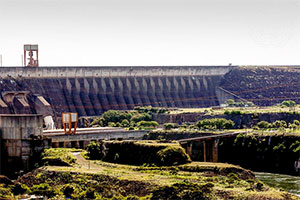 UN Power Plant, Paraguay. Credit: UN Photo/Evan Schneider
Energy has posed a great challenge for economies around the world. As global energy consumption skyrockets throughout the years, so does the need for sustainable solutions. The Sustainable Development Goals are essential in providing people with access to safe, affordable, and sustainable energy sources that minimize harm on the planet. Progress towards these goals opens the door for an advancement in modernization for communities on a global level and allows for a potential mitigation of tensions between nations.
The UN’s Summit of the Future in 2024 offered new initiatives that are being taken to achieve these goals, including a decreased reliance on fossil fuels, a switch to renewable energy sources, and improved climate financing.
IPS is well positioned to provide relevant, insightful, and compelling analysis of recent updates and measures being taken around the world to achieve a cleaner future.

The Week with IPS

NEXT STOP - SDGs
Tracking global progress towards a sustainable world
Tracking global progress towards a sustainable world
