Languages
Saturday, October 17, 2026



News and Views from the Global South
Food and Agriculture

Kashmir Frontier Woman Leads the Way in Breaking Down Patriarchy
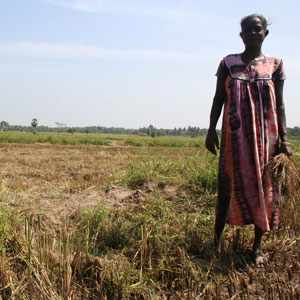
Smelling the toxic smoke coming from burned powder kegs and helplessly watching fields turn into smoke and ash is traumatic. Rushing to the government's safe houses and leaving your homes, belongings and cattle behind whenever the armies of India and Pakistan trade fire is inexplicable. Then came climate-change-induced weather unpredictability.
Women Warriors Winning Fight to Bring Back Indigenous Food Traditions
As the school lunch bell goes off, 40 eager little bodies—41 if you count the school dog—burst out onto the veranda. Awaiting them are a stack of steel platters, into which will be ladled a nutritious and delicious lunch, all of it indigenous cuisine.
The World Bank Must Double Its Fund for the Poorest Nations like Mine to Tackle Hunger Crisis
After El Niño-induced floods and devastating drought, roughly two in five people in Malawi – a country of some 20 million people – are now facing the looming prospect of acute hunger by the end of the year.
Unveiling the “Dark Matter” of Food, Diets and Biodiversity
This year, bee pollen has become a trendy superfood thanks to a wide range of potential benefits. Last year, sea moss led the superfood trends. Before that, it was turmeric.
Transforming African Food Systems from the Ground Up
All news is local, they say. The same is true of innovations—those many new technologies, policies, and practices that steadily stream from research to enhance our lives.
Land Grabs Squeeze Rural Poor Worldwide
Since 2008, farmland acquisitions have doubled prices worldwide, squeezing family farmers and other poor rural communities. Such land grabs are worsening inequality, poverty, and food insecurity.
A River’s Contrasts and Inequalities in the Arid Lands of Brazil
Osmir da Silva Rubez refuses to join the drip system, and is the only one among the 51 families living in the Mandacaru Public Irrigation Project in Juazeiro, a municipality in the state of Bahia, in the Northeast region of Brazil, to maintain the furrows that carry water to their crops.
Climate Change, Pollution Push Karnaphuli Fishers Out of the Profession
Jishuram Das, a sexagenarian who was born in Jelepara, located in Chattogram, has been catching fish from the Karnaphuli River since his childhood. But nowadays, he often sits idle without going to catch fish, as their catches have drastically fallen.
Explainer: What You Need to Know About Climate Change and Blue Carbon
The area where land meets the sea, known as coastal ecosystems, could be the key to reducing the effects of climate change. What is blue carbon? Blue carbon refers to the carbon dioxide (CO2) stored within marine or coastal ecosystems worldwide. These ecosystems include coastal plants such as mangroves, seagrasses, and salt marshes, which trap CO2 in their seabeds.
Blue Economy Must Benefit Fishing Communities in Global South, Says WorldFish Chief
The Global South is crucial for ensuring aquatic food security to feed the growing world population. It is imperative that blue economy initiatives benefit fishing communities in developing and small island nations, which are facing disproportionate impacts of climate change, says Dr Essam Yassin Mohammed, Director General of WorldFish, an international non-profit research organization based in Penang, Malaysia.
Quiet Revolution Underway as IFAD’s Innovative Solutions Rise to Global Rural Challenges
Technology and innovation are at the center of the International Fund for Agricultural Development’s strategy to fulfill its global mission to eradicate poverty and hunger in the developing world, IFAD’s President Alvaro Lario told IPS in an exclusive interview.
Bringing Drought and Floods, El Niño Hits the Most Fragile in Southern Africa
Kaponde Likando does not know how his family will survive until the next farming season. “We are not going to have anything (to harvest),” said the 60-year-old from Chingobe village in southern Zambia after his maize, sorghum, groundnut and sweet potato crops failed. “This has been the very opposite of what we expected.”
Maggot Farming Creates Entrepreneurs, Saves Farming Costs in Zimbabwe
Three years ago, 43-year-old Benard Munondo was an "ordinary" Zimbabwean teacher at a local primary school, but now he has turned maggots into gold. Thanks to maggot farming, Munondo, who has never owned a home nor driven a car, now has both. In 2020, a week’s training on maggot farming changed his world.
Dissenting Voices at Nairobi Soil Health Forum Over Increased Fertilizer Use
As the Africa Fertilizer and Soil Health Summit convened in Nairobi to review the progress made in terms of increasing fertilizer use in line with the 2006 Abuja Declaration, experts, practitioners, activists, and even government officials pointed out that accelerated fertilizer use may not be the magic bullet for increased food production in Africa.
Beyond the Fields: Unraveling Zambia’s Drought Crisis and the Urgent Call for Climate-Health Solutions
For most families in Zambia, April is traditionally a month of plenty—it is typically the beginning of a harvest season for various food and cash crops. Both fresh and dried maize, groundnuts, pumpkins, and a whole variety of both traditional and exotic food crops are usually in full supply and readily available for consumption, supporting household food security and nutrition.
Trade Liberalisation Kicked Away African Development Ladder
Africans have long been promised trade liberalisation would accelerate growth and structural transformation. Instead, it has cut its modest production capacities, industry and food security.
Rainy Chiloé, in Southern Chile, Faces Drinking Water Crisis
The drinking water supply in the southern island of Chiloé, one of Chile's rainiest areas, is threatened by damage to its peatlands, affected by sales of peat and by a series of electricity projects, especially wind farms.
Drought and Unequal Water Rights Threaten Family Farms in Chile
Lack of water threatens the very existence of family farming in Chile, forcing farmers to adopt new techniques or to leave their land. The shortage is caused by a 15-year drought and exacerbated by the unequal distribution arising from the Water Code decreed in 1981 by the 1973-1990 dictatorship of General Augusto Pinochet, which turned water into a tradable commodity and gave its owners rights in perpetuity.
Using Industrial Waste to Fight Pollution in Brazil
Biogas sounds like redemption, the conversion of the sinner. Its production involves extracting energy from filth, from the most disgusting environmental pollution, and at the same time avoiding the worsening of the global climate crisis.
Cuban Family Harnesses Biogas and Promotes its Benefits
Just to obtain a good fertilizer it was worth building a biodigester, says Cuban farmer Alexis García, who proudly shows the vegetables in his family's garden, as well as the wide variety of fruit trees that have benefited from biol, the end product of biogas technology.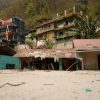
Climate Crisis in Mountains: Borderless Struggle for Frontline Communities
For the last three years, Sambhunath Guragain has been waking up every morning to a view he doesn't want to see: discarded agricultural land where he and his family used to grow food, including rice, but the flood in 2021 changed everything. “We don’t have any crops now, but we are farmers,” Guragain said in November 2021, while looking towards a quietly flowing Melamchi river. This was six months after the massive flash flood in Helambu-Melamchi in Sindhupalchowk district in Nepal. After three years, the situation hasn’t changed.« Previous Page — Next Page »





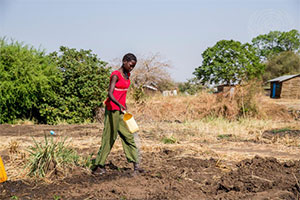 Farming on the Outskirts of Juba. Credit: UN Photo/JC McIlwaine
Promoting human and planetary health is a central focus of the United Nations, as laid out in the 2030 Sustainable Development Goals (SDGs). World hunger and unsustainable farming practices continue to be pressing concerns for the world. According to the 2025 State of Food Security and Nutrition in the World report by the Food and Agriculture Organization (FAO), 673 million people faced hunger in 2024. There are stark regional disparities, with the FAO projecting that 60% of the world population facing hunger will reside in Africa by 2030. Globally, the prevalence of food insecurity has remained consistently higher for women than men.
Sustainable and efficient national food systems are essential in preserving health, education, environmental well-being, peace, economy, and security. However, creating sustainable food systems can be a challenging endeavor, as food production takes a heavy toll on the environment. The agricultural sector accounts for a significant portion of greenhouse gases. Finding safe, sustainable, and ethical strategies to feed the world is crucial in ensuring planetary longevity. A recent initiative from 2023, the EU Regulation on Deforestation-free Products (EUDR), seeks to advocate for sustainable food systems. The main driver of deforestation is the expansion of agricultural land used to produce commodities like cattle, wood, cocoa, coffee, etc. The EUDR is part of the 2020 European Green New Deal and the EU Biodiversity Strategy for 2030 and aims to limit Europe’s consumption of products linked with deforestation by requiring that companies prove that their products are deforestation-free. Despite aiming to achieve major strides in sustainability, policies such as EUDR also raise socioeconomic concerns for targeted countries. Many emerging Latin American economies are impacted by the policy, and have raised the question of how developing countries can grapple with the tensions between economic development and advancing sustainability.
IPS has been at the forefront of providing compelling and insightful stories on communities facing hunger as well as the cost of food production. IPS uses statistics from FAO, the World Food Programme (WFP) and the International Fund for Agricultural Development (IFAD) to bring relevant and hard-hitting facts to readers. This gathering of information and data from such organizations helps bring the best stories from IPS journalists working in the different regions in consultation with experts on the ground.

The Week with IPS

NEXT STOP - SDGs
Tracking global progress towards a sustainable world
Tracking global progress towards a sustainable world