Languages
Saturday, November 21, 2026



News and Views from the Global South
Food and Agriculture
TRADE: French Report Condemns EPAs as Anti-Development
The approach taken by the European Union (EU) in trade talks with Africa has been strongly criticised in an official report commissioned by France, the new holder of the EU’s rotating presidency.AGRICULTURE: ‘Don’t Do It Europe’s Way’
Europe's system of agricultural support should not be emulated in other regions of the world grappling with high food prices, the top United Nations official for humanitarian affairs has suggested.G8: Global Food Security Plan Expected
A landmark agreement on ensuring global food security is likely to emerge from the G8 summit in Toyako.ENERGY: Don't Write Off Biofuels Yet, Advocates Say
Japan wants countries to reconsider biofuels as an alternative technology to fight climate change by using fuel cell cars at the Group of Eight (G8) Summit on Jul. 7-9. The vehicles will transport the leaders of the world's major industrialised nations when they gather on the northern Japanese Island of Hokkaido.DEVELOPMENT: 'African Agriculture Needs Green Growth'
Caution needs to be exercised in developing African food production to avoid long-term social and environmental harm, according to an ecologist credited with averting mass hunger on the continent.AUSTRALIA: Food At Risk From Bee Pest
Australia’s food security is under threat from a tiny parasite with the potential to devastate the nation’s bee and pollination industries.
G8: Japan Showcases its Environmental Policy
Japan has one of the world’s most aggressive environmental policies, set both to meet 2012 emission reduction targets and to make the country - which has no natural resources of its own - less dependent on imports, according to experts meeting here. At a meeting of influential parliamentarians of GLOBE (global legislators for a balanced environment) ahead of the upcoming G8 summit in Hokkaido, Jul. 7-9, several high-profile Japanese politicians spoke of Prime Minister Fukuda’s low-carbon initiatives.
DEVELOPMENT-GHANA: Lethal Yellow Disease Has Scientists Stumped
Older Ghanaians remember when the country's coast was lined with coconut trees. Fishermen would mend their nets in the shade the trees provided, as well as drink the water and eat the fruit. Thousands of women made a living extracting oil from copra - the dried meat of the coconut. But today, the beaches have been stripped bare by Lethal Yellow Disease (LYD).ECONOMY-ARGENTINA: A Cold Wind from the Pampas
Over 100 days of conflict in Argentina's farm sector, where most of the latest record crop is safely stored in silos, has cooled the pace of consumption and caused a general slowdown in economic activity, which had been expanding at an unprecedented rate since 2003.ZIMBABWE: Tobacco Sector Up in Smoke as State Violence Escalates
The perennial political and economic crisis in Zimbabwe has wreaked havoc with the country’s once thriving tobacco industry.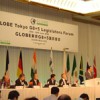
G8: Trying to Move Beyond Debate on Emission Targets
Approximately 133 parliamentarians from 23 countries along with prominent politicians under a caucus called GLOBE (global legislators for a balanced environment) have gathered here ahead of the Jul. 7-9 G8 meetings in Hokkaido. They hope to influence the G8 - the world’s most industrialised countries - to adopt a policy for tacking climate change post-2012 when the current Kyoto Protocol ends.G8: Climate Change High On Summit Agenda
The leaders of the world's most industrialised nations are now arriving in Japan for the Group of Eight (G8) Summit, Jul. 7-9. In the northern mountain resort of Lake Toyako they will confront challenges of climate change, the food shortage, and development, especially in Africa. Other agenda items are likely to include Japan’s recent bilateral summit with Hu Jinatao of China, as well as measures to control rising global fuel prices and nuclear proliferation.DEVELOPMENT-EU: Saving Agriculture From Climate Change
Climate change will top the agenda of an international food conference on Europe that begins Thursday in Innsbruck, Austria.ARGENTINA: Who Are Today’s Farmers?
"I could even do without land, my business would not be affected," Gustavo Grobocopatel, one of Argentina’s largest agribusiness owners, said some time ago. His case illustrates how the rural sector includes much more than the associations leading the radical farmers’ protests of the past few months.TRADE: U.S. Farm Subsidies May Survive WTO Doha Round
Delegates at the World Trade Organisation (WTO) disagree with WTO Director General Pascal Lamy’s view that the negotiations on trade in agricultural products are ‘‘nearly there’’.POLITICS: Weak States Got Weaker in 2007
Weak states already close to collapse at the end of 2006 moved closer to the brink last year, even before the latest explosion of food and fuel prices that are certain to feed instability in vulnerable countries, according to the latest edition of the annual "Failed States Index" released here Monday by Foreign Policy magazine.BRAZIL: Bringing Development to Poverty-Stricken Maranhão State
The construction of what will be Latin America’s biggest oil refinery and of a large steel mill, as well as the promotion of food production, are among the initiatives aimed at pulling the state of Maranhão in northeast Brazil out of decades of poverty.TRADE: WTO Delegates Following Talks Through News Media
As closed-door meetings proceed between selected countries, other member states of the World Trade Organisation (WTO) have resorted to following media reports in an attempt to stay abreast with the current Doha Round of negotiations on agriculture and industrial goods.TRADE: China and India Should Join Effort to Stop Illegal Logging
‘‘Greed should not lead us to destroy our forests,’’ according to Abraham Ansah, an executive member of the non-governmental organisation (NGO) the Bunso Conservationists.PHILIPPINES: Jatropha Key to Self Sufficiency?
The jatropha plant may be the key to addressing the problems of energy and food self-sufficiency in the Mekong region. Cultivating this hardy plant will not only provide biofuel but will also ensure that agricultural lands devoted to food production will not be diverted to fuel crops.
Q&A: Righting Human Wrongs
Mary Robinson spoke to Nastasya Tay of TerraViva/IPS about human rights today and the new campaign Every Human Has Rights, on the sidelines of the eighth CIVICUS World Assembly (Jun. 18-21).« Previous Page — Next Page »


 Farming on the Outskirts of Juba. Credit: UN Photo/JC McIlwaine
Promoting human and planetary health is a central focus of the United Nations, as laid out in the 2030 Sustainable Development Goals (SDGs). World hunger and unsustainable farming practices continue to be pressing concerns for the world. According to the 2025 State of Food Security and Nutrition in the World report by the Food and Agriculture Organization (FAO), 673 million people faced hunger in 2024. There are stark regional disparities, with the FAO projecting that 60% of the world population facing hunger will reside in Africa by 2030. Globally, the prevalence of food insecurity has remained consistently higher for women than men.
Sustainable and efficient national food systems are essential in preserving health, education, environmental well-being, peace, economy, and security. However, creating sustainable food systems can be a challenging endeavor, as food production takes a heavy toll on the environment. The agricultural sector accounts for a significant portion of greenhouse gases. Finding safe, sustainable, and ethical strategies to feed the world is crucial in ensuring planetary longevity. A recent initiative from 2023, the EU Regulation on Deforestation-free Products (EUDR), seeks to advocate for sustainable food systems. The main driver of deforestation is the expansion of agricultural land used to produce commodities like cattle, wood, cocoa, coffee, etc. The EUDR is part of the 2020 European Green New Deal and the EU Biodiversity Strategy for 2030 and aims to limit Europe’s consumption of products linked with deforestation by requiring that companies prove that their products are deforestation-free. Despite aiming to achieve major strides in sustainability, policies such as EUDR also raise socioeconomic concerns for targeted countries. Many emerging Latin American economies are impacted by the policy, and have raised the question of how developing countries can grapple with the tensions between economic development and advancing sustainability.
IPS has been at the forefront of providing compelling and insightful stories on communities facing hunger as well as the cost of food production. IPS uses statistics from FAO, the World Food Programme (WFP) and the International Fund for Agricultural Development (IFAD) to bring relevant and hard-hitting facts to readers. This gathering of information and data from such organizations helps bring the best stories from IPS journalists working in the different regions in consultation with experts on the ground.

The Week with IPS

NEXT STOP - SDGs
Tracking global progress towards a sustainable world
Tracking global progress towards a sustainable world

