Languages
Saturday, November 21, 2026



News and Views from the Global South
Food and Agriculture

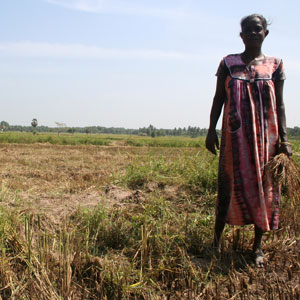
RIGHTS-BOLIVIA: Guarani Families in Forced Servitude
Efforts by Bolivia’s land reform authorities to free 167 Guaraní families living in servitude in Alto Parapetí, a rural area in the eastern Bolivian lowlands province of Santa Cruz, have brought to light a phenomenon that had remained largely hidden and ignored until now in the country’s vast Chaco plains region.MOZAMBIQUE: Officials Master Floods – But Battle To Contain Diseases That Follow
More people have died of cholera following recent floods in Mozambique than the number of those who perished in the rising floodwaters. Most rivers in central and northern Mozambique burst their banks after heavy rains in December, January and February, and as a result of Cyclone Jokwe - which hit in early March.RIGHTS: Native People Warn U.N. of Biofuels Disaster
Growing demand for biofuels by the world's rich nations is propelling attacks on indigenous people and destroying their lands and forests, according to native leaders attending a three-week international meeting here.TRADE-RUSSIA: Ethiopia Seeks Preferential Treatment for Coffee
After several months of trade negotiations in the joint Russian-Ethiopian economic commission, Russia is considering allowing Ethiopia to bring in its different brands of aromatic coffees on a preferential basis.ARGENTINA: Smoke Was a Long Time Coming
"The work has been relentless. We finish putting out one big fire and another one breaks out in the same area." This remark by a firefighter in Argentina, frustrated at the grass fires on the islands in the Paraná river delta, was not made this month, while smoke has covered Buenos Aires and even the capital of neighbouring Uruguay, but in 2004.DEVELOPMENT: Food Crisis May Get Worse Before it Gets Better
The spreading food crisis - triggered primarily by rising prices, declining outputs and growing scarcities worldwide - is threatening to impact heavily on the most vulnerable in society: women and children.INDIA: Blames West For High Food, Energy Prices
While moving firmly to curb inflationary trends, India’s coalition government, which faces a general election next year, continues to blame a poorly managed international financial system for spiralling food and energy prices at home.ASIA: Food Crisis Adds to Women’s Burden
As if the burdens they shoulder are not enough, Asia’s women are being compelled to bear the additional weight of rising food prices, say women’s rights activists from across the region.
PERU: Preserving the Potato in Its Birthplace
Thousands of varieties of potato (Solanum tuberosum), one of the most widely-eaten and well-known foods in the world, have been developed in the heart of South America’s Andes mountains, where the crop was domesticated more than 8,000 years ago.
DEVELOPMENT: If There's No Rice, Let Them Eat Potatoes
When a gaggle of unruly and starving peasants complained about a shortage of bread in 17th century France, the queen consort Marie Antoinette is said to have infamously remarked: "Let them eat cake."
EGYPT: The Global Makes the Local Worse
The appearance of long breadlines outside state-run distribution centres in recent weeks has raised fears of possible bread shortages. Although the government has taken measures aimed at easing the crisis, experts point to soaring international wheat prices that have made the commodity more costly for households worldwide.
AFRICA: Agricultural Extension Work Both Important and Under-valued
At a time of international concern about the future of the world's food supply, it's a comment that gives pause for thought: "I teach university students agriculture and extension but many of them opt for other professions, especially in ICTs, because agriculture is 'for those who haven't gone to school'."ECONOMY-ARGENTINA: Mr. Kirchner, the eminence Not-So-Grise
Above and beyond its impact on the markets or the economy itself, the change of economy minister in Argentina has clearly demonstrated the enormous power that former President Néstor Kirchner exerts within the government of his wife and successor, President Cristina Fernández, analysts say.AGRICULTURE: What Is Really Causing ‘Agflation’?
The old laws of the marketplace are no longer working. Food prices have been rising for six years because of surging demand, and increased production is not restoring the balance as it used to in the past. In fact, prices have been going up even faster over the last year.
ASIA: 'Neglect of Farming Led to Rice Crisis'
The headlines screaming about a global food shortage have not aroused surprise in a leading non-governmental organisation (NGO) working with farming communities across Asia. To its members, warnings of hunger on a biblical scale are hardly news.
AFGHANISTAN: Global Emergency Triggers Food Riots
In the teeming, dense flour bazaars of Kabul, it's hard not to miss the anger.EUROPE: Subsidies Feeding Food Scarcity
European subsidies for agriculture are contributing to rapidly rising food prices and the destruction of small-scale farming in the South, experts say.
Q&A: Land Reform Agents Try to Free Indians from Servitude in Bolivia
Alto Parapetí, a rural area in the eastern Bolivian province of Santa Cruz, is caught up in a dispute between large landowners and the government, which is trying to free more than 2,700 Guaraní Indians from a state of servitude.LATIN AMERICA: Can Rising Food Prices Help Small Family Farms?
Rising global food prices could represent an opportunity for the development of small-scale family farming if national governments provide effective support as part of long-term policies, say experts from various agencies.INDIA: Futures Trade in Farm Commodities – Wrangle Continues
The reluctance of a high-level committee set up by the Indian government to spell out whether futures trading in agricultural commodities has resulted in an escalation of food prices has revealed deep divisions over the issue.Q&A: “Transgenic Seed Companies Lie and Bribe”
Biotech corporations that developed genetically modified seeds are bribing authorities and carrying out costly advertising campaigns "plagued with lies in order to create monsters that attack life," says Jesús León Santos, an indigenous man who is one of this year's winners of the Goldman Environmental Prize.« Previous Page — Next Page »


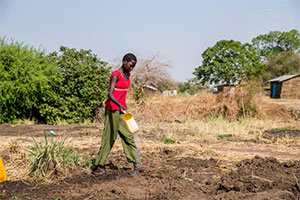 Farming on the Outskirts of Juba. Credit: UN Photo/JC McIlwaine
Promoting human and planetary health is a central focus of the United Nations, as laid out in the 2030 Sustainable Development Goals (SDGs). World hunger and unsustainable farming practices continue to be pressing concerns for the world. According to the 2025 State of Food Security and Nutrition in the World report by the Food and Agriculture Organization (FAO), 673 million people faced hunger in 2024. There are stark regional disparities, with the FAO projecting that 60% of the world population facing hunger will reside in Africa by 2030. Globally, the prevalence of food insecurity has remained consistently higher for women than men.
Sustainable and efficient national food systems are essential in preserving health, education, environmental well-being, peace, economy, and security. However, creating sustainable food systems can be a challenging endeavor, as food production takes a heavy toll on the environment. The agricultural sector accounts for a significant portion of greenhouse gases. Finding safe, sustainable, and ethical strategies to feed the world is crucial in ensuring planetary longevity. A recent initiative from 2023, the EU Regulation on Deforestation-free Products (EUDR), seeks to advocate for sustainable food systems. The main driver of deforestation is the expansion of agricultural land used to produce commodities like cattle, wood, cocoa, coffee, etc. The EUDR is part of the 2020 European Green New Deal and the EU Biodiversity Strategy for 2030 and aims to limit Europe’s consumption of products linked with deforestation by requiring that companies prove that their products are deforestation-free. Despite aiming to achieve major strides in sustainability, policies such as EUDR also raise socioeconomic concerns for targeted countries. Many emerging Latin American economies are impacted by the policy, and have raised the question of how developing countries can grapple with the tensions between economic development and advancing sustainability.
IPS has been at the forefront of providing compelling and insightful stories on communities facing hunger as well as the cost of food production. IPS uses statistics from FAO, the World Food Programme (WFP) and the International Fund for Agricultural Development (IFAD) to bring relevant and hard-hitting facts to readers. This gathering of information and data from such organizations helps bring the best stories from IPS journalists working in the different regions in consultation with experts on the ground.

The Week with IPS

NEXT STOP - SDGs
Tracking global progress towards a sustainable world
Tracking global progress towards a sustainable world