Languages
Saturday, November 21, 2026



News and Views from the Global South
Food and Agriculture
EUROPE: Subsidies Fail the Poor Among the Rich
Romanian farmers have started receiving the first payments under the European Union's Common Agricultural Policy (CAP). But the poorest farmers might have to wait years to see some benefits.TRADE: Doha Talks Sweating Over Tropical Products
The hot potato these days in the Doha Round of World Trade Organisation (WTO) negotiations is tropical products, a burning issue for the world’s poorest countries.IRAQ: Food Crisis Hits Fallujah
Sharp increases in food prices have generated a new wave of anti-occupation and anti-U.S. sentiment in Fallujah.
DEVELOPMENT: Food Crisis Symptom of Dubious Liberalisation
The high food prices that have sparked riots in many parts of the developing world - from Indonesia, India and Bangladesh to Cameroon, Cote d'Ivoire and Haiti - should come as no surprise. These are only the latest in a series of events many developing countries have suffered as a result of opening their borders and neglecting domestic agriculture.BRAZIL: Sugarcane Alcohol Tarnished by U.S. Maize Ethanol
Recent efforts by President Luiz Inácio Lula da Silva to clearly mark the difference between Brazilian ethanol and the agrofuels produced by the United States are an admission that signing an agreement with Washington to promote a global bioethanol market was a serious political mistake, say analysts.DEVELOPMENT-AFRICA: "Political Will" Needed To Address Food Crisis
The need to give agriculture top billing on governmental "to do" lists has been highlighted at a telephone briefing to discuss the current food crisis as it affects Africa.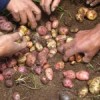
PERU: Highlands Families Work to Save Their Birthright – the Potato
A plate of parboiled potatoes of various sizes, shapes and colours welcomes the visitor to Huama, a town in the southern Peruvian Andes, at an altitude of 4,500 metres.CHINA: Buying Farmland Abroad, Ensuring Food Security
Rattled by rapidly rising global grain prices, China is looking at strategies to ensure long-term food security for its 1.3 billion people such as procuring farmland overseas and opposing the formation of any international grain price- fixing monopolies.
INDIA: Gov't Leaves Farmers to the Mercy of Moneylenders
There is no let up in farmers’ suicides, say activists urging the Indian government to extend its loan waiver offer to more agriculturists in western Maharashtra and central Madhya Pradesh states where the agrarian crisis is most severe.LATIN AMERICA: Food Summit Declares Regional Emergency
The presidential summit on "Food for Life", held in Nicaragua, has ended with 16 Latin American countries agreeing to produce more food and sell it at low prices through strategic alliances, amid criticisms of free markets and capitalism.DEVELOPMENT: Food Crisis Linked to Doha Deal
The issue of rising food prices was raised at the WTO's General Council meeting Wednesday, and for the first time, discussed in some detail. But there remains, as one African delegate put it, "a lot of confusion about the rising prices of commodities and the Doha Round. Somebody needs to demystify the links. The D-G (Director-General) is using this as a bait to catch us on concluding the Round as soon as possible."
NEPAL: Poor Planning Behind Rising Food Prices
As the sole breadwinner in a family of five, Maya Tamang watches her food budget carefully. And she can vouch best for the way many items are steadily disappearing from the table as food prices spiral steadily.ARGENTINA: Food Inflation Hits People Close to Poverty Line
Poverty is once again growing in Argentina, reversing the downward trend recorded since 2003, as a result of price inflation mainly affecting basic food products, analysts say. But the government’s only response, according to its critics, has been to stop reporting poverty statistics.
DEVELOPMENT-SOUTHERN AFRICA: Small Can Be Beautiful
Is small the new big when it comes to agriculture in Southern Africa? As rising food prices place this sector firmly in the spotlight, there are compelling examples at hand to make the case for greater investment in small-scale farming.LATIN AMERICA: South-South Cooperation to Fight Child Malnutrition
Cooperation between Latin American countries, which is cheap, efficient and horizontal, could fast-track the fight against child malnutrition, Nils Kastberg, the regional director of the United Nations Children’s Fund (UNICEF), said at a conference held in the Chilean capital.DEVELOPMENT: Food Crisis Escapes Security Council Scrutiny
The food crisis that has triggered street demonstrations and riots in nearly 30 countries - including Haiti, Indonesia, Cote d'Ivoire, Mauritania, Mozambique, Senegal, and most recently in Somalia - continues to escape the scrutiny of the most powerful body at the United Nations: the Security Council.EUROPE: Warnings Against Biofuels Get Louder
European efforts to promote biofuels should be rethought because of the contribution they have made to rising food prices, according to Jeffrey Sachs, a top economic advisor to the United Nations.MALAYSIA: Food Futures Behind Rising Prices
With stock markets and the property sector in the United States weakening, speculative investors are turning to fuels and the food sector as a "safe haven", driving up prices in the process, say some food security activists.DEVELOPMENT: U.N. Bodies Under Fire for Food Crisis
As the Food and Agriculture Organisation (FAO) readies for a summit of world leaders next month, Secretary-General Ban Ki-moon Monday defended the Rome-based U.N. agency, which has come under fire for its failure to help meet the growing challenges of hunger worldwide.IRAQ: Corruption Eats Into Food Rations
Amidst unemployment and impoverishment, Iraqis now face a cutting down of their monthly food ration – much of it already eaten away by official corruption.
MEXICO: No Place for Small Farmers at the Supermarkets
A Mexican coffee grower receives about three dollars per kilogram of unprocessed coffee beans, and the consumer here pays 11 dollars. That price difference, in large part, is the result of the growing power of a handful of supermarkets.« Previous Page — Next Page »


 Farming on the Outskirts of Juba. Credit: UN Photo/JC McIlwaine
Promoting human and planetary health is a central focus of the United Nations, as laid out in the 2030 Sustainable Development Goals (SDGs). World hunger and unsustainable farming practices continue to be pressing concerns for the world. According to the 2025 State of Food Security and Nutrition in the World report by the Food and Agriculture Organization (FAO), 673 million people faced hunger in 2024. There are stark regional disparities, with the FAO projecting that 60% of the world population facing hunger will reside in Africa by 2030. Globally, the prevalence of food insecurity has remained consistently higher for women than men.
Sustainable and efficient national food systems are essential in preserving health, education, environmental well-being, peace, economy, and security. However, creating sustainable food systems can be a challenging endeavor, as food production takes a heavy toll on the environment. The agricultural sector accounts for a significant portion of greenhouse gases. Finding safe, sustainable, and ethical strategies to feed the world is crucial in ensuring planetary longevity. A recent initiative from 2023, the EU Regulation on Deforestation-free Products (EUDR), seeks to advocate for sustainable food systems. The main driver of deforestation is the expansion of agricultural land used to produce commodities like cattle, wood, cocoa, coffee, etc. The EUDR is part of the 2020 European Green New Deal and the EU Biodiversity Strategy for 2030 and aims to limit Europe’s consumption of products linked with deforestation by requiring that companies prove that their products are deforestation-free. Despite aiming to achieve major strides in sustainability, policies such as EUDR also raise socioeconomic concerns for targeted countries. Many emerging Latin American economies are impacted by the policy, and have raised the question of how developing countries can grapple with the tensions between economic development and advancing sustainability.
IPS has been at the forefront of providing compelling and insightful stories on communities facing hunger as well as the cost of food production. IPS uses statistics from FAO, the World Food Programme (WFP) and the International Fund for Agricultural Development (IFAD) to bring relevant and hard-hitting facts to readers. This gathering of information and data from such organizations helps bring the best stories from IPS journalists working in the different regions in consultation with experts on the ground.

The Week with IPS

NEXT STOP - SDGs
Tracking global progress towards a sustainable world
Tracking global progress towards a sustainable world

