Languages
Thursday, October 8, 2026



News and Views from the Global South
Population

Q&A: Leprosy-affected People Live Not at the Bottom, but Outside the Social Pyramid
Takahiro Nanri is the Executive Director of Sasakawa Memorial Health Foundation which has been supporting the global fight against leprosy for almost five decades. Since 2014, Nanri has been leading the foundation’s leprosy projects across the world and has deep insights into the challenges faced by the people affected by leprosy as well as the organisations that work with them.
Living with Leprosy on the Climate-Vulnerable Kiribati Island Atolls
Kurarenga Kaitire lives in Kiribati—one of the world’s most climate-vulnerable nations. Already vulnerable to nature, the 29-year-old mother of five has faced a series of vulnerabilities over the past decade, including facing social stigma and domestic abuse.
A Leprosy-free Philippines by 2020?
 Dr Maria Francia Laxamana, assistant secretary of health in the Department of Health, Philippines outlines her recommendations for a leprosy country by 2020.
Capacity Building the Key to Fighting Leprosy
Strengthening the participation of persons affected by leprosy, or SPP, has proven to be an effective strategy in reaching out to often isolated sufferers in local communities throughout Asia. A significant challenge to civil society organisations, however, is finding enough management talent to maintain and expand the programmes.
First Asian Leprosy Assembly Calls for Greater Social Inclusion for the Affected
Growing up in Kathmandu, Nepal, Amar Bahadur Timalsina wasn’t allowed to attend school as a young boy because he was affected by leprosy. But decades later, after treatment and being able to re-integrate into his community, the boy who was once denied an education is now inspiringly the principal of a school of 400 students.
Leprosy Remains a Stubborn, Unseen Problem in the Philippines
The stubborn challenge of diagnosis and treatment of leprosy among difficult to reach populations in the Philippines should soon become easier with the rollout of a mobile app connecting field health workers with physicians and clinics.
Hate Speech Threatens Our Humanity
Do politicians’ words matter? Since becoming US President, Donald J Trump has dismissed his opponents and others he does not like as evil, stupid or both. He has referred to undocumented immigrants as animals, and to poor countries as shitholes.
Modern Day Slavery Rated World’s Largest Single Crime Industry
After an exhaustive study of modern day slavery, the Geneva-based International Labour Organization (ILO) concluded there are over 40 million people who are victims of slavery, including 25 million in forced labour and 15 million in forced marriages – with at least 71 percent of them comprising women and girls.Bangladesh faces a challenge to ensure welfare of its aging population
(IPS/UNB) – Bangladesh economy’s impressive growth trajectory over the last decade has been buttressed by the demographic dividend resulting from a large portion of its population -- around 65 percent on average -- being of working age.
Local School Is a Model for Energy and Water in Rapa Nui
A school in the capital of Easter Island (Rapa Nui, in the local indigenous tongue) gives an example of clean management with the use of solar energy, rainwater recovery and an organic vegetable garden, as well as rooms and spaces built with waste materials.
The Future of Urbanism: Is the UAE Pioneering it?
According to data from the UN Development Programme (UNDP), the Arab world is one of the most urbanised areas in the world, with more than 70 per cent of the population of the six-member Gulf Cooperation Council (GCC)--- Bahrain, Kuwait, Oman, Qatar, Saudi Arabia, and the United Arab Emirates (UAE)-- living in urban areas.
World’s Youth Are Being Left Behind
Globally, youth are being left behind in education and employment, threatening the future vision of sustainable, inclusive, and prosperous societies.
Agribusiness Is the Problem, Not the Solution
For two centuries, all too many discussions about hunger and resource scarcity has been haunted by the ghost of Parson Thomas Malthus. Malthus warned that rising populations would exhaust resources, especially those needed for food production. Exponential population growth would outstrip food output.
Mining Grabs Up Land, Deals Blow to Agriculture in Central America
Like an octopus, metals mining has been spreading its tentacles throughout Central America and dealing a blow to the region's agriculture and natural ecosystems, according to affected villagers, activists and a new report on the problem.
What, After Buenos Aires Conference on South-South Cooperation?
Initially, in its BAPA+40 follow-up, the Group of 77 should address – in its own circle and in a comprehensive manner – the challenges and opportunities facing South-South cooperation.
Q&A: What of the Carbon Neutral Countries?
As High Forest Cover and Low Deforestation (HFLD) nations meet in Suriname at a major conference, it is obvious that the decision made by these countries to preserve their forests has been a difficult but good one.
Our Forests Provide the World With Oxygen But We Need More Climate Change Finance – HFLD Countries
Suriname, the most forested country in the world, is this week hosting a major international conference on climate financing for High Forest Cover and Low Deforestation (HFLD) countries.
Q&A: A Cuban Film About Family in the “Global South” Premieres in Berlin
A documentary about a Cuban family facing an uncertain future had its world premiere Feb. 12 at the Berlin International Film Festival, one of the world’s most prestigious cinema events. “La Arrancada” (On the starting line) is a debut feature by Brazilian director Aldemar Matias, focusing on a young athlete who is having doubts about her role in national sports in the Caribbean country. The narrative follows her as she considers her future, which may well lie abroad, she reluctantly realises.
Solar Energy Provides Hope for Poor Neighbourhoods in Buenos Aires
Solar panels shine on the rooftop terraces of 10 neat buildings with perfectly straight lines and of uniform height, an image of modernity that contrasts with the precariously-built dwellings with unplastered concrete block walls just a few metres away, with rooms added in a disorderly manner, surrounded by a tangle of electric cables.
Transforming Economies, States, & Societies – Building Evidence for Achieving SDGs
Following on from Finn Tarp, my predecessor, is a daunting prospect, but I look forward to working with my colleagues at UNU-WIDER and with our many partners to build on the achievements of the past 10 years.
Canada Implements New Food Guidelines, But What About the Food Waste?
Canada introduced a new healthy eating food guide January 2019 and, for the first time, the meat, dairy and processed food and beverage industries were not involved. Based on the recommendations of health and nutrition experts, the guide places a new emphasis on eating plants, drinking water and cooking at home.« Previous Page — Next Page »





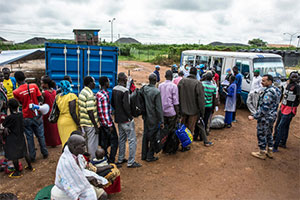 One Thousand Internally Displaced Persons (IDPs) Relocated from Tomping Camp in South Sudan. Credit: UN Photo/Isaac Billy
It took hundreds of thousands of years for the world’s human population to cross one billion in 1804. Approximately 200 years later, the population has multiplied sevenfold. In 2023, the global population crossed 8 billion, and is expected to reach 9 billion before 2050. With the planet more crowded than ever, it is essential to keep track of population trends, urbanization, migration, and reproduction across the world.
Life expectancy has seen significant strides in the past century, largely due to economic development and increased standards of living. On the contrary, trends in global fertility are shifting, with certain regions in Africa and Asia reporting higher rates, while parts of Europe and North America report stagnant or lower rates. This is in part due to differences in sexual and reproductive healthcare, as well as societal and economic conditions around the world. For example, child marriage is prevalent in certain societies, where childbearing is also considered a familial duty. Meanwhile, stagnating economies frequently experience lower marriage and childbearing rates.
The increase in migration and urban development around the world is also linked to global population trends. By 2050, it is expected that approximately 66 percent of all people will live in cities. Furthermore, global crises such as warfare and natural disasters also prompt transnational migration. Transnational migration is linked to a variety of socioeconomic issues in both host and receiving countries: migrants often leave developing countries with less access to educational and economic opportunities and arrive in developed countries where they are frequently the targets of ethnic, racial, and cultural discrimination, and economic exploitation. Recent crises in Europe and the United States demonstrate the importance of advocating for migrants worldwide. As migrants from the Global South are increasingly stripped of their legal and civic rights in unlawful deportations, or targeted in acts of identity-based violence, it is essential to keep track of population trends and protect the human rights of migrant populations. Climate-related disasters are now a major driver of displacement, with nearly half of all new internal displacements in 2025 being disaster-related.
IPS is devoted to covering issues surrounding population trends, migration, and reproduction through its compelling articles, which use both statistics and human stories to provide readers with robust and informative viewpoints.

The Week with IPS

NEXT STOP - SDGs
Tracking global progress towards a sustainable world
Tracking global progress towards a sustainable world
