Languages
Thursday, October 8, 2026



News and Views from the Global South
Population

The Right to Life, Liberty, and Land
Sustainable land management is becoming more important than ever as rates of emissions, deforestation, and water scarcity continue to increase. But what if you don’t have rights to the land? While the impact of agriculture on land is well known, the relationship between land degradation and land tenure seems to be less understood.
The Upcoming Generations Can Lift the Arab Region out of Its Current Crisis
History testifies that there is no end to its evolution despite what some have claimed. This is because aspirations of its actors are in constant flux and because the quest for an « ideal city » is asymptotic. Each generation wants to put its imprint on the present and to be the architect of its future in the pursuit of its own ideal.
Bullets Against Pots and Pans in the Crackdown on Venezuela’s Protests
The protests in Venezuela demanding an end to the presidency of Nicolás Maduro in the last 10 days of January, whose soundtrack was the sound of banging on pots and pans in working-class neighbourhoods, had a high human cost: more than 40 deaths, dozens wounded and about a thousand detainees, including 100 women and 90 children under 18.
Mexican Village Wants to Turn Thermoelectric Plant into Solar Panel Factory
Social organisations in the central Mexican municipality of Yecapixtla managed to halt the construction of a large thermoelectric plant in the town and are now designing a project to convert the installation into a solar panel factory, which would bring the area socioeconomic and environmental dividends.
Gender Gap Made Worse by Land Degradation
In parts of the world where the gender gap is already wide, land degradation places women and girls at even greater risk.
People Power Will Bring Change — Not Davos
They said they cared about climate change but they flew in on private jets in record numbers. They said they cared about inequality but laughed off the idea of higher taxes for the rich. They spoke about democracy and human rights but they dined with a far-right populist. If there was ever any doubt about Davos representing the epitome of duplicity, then 2019 has firmly laid that to rest.
Crusade Against Sex Education Undermines Progress Made in Latin America
The crusade against comprehensive sex education by conservative and religious sectors undermines progress in Latin America and could further drive up rates of teen pregnancy, communicable diseases and abuse against girls and adolescents.
The Marrakech Compact on Migration: Myths & Realities
When 164 UN member states adopted the Global Compact for Safe, Orderly, and Regular Migration (the Marrakech Compact on Migration) on 10 December last year, I read on social media that they had decided to give up control over migration to the UN.
The Silent, Invisible Crisis Destabilising Communities Could be a Subject of Hope
New data show that globally two billion hectares of land—roughly twice the size of China—have been degraded. And of this amount, 500 million hectares are abandoned agricultural lands.
Ending Poverty is Possible, but it Means Facing up to Inequality – Within & Between Countries
World leaders have committed to ending poverty everywhere for all people by 2030. Achieving this aim means facing up to the need for dramatic declines in inequalities – in income, in opportunity, in exposure to risk, across gender, between countries and within countries – over the next decade.
Mexico Opens Its doors to Central American Migrants
A few months ago, Candelario de JesúsChiquillo Cruz reached Mexico's southern border and ran into a fence reinforced with barbed wire, while a barrier of police officers sprayed him with gas. Today, he is walking freely over the bridge that crosses the Suchiate River, a natural border with Guatemala.
Making Tourism More Responsible
Long before Joy Daniels became the manager of a travel company she was cleaning rooms at a guesthouse. But after joining a Fair Trade-certified business, a place that valued its staff, in a few years she was soon promoted to manager.
Solar Energy Begins to Light Up Favelas in Rio de Janeiro
 “We can’t work just to pay the electric bill,” complained José Hilario dos Santos, president of the Residents Association of Morro de Santa Marta, a favela or shantytown embedded in Botafogo, a traditional middle-class neighborhood in Rio de Janeiro.
Bringing Greener Pastures Back Home
One month on since the Global Compact for Migration was approved, civil society has highlighted the need to turn words into action, supporting those who have been displaced or forced to migrate as a result of environmental degradation.
Asia’s Landlocked
Structural economic transformation and the expansion of international trade are among the most pressing issues to be addressed, if Asia’s landlocked developing countries (LLDCs) are to overcome the development challenges related to their geographical locations.
Quenching Humanity’s Freshwater Thirst Creates a Salty Threat
Starting from a few, mostly Middle Eastern facilities in the 1960s, today almost 16,000 desalination plants are in operation in 177 countries, producing 95 million cubic meters of freshwater every day - equal to about half the flow over Niagara Falls.
Davos, Inequality & the Climate Emergency
Four of the top five most impactful threats in this year’s World Economic Forum´s Global Risks report are related to climate change. The report warns that we are “sleepwalking to disaster” . But that is not true. The disaster is already here, it´s not something we are still walking towards. Climate change is no future threat, it´s a current one. We have entered a new phase, one in which the impacts are coming faster, with greater intensity.
Wasting & Dining: the New Water Dilemma
Concerns about the supply side of food systems are shifting from insufficient production and supply, to issues likely to affect food production in the medium and long term, such as water risks, global warming and environmental consequences.
Experience With Irregular Migration is the Best Teacher
The International Organization For Migration (IOM) has taken its campaign against irregular migration to schools in Nigeria. The school campaigns are meant to educate children who are among victims of human traffickers.
A Salty Dilemma
As the threat of water scarcity increasingly grows, many have turned to the Earth’s plentiful oceans for a solution. However, this has created a new risk threatening public and environmental health: brine.
Why We Should Care about Vulnerable Coastal Communities
According to UN statistics, approximately 40 per cent of the world’s population lives within 100 kilometers of the coast, and overall the world’s coastal population is increasing faster than the total global population. At the same time, global warming is causing sea levels to rise and increasing extreme weather incidents on coastlines.« Previous Page — Next Page »





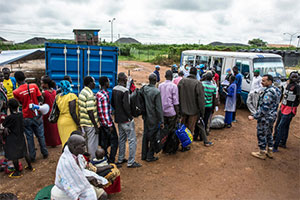 One Thousand Internally Displaced Persons (IDPs) Relocated from Tomping Camp in South Sudan. Credit: UN Photo/Isaac Billy
It took hundreds of thousands of years for the world’s human population to cross one billion in 1804. Approximately 200 years later, the population has multiplied sevenfold. In 2023, the global population crossed 8 billion, and is expected to reach 9 billion before 2050. With the planet more crowded than ever, it is essential to keep track of population trends, urbanization, migration, and reproduction across the world.
Life expectancy has seen significant strides in the past century, largely due to economic development and increased standards of living. On the contrary, trends in global fertility are shifting, with certain regions in Africa and Asia reporting higher rates, while parts of Europe and North America report stagnant or lower rates. This is in part due to differences in sexual and reproductive healthcare, as well as societal and economic conditions around the world. For example, child marriage is prevalent in certain societies, where childbearing is also considered a familial duty. Meanwhile, stagnating economies frequently experience lower marriage and childbearing rates.
The increase in migration and urban development around the world is also linked to global population trends. By 2050, it is expected that approximately 66 percent of all people will live in cities. Furthermore, global crises such as warfare and natural disasters also prompt transnational migration. Transnational migration is linked to a variety of socioeconomic issues in both host and receiving countries: migrants often leave developing countries with less access to educational and economic opportunities and arrive in developed countries where they are frequently the targets of ethnic, racial, and cultural discrimination, and economic exploitation. Recent crises in Europe and the United States demonstrate the importance of advocating for migrants worldwide. As migrants from the Global South are increasingly stripped of their legal and civic rights in unlawful deportations, or targeted in acts of identity-based violence, it is essential to keep track of population trends and protect the human rights of migrant populations. Climate-related disasters are now a major driver of displacement, with nearly half of all new internal displacements in 2025 being disaster-related.
IPS is devoted to covering issues surrounding population trends, migration, and reproduction through its compelling articles, which use both statistics and human stories to provide readers with robust and informative viewpoints.

The Week with IPS

NEXT STOP - SDGs
Tracking global progress towards a sustainable world
Tracking global progress towards a sustainable world
