Languages
Tuesday, October 6, 2026



News and Views from the Global South
Population

Honduran Crisis Produces New Caravan
A new caravan heading towards Mexico and the United States was reportedly set to leave San Pedro Sula in Honduras on 15 January. The large number of people expected to leave Central America is a true testimony to the desperate situation for children, women and men in this poor and violence affected region.
With All Things Equal Would the Ruling Party have Won the Elections in Bangladesh ?
It was the first time in the history of parliamentary elections in Bangladesh that a party won with such a huge margin. But according to local analysts familiar with Bangladesh's political climate, the victory by the ruling Awami League (AL) led coalition—which won over 96 percents of seats in parliament in the country's 11th national elections on Dec. 30—was expected in the face of the country's unprecedented development.
Shedding Light on Forced Child Pregnancy and Motherhood in Latin America
Research and campaigns by women’s rights advocates are beginning to focus on the problem of Latin American girls under the age of 14 who are forced to bear the children of their rapists, with the lifelong implications that entails and without the protection of public policies guaranteeing their human rights.
Argentina’s Indigenous People Fight for Land Rights
Nancy López lives in a house made of clay, wood and corrugated metal sheets, on private land dedicated to agriculture. She is part of an indigenous community of 12 families in northern Argentina that, like almost all such communities, has no title to the land it occupies and lives under the constant threat of eviction.
Q&A: ‘There’s a Lot More Climate Finance Available than People Think’
While growth in the green economy looks promising, government regulation and a business-as-usual approach are among the hurdles inhibiting cleaner energy production.
A Closer Look at the World Bank’s Sizable China Portfolio
China continues to borrow an average of $2 billion a year from the World Bank, making it one of the Bank’s top borrowers—despite being the world’s second-largest economy and itself a major global lender, according to our study released today.
Walking Miles In Their Shoes
In light of the millions of refugees escaping persecution in search of a safer, more prosperous future, a new campaign aims to raise awareness of the difficult journeys such populations take around the world.
Indigenous People, the First Victims of Brazil’s New Far-Right Government
"We have already been decimated and subjected, and we have been victims of the integrationist policy of governments and the national state," said indigenous leaders, as they rejected the new Brazilian government’s proposals and measures focusing on indigenous peoples.
Recorded Increase in Human Trafficking, Women and Girls Targeted
Human trafficking is on the rise and it is more “horrific” than ever, a United Nations agency found. In a new report examining patterns in human trafficking, the U.N. Office on Drugs and Crime (UNODC) found that the global trend has increased steadily since 2010 around the world.
Local Innovation Facilitates Solidarity-Based Biogas Networks in Cuba
Black plastic pipes, readily available on the mainly empty shelves of Cuba’s shops, distribute biogas to homes in the rural town of La Macuca, buried under the ground or running through the grass and stones in people’s yards.
Designer Babies can Lead to Growth of Homogenous Individuals
A Chinese researcher has claimed that he helped make world’s first genetically edited babies but the development may come at a heavy cost. A designer baby is a GM human embryo with appropriate qualities which have been shaped as per the instructions received from the parents.
Solar Energy Crowns Social Housing Programme in Brazil
"Solar energy makes my happiness complete," said Divina Cardoso dos Santos, owner of one of 740 houses with photovoltaic panels on the rooftops in a settlement on the outskirts of this central Brazilian city.
Getting Sustainable Development Back on Track in Asia & the Pacific
2019 will be a landmark year for the United Nations 2030 Agenda for Sustainable Development. Four years will have passed since world leaders adopted the Sustainable Development Goals (SDGs). Four years since governments recommitted themselves to eradicating extreme poverty, improving universal health care coverage, education and food security, and achieving a sweeping set of economic, social and environmental objectives. Long enough to assess our direction of travel and then refocus work where progress is falling short.
Nigerian Radio Drama Tells True Life Stories of Irregular Migration
The International Organization for Migration has taken its campaign against irregular migration to the airwaves in Nigeria. Working in conjunction with some Nigerian radio stations, the United Nations Migration Agency has launched a radio series on safe migration.
BAPA+40: An Opportunity to Reenergize South-South Cooperation
The upcoming conference on the Buenos Aires Plan of Action (BAPA+40), scheduled to take place in the Argentine capital on 20-22 March 2019, ought to be more than just another UN conference where the developing countries assemble to present their demands and seek support from the North.
Ghana’s Contribution to Plastic Waste Can Be Reduced with the Right Investment
Twelve-year-old Naa Adjeley lives in Glefe, a waterlogged area that is one of the biggest slums along the west coast of Accra, Ghana. The sixth grade student, his parents and three siblings use 30 single-use plastic bags per day for breakfast.
Mercury Contamination Threat Gravitates into Outer Space
The dangers of mercury contamination have escalated from the dental chair to the realm of outer space. First, it was the hazardous use of mercury in dentistry, then in cosmetics, particularly skin-lightening creams, and now it is threatening to make its way into satellite propulsion systems.
The Movement Fighting Inequality is Growing
The world’s political and economic elites, that will once again gather at the Swiss mountain resort of Davos for the annual World Economic Forum (WEF) 22-25 January, have become all too predictable. It's not difficult to predict what they will say, because they always say what's in their interests.
For Love of the Game: Using Football to Educate Nigerians About the Dangers of Irregular Migration
 Hundreds of desperate young Nigerians die yearly in the Sahara Desert or at sea while making irregular journeys to Europe. The desperation to reach Europe at all cost, irrespective of the risks, is a major social problem in Africa’s most populous country.

Restoring Ghana’s Mangroves and Depleted Fish Stock
It was just three and a half years ago that the Sanwoma fishing village, which sits between the sea and the mouth of the Ankobra River on the west coast of Ghana, experienced perpetual flooding that resulted in a loss of property and life.
From Irregular Migrant to Graduate Lawyer: One Woman’s Journey to Success
Masters of Laws student Khoudia Ndiaye will graduate from Senegal’s University Cheikh Anta Diop (UCAD) next year. The 24-year-old, who specialised in notarial law and dreams of becoming a notary, wants to bring justice closer to local communities like those in her local district of Hann Bel-Air, in Senegal’s capital Dakar, where she rarely sees female lawyers.« Previous Page — Next Page »





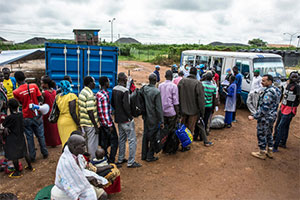 One Thousand Internally Displaced Persons (IDPs) Relocated from Tomping Camp in South Sudan. Credit: UN Photo/Isaac Billy
It took hundreds of thousands of years for the world’s human population to cross one billion in 1804. Approximately 200 years later, the population has multiplied sevenfold. In 2023, the global population crossed 8 billion, and is expected to reach 9 billion before 2050. With the planet more crowded than ever, it is essential to keep track of population trends, urbanization, migration, and reproduction across the world.
Life expectancy has seen significant strides in the past century, largely due to economic development and increased standards of living. On the contrary, trends in global fertility are shifting, with certain regions in Africa and Asia reporting higher rates, while parts of Europe and North America report stagnant or lower rates. This is in part due to differences in sexual and reproductive healthcare, as well as societal and economic conditions around the world. For example, child marriage is prevalent in certain societies, where childbearing is also considered a familial duty. Meanwhile, stagnating economies frequently experience lower marriage and childbearing rates.
The increase in migration and urban development around the world is also linked to global population trends. By 2050, it is expected that approximately 66 percent of all people will live in cities. Furthermore, global crises such as warfare and natural disasters also prompt transnational migration. Transnational migration is linked to a variety of socioeconomic issues in both host and receiving countries: migrants often leave developing countries with less access to educational and economic opportunities and arrive in developed countries where they are frequently the targets of ethnic, racial, and cultural discrimination, and economic exploitation. Recent crises in Europe and the United States demonstrate the importance of advocating for migrants worldwide. As migrants from the Global South are increasingly stripped of their legal and civic rights in unlawful deportations, or targeted in acts of identity-based violence, it is essential to keep track of population trends and protect the human rights of migrant populations. Climate-related disasters are now a major driver of displacement, with nearly half of all new internal displacements in 2025 being disaster-related.
IPS is devoted to covering issues surrounding population trends, migration, and reproduction through its compelling articles, which use both statistics and human stories to provide readers with robust and informative viewpoints.

The Week with IPS

NEXT STOP - SDGs
Tracking global progress towards a sustainable world
Tracking global progress towards a sustainable world
