Languages
Monday, October 5, 2026



News and Views from the Global South
Population

Why It is Vital for Everyone to Eat Organic
 "Organic is the only living solution to climate change," says Vandana Shiva, food and agriculture expert and member of the World Future Council (WFC). Nowadays, favouring the scale up of agroecology – which includes producing organic products – is unfortunately not that simple.
Women’s Climate Leadership More Vital Than Ever In Light Of Climate Change Report
The latest Intergovernmental Panel on Climate Change (IPCC) report, which arrived thunderously in October, concludes that we have only 12 years remaining to transform our energy systems and ways of living to limit the worst effects of climate change.
Canada Takes a Lead Role Funding Reproductive Health, Women’s Rights & Sustainable Development
Canada, which has been described as one of the world’s most progressive countries, has legitimized gay rights, vociferously advocated gender empowerment, offered strong support for abortion rights – and recently became the world’s first major economy to legalize recreational marijuana.
Sustainable Coastal Fisheries in the Pacific Depends on Improving Sanitation
At the mouth of the Mataniko River, which winds its way through the vibrant coastal port town of Honiara to the sea, is the sprawling informal community of Lord Howe Settlement, which hugs the banks of the estuary and seafront. A walk from the nearby main road to the beach involves a meandering route through narrow alleys between crowded dwellings, homes to about 630 people, which are clustered among the trees and overhang the water.
Africa’s Fast-Growing Population: Tackling Youth Unemployment and Capturing the Demographic Dividend
Africa’s population is growing at an astonishing rate. By 2050, the number of people on the continent will climb to 2.5 billion. By the same year, the United Nations predicts that nearly half of the countries in Africa will double their populations. While regions such as Europe have virtually stopped growing, Africa’s population growth shows no signs of slowing.
Africa’s Bumpy Road to Sustainable Energy
For years, Kenyans freely used and disposed of plastic bags. The bags were ubiquitous—in the markets, in the gutters and in the guts out of 3 out of every 10 animals taken to slaughter.
With Poor Human Rights Record, Repatriation Not Possible
Policies that allow for impunity, genocide, and apartheid are “intolerable” and make repatriation of Rohingya refugees impossible, say United Nations investigators.
Kashmir’s Fisherwomen Live Between Hope and Despair
Much has changed since Rahti Begum, a fisherwoman in Kashmir, now in her late 60s, first began wandering the streets with a bucketful of fish on her head. She was 17 when her father roped her into the business that became the source of her livelihood for the remainder of her life.
Buenos Aires Shantytowns, Caught Between Exclusion and Hope
"We are the people who are excluded from the system," says Rafael Rivero, sitting in his apartment in a new social housing complex next to one of the largest slums in Buenos Aires. The contrast sums up the complexity of the social reality in the Argentine capital.
Population and security
Population explosion, though missing from the country’s policy discourse, presents one of the most serious threats to our national security. There may not be a simple causal relationship between demography and security, but evidence shows that high population growth is a major destabilising factor in the least developed countries. There are many examples to show that tensions leading up to conflict may have been heightened by demographic pressures.
Rich in Agriculture, Madagascar Suffers from Extreme Malnutrition
As much as 80 percent of Madagascar’s population of 24 million people is involved in agriculture and the country’s economy largely depends on the sector, yet 48 percent of households are faced with food insecurity according to the National Nutrition Office (NNO). Over 70 percent of households live below the national poverty line of 535,603 Malagasy ariary per year (1 U.S. dollar equals 3,447.50 ariary).
Parliamentarians Promote Youth Investment in Kazakhstan
Parliamentarians from 36 countries met this weekend in Astana, Kazakhstan, to discuss the future of youth in Central Asia and the Asia-Pacific region. The gathering called “International Conference on Investing on Youth: Leaving No One Behind” took place on the Oct. 19 to 20, and the goal was to advance the Sustainable Development Goals (SDGs), set by the United Nations, with regards to youth.
Despite Progress, Over 200 Million Women Still Waiting for Modern Contraception
The international community will be commemorating two milestones in the history of population and development next year: the 50th anniversary of the UN Population Fund (UNFPA) and the 25th anniversary of a Programme of Action (PoA) adopted at the1994 International Conference on Population and Development (ICPD) in Cairo.
Honduran Migrant Caravan Moves Northwards, Defying all Obstacles
A long chain of people is winding its way along the highways of Chiapas, the southernmost Mexican state. It is moving fast, despite the fact that one-third of its ranks are made up of children, and it has managed to avoid the multiple obstacles that the governments of Honduras, Guatemala and now Mexico, under pressure from the United States, have thrown up in a vain effort to stop it.
Solar Power Lights up the World’s Fastest-Growing Refugee Camp
Solar energy has long powered homes, businesses and portable electronics. Now, it’s powering a field hospital in the middle of the world’s fastest-growing refugee camp.
Time for Global Collaboration to Address Pressing Issues of Sexual & Reproductive Health & Rights
300 Parliamentarians from over 150 nations will meet, in Ottawa, to tackle one of the most serious global challenges facing humanity. The International Parliamentarians’ Conference on the Implementation of the ICPD Program of Action (IPCI), October 22-23, is a forum, for all global regions, to generate collective action on issues of population and development, specifically as they relate to sexual and reproductive health and rights (SRHR).
The Right to Choose
Reproductive choice can transform the world and our goals towards a sustainable society, a new report says.
UAE Raising Awareness About the Impact of Climate Change
The Middle East, due to its geographical location, is particularly prone to the impacts of climate change. Longer droughts, more frequent and intense heatwaves, and higher temperatures in the summer are expected to to become increasingly prevalent throughout the Middle East - from Sana’a to Jeddah to Dubai to Tehran.
Africa Remains Resolute Heading to COP 24
In December 2015, nations of the world took a giant step to combat climate change through the landmark Paris Agreement. But African experts who met in Nairobi, Kenya at last week’s Seventh Conference on Climate Change and Development in Africa (CCDA VII) say the rise of far-right wing and nationalist movements in the West are threatening the collapse of the agreement.
Africa Must Increase Spending on Health Care, Education & Modern Contraception
One of the main challenges which we are facing across Africa today is the imperative to empower its largest ever young population and to provide them with opportunities to realise their full potential.
For the Survival of the Nile and its People
Running through eleven countries for 6,853 kilometres, the Nile is a lifeline for nearly half a billion people. But the river itself has been a source of tension and even conflict for countries and territories that lie along it and there have been rumours of “possible war for the Nile” for years now. While to date there has been no outbreak of irreversible tension, experts say that because of increasing changes in the climate a shared agreement needs to be reached on the redistribution of water soon.« Previous Page — Next Page »


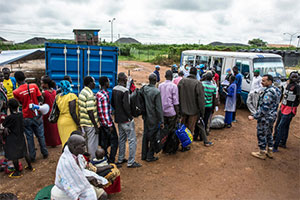 One Thousand Internally Displaced Persons (IDPs) Relocated from Tomping Camp in South Sudan. Credit: UN Photo/Isaac Billy
It took hundreds of thousands of years for the world’s human population to cross one billion in 1804. Approximately 200 years later, the population has multiplied sevenfold. In 2023, the global population crossed 8 billion, and is expected to reach 9 billion before 2050. With the planet more crowded than ever, it is essential to keep track of population trends, urbanization, migration, and reproduction across the world.
Life expectancy has seen significant strides in the past century, largely due to economic development and increased standards of living. On the contrary, trends in global fertility are shifting, with certain regions in Africa and Asia reporting higher rates, while parts of Europe and North America report stagnant or lower rates. This is in part due to differences in sexual and reproductive healthcare, as well as societal and economic conditions around the world. For example, child marriage is prevalent in certain societies, where childbearing is also considered a familial duty. Meanwhile, stagnating economies frequently experience lower marriage and childbearing rates.
The increase in migration and urban development around the world is also linked to global population trends. By 2050, it is expected that approximately 66 percent of all people will live in cities. Furthermore, global crises such as warfare and natural disasters also prompt transnational migration. Transnational migration is linked to a variety of socioeconomic issues in both host and receiving countries: migrants often leave developing countries with less access to educational and economic opportunities and arrive in developed countries where they are frequently the targets of ethnic, racial, and cultural discrimination, and economic exploitation. Recent crises in Europe and the United States demonstrate the importance of advocating for migrants worldwide. As migrants from the Global South are increasingly stripped of their legal and civic rights in unlawful deportations, or targeted in acts of identity-based violence, it is essential to keep track of population trends and protect the human rights of migrant populations. Climate-related disasters are now a major driver of displacement, with nearly half of all new internal displacements in 2025 being disaster-related.
IPS is devoted to covering issues surrounding population trends, migration, and reproduction through its compelling articles, which use both statistics and human stories to provide readers with robust and informative viewpoints.

The Week with IPS

NEXT STOP - SDGs
Tracking global progress towards a sustainable world
Tracking global progress towards a sustainable world
