Languages
Tuesday, October 6, 2026



News and Views from the Global South
Population

Africa Must Increase Spending on Health Care, Education & Modern Contraception
One of the main challenges which we are facing across Africa today is the imperative to empower its largest ever young population and to provide them with opportunities to realise their full potential.
For the Survival of the Nile and its People
Running through eleven countries for 6,853 kilometres, the Nile is a lifeline for nearly half a billion people. But the river itself has been a source of tension and even conflict for countries and territories that lie along it and there have been rumours of “possible war for the Nile” for years now. While to date there has been no outbreak of irreversible tension, experts say that because of increasing changes in the climate a shared agreement needs to be reached on the redistribution of water soon.
Parliamentarians to Assess Population & Development Funding 24 Years After Historic Conference
When international parliamentarians-– both from the developed and developing world— meet in Canada next week, the primary focus would be to assess the implementation of a landmark Programme of Action (PoA) on population and development adopted at a ground breaking UN conference, led by the UN Population Fund (UNFPA), held in Cairo back in 1994.
Q&A: Using Data to Predict Internal Displacement Trends
This year the Internal Displacement Monitoring Centre (IDMC) noted that 2017 saw the highest number of displacements associated with conflict in a decade-11.8 million people. But this is not a situation that is going to be resolved any time soon, says the organisation which has been reporting on displacements since 1998.
True Cost of a Plate of Food Around the World
How much would you expect to pay for the most basic plate of food? The kind of thing you might whip up at home – nothing fancy, just enough to fill you up and meet a third of today’s calorie needs. A soup, maybe, or a simple stew – some beans or lentils, a handful of rice, bread, or corn?
Rural Migration: An Opportunity, Not A Challenge
While it can be a challenging issue, migration must be seen as an opportunity and be met with sound, coherent policies that neither stem nor promote the phenomenon.
Students Go Green to End Global Energy Poverty
In Africa, over 640 million people – almost double the population of United States – have no access to electricity, with many relying on dirty sources of energy sources for heating, cooking and lighting. While not offering a solution to the electricity gap in Africa, Brian Kakembo Galabuzi, a Ugandan economics student, can offer a cleaner and cheaper solution.
Latin America Backslides in Struggle to Reach Zero Hunger Goal
For the third consecutive year, South America slid backwards in the global struggle to achieve zero hunger by 2030, with 39 million people living with hunger and five million children suffering from malnutrition.
Rwanda Leverages Green Climate Fund’s Opportunities to Fast-Track Sustainable Development
In a move to achieve its green growth aspirations by 2050, Rwanda has placed a major focus on promoting project proposals that shift away from "business as usual" and have a significant impact on curbing climate change while attracting private investment.
Kenyan Women Turning the Tables on Traditional Banking and Land Ownership
It was less than eight months ago that Mary Auma and her three children, from Ahero in Kenya’s Nyanza region, were living in a one-room house in an informal settlement. Ahero is largely agricultural and each day Auma would go and purchase large quantities of milk and resell it – earning only a 10 percent profit.
The Caribbean Reiterates “1.5 Degrees Celsius to Stay Alive”
If there is one lesson that Dominican Reginald Austrie has learnt from the devastation Hurricane Maria brought to his country last September, it is the need for “resilience, resilience, resilience”. And it is not just because he is his country’s minister of agriculture.
Transforming Food Systems for Resilience in Africa & Asia
Our food system requires fundamental transformation. Disasters and shocks, from extreme flooding to persistent drought, are occurring more frequently and lasting longer, threatening the food security and livelihoods of millions of small farmers across the globe.
Mother Nature Can Help us Deal With Her Water Disasters
Almost every day we hear news about catastrophic flooding or drought somewhere in the world. And many nations and regions are on track for even more extreme water problems within a generation, the latest IPCC report warns.
Sustainable Development Depends on Better Nutrition for All Nations
From cold chains and blockchains - major technological revolutions are on the brink of transforming food systems.
Senegal’s Migrant Returnees Become Storytellers
Khoudia Ndiaye and Ndeye Fatou Sall set up a smartphone on a tripod to begin recording a video interview with Daro Thiam in Hann Bel-Air, a neighbourhood in Senegal’s capital Dakar. Hann Bel-Air is the departure point for many of the migrants who leave the city and country on irregular routes – boats to Spain, crossing the Sahara desert to the Mediterranean Sea, or to countries nearby.
Women as Influencers
 The Migrants as Messengers awareness-raising campaign (MaM), developed by the International Organization for Migration (IOM), uses innovative mobile technology to empower migrants to share their experiences and to provide a platform for others to do the same.
Conserving Africa’s Precious Resource Base While Fighting Hunger
Rosemary Chate’s seven children gather around the table inside their home in Malela, a village in Zambia’s remote Northern Province. They dig their spoons into bowls of food prepared by their mother – for the second time that day.
TB Remains World’s Single Largest Infectious Killer, says WHO
A disease that we know how to prevent, treat, and cure has become the world’s leading infectious killer: tuberculosis (TB), an airborne bacterial infection.
Consumption & Emissions: Rich Indians v/s Rich (& Poor) Americans
The growing consumption of the ‘rich’ in ‘poor’ countries has been a running theme in the climate change debate for some time now. A large majority of opinion makers in developed countries, especially the US, are convinced that rising consumption of the rich in the developing world is responsible for climate change.
Leveraging the Potential for Green Growth in Vulnerable Countries
In May the United Nations Secretary General Antonio Guterres announced next year’s summit on climate. This assertion has given the Global Green Growth Institute international momentum, which was reflected in the events of the 73rd session of the United Nations General Assembly (UNGA) in New York City.
G20 Women’s Summit Pushes for Rural Women’s Rights
Rural women play a key role in food production, but face discrimination when it comes to access to land or are subjected to child marriage, the so-called affinity group on gender parity within the G20 concluded during a meeting in the Argentine capital.« Previous Page — Next Page »





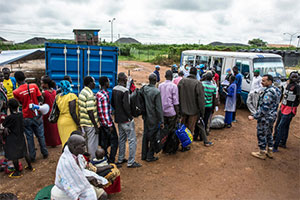 One Thousand Internally Displaced Persons (IDPs) Relocated from Tomping Camp in South Sudan. Credit: UN Photo/Isaac Billy
It took hundreds of thousands of years for the world’s human population to cross one billion in 1804. Approximately 200 years later, the population has multiplied sevenfold. In 2023, the global population crossed 8 billion, and is expected to reach 9 billion before 2050. With the planet more crowded than ever, it is essential to keep track of population trends, urbanization, migration, and reproduction across the world.
Life expectancy has seen significant strides in the past century, largely due to economic development and increased standards of living. On the contrary, trends in global fertility are shifting, with certain regions in Africa and Asia reporting higher rates, while parts of Europe and North America report stagnant or lower rates. This is in part due to differences in sexual and reproductive healthcare, as well as societal and economic conditions around the world. For example, child marriage is prevalent in certain societies, where childbearing is also considered a familial duty. Meanwhile, stagnating economies frequently experience lower marriage and childbearing rates.
The increase in migration and urban development around the world is also linked to global population trends. By 2050, it is expected that approximately 66 percent of all people will live in cities. Furthermore, global crises such as warfare and natural disasters also prompt transnational migration. Transnational migration is linked to a variety of socioeconomic issues in both host and receiving countries: migrants often leave developing countries with less access to educational and economic opportunities and arrive in developed countries where they are frequently the targets of ethnic, racial, and cultural discrimination, and economic exploitation. Recent crises in Europe and the United States demonstrate the importance of advocating for migrants worldwide. As migrants from the Global South are increasingly stripped of their legal and civic rights in unlawful deportations, or targeted in acts of identity-based violence, it is essential to keep track of population trends and protect the human rights of migrant populations. Climate-related disasters are now a major driver of displacement, with nearly half of all new internal displacements in 2025 being disaster-related.
IPS is devoted to covering issues surrounding population trends, migration, and reproduction through its compelling articles, which use both statistics and human stories to provide readers with robust and informative viewpoints.

The Week with IPS

NEXT STOP - SDGs
Tracking global progress towards a sustainable world
Tracking global progress towards a sustainable world
