Languages
Wednesday, September 30, 2026



News and Views from the Global South
Population

Tree Regeneration Restoring Hope
Maurice Kaduka Lukaro, 54, is a farmer in Oljorai, an area with short grasses and small-scattered bushes in Nakuru county in Kenya’s Great Rift Valley. Crop production has declined tremendously in this region. Like the rest of the arid and semi-arid lands (ASAL) in the Sub Saharan region, Maurice Kaduka Lukaro, 54, is a farmer in Oljorai, an area with short grasses and small-scattered bushes in Nakuru county in Kenya’s Great Rift Valley. Crop production has declined tremendously in this region. Like like the rest of the arid and semi-arid lands (ASAL) in the Sub Saharan region, Kenya hosts a population worst hit by the reality of climate change. Kenya hosts a population worst hit by the reality of climate change.
Quake Fear Stalks Kathmandu
Early evening, there is a play of light and shadow over Kathmandu’s famous Durbar Square. The rising monuments, damaged by the April 2015 earthquake, appear as dark silhouettes while large flash lights streak through in between them.
The PELIS Factor
Peter Wainaina’s focus is on the fresh Irish potatoes he has just harvested. He assembles them into a 90-kilogramme bag while sorting out the unmarketable ones like sliced and tiny tubes. He lives on a small plot of land in Njabini, 600 metres away from a farm in Aberdares forest, west central Kenya, where he has been growing this fast-maturing crop for the past three months.
Build Healthy, Sustainable Food Systems to Fight Malnutrition
Creating healthy and sustainable food systems is key to overcoming hunger and all forms of malnutrition (undernourishment, micronutrient deficiencies, obesity) around the world. Food production has tripled since 1945 while average food availability per person has risen by 40 per cent. Current food systems are not delivering well on ensuring healthy diets for all. We have to fix the problem. The most efficient and sustainable approach will be to reshape and strengthen food systems that support healthy diets for all.Will Children of Colombia Know Peace at Last?
“No child in Colombia today knows what it is like to live in a country at peace,” said UN Children’s Fund’s (UNICEF) Representative in Colombia Roberto De Bernardi during the launch of a new report.
Water Crisis in Zimbabwe
A narrow dirty trail snakes through what used to be a small dam in Mpudzi Resettlement Scheme south of the eastern border city of Mutare. And what remains of this once perennial dam is just a small puddle of mudded water; the dirty water is completely covered with thick green algae.
Reaping the Gender Dividend
For the first time, an all-female flight crew recently operated a Royal Brunei Airlines jet from Brunei to Jeddah in Saudi Arabia. Such a feat certainly appears noteworthy in a country where gender segregation is pervasive. When women are still not permitted to drive a car; where there are separate entrances for men and women in banks, is there a possibility of an all-female crew operating a Saudi Airlines plane from Jeddah to Brunei? Not immediately, as there are disturbing signs that the limited gains on the gender front might face reversals.
Corruption Threat to Pacific Island Forests
The vast rainforests of Papua New Guinea (PNG) and the Solomon Islands in the southwest Pacific Ocean are crucial for environmental sustainability, survival of indigenous peoples and the wider goal of containing climate change. But forest degradation, driven primarily by excessive commercial logging, most of which is illegal, is a perpetual threat.
How to Be Happy… By Decree!
When the United Nations was still getting ready to mark this year’s International Day of Happiness on 20 March, the rulers of an Arab State could have well said: ”but we are ahead and have already created a Ministry for Happiness and appointed a young lady to be in charge of it!”
Argentina’s ‘Shale Capital’ Suffers from Slowdown
The dizzying growth of Añelo, a town in southwest Argentina, driven by the production of shale oil and gas in the Vaca Muerta geological reserve, has slowed down due to the plunge in global oil prices, which has put a curb on local development and is threatening investment and employment.
Myanmar’s Rohingya Humanitarian Crisis
The persisting humanitarian crisis of the Rohingya minority in Myanmar has been a global concern after two bouts of organised mass violence against them in 2012. While the Rohingya persecution has been going on for nearly four decades, Myanmar’s reforms launched in 2011 facilitated the international media’s coverage of the mass violence.
Improving Rural Livelihoods Boost Agrarian Economies
For two decades, Dickson Kamau only grew maize on his 0.5 hectare (ha) of land earning himself the nickname Kamau wa mbembe or Kamau who owns maize in his native Kikuyu language.
Rural Costa Rican Families Flourish in the Shade
Before they got involved in farming, Luis Diego Murillo and Xinia Solano paid their bills and put food on their table with Luis’s salary as a foreman on construction sites, an unstable job that kept him on the move.
Outsourcing Jobs, Insourcing Labour & Increasing Profits
For decades “outsourcing” jobs from wealthy developed countries to low-wage developing countries has been a major strategy of many corporations, industries and businesses to increase profits by reducing labor costs and operating expenses.
Fat’s Heavy Burden on the World Economy
About 2.1 billion people are regarded as overweight or obese today, or almost thirty per cent of the world’s population. With over 800 million people estimated to be chronically hungry in the world, it appears that the number of overweight is more than 2.5 times the number of undernourished.
Turkey’s Crackdown on the Press
On the evening of March 4, heavily armed police forced their way into the headquarters of the Turkish daily Zaman. The hundreds of protesters that had gathered in front of the building in an Istanbul suburb in solidarity with their newspaper were violently dispersed.
Clean Clothes – Fashion Free of Slave Labour in Argentina
In Argentina, there are now 20 brand names that guarantee that their garments are produced by workers in decent working conditions, thanks to the Clean Clothes network, aimed at eradicating slave labour in the garment industry, which illegally employs some 30,000 people in sweatshops around the country.
Enriching Education in Bangladesh
About a year ago, seven year-old Afroza Khatun dropped out of school as her mother could not continue supervising her homework. The interruption in her grade II lessons was soon noticed by a teacher of an information education centre known as ENRICH, a state-funded programme which aims at supporting children who drop out to continue their education from the primary level (up to grade II).
Repressive NGO Act
Nearly two weeks after controversially winning a fifth term, it has emerged that Uganda’s President Yoweri Museveni has signed another repressive law which restricts the operations of thousands of NGOs working in the country.
Public Primary Boarding Schools in Pastoral Communities
Jonathan Tipapa is a nine year-old boy whose daily journey to and from school exposes him to many dangers that have seen him come close to dropping out of school -- like many of his friends who can be seen running after cows even on school days. He attends Enkutoto primary school in the expansive Narok South Constituency in the Rift Valley region, approximately 70 miles from the capital Nairobi.
Border Restrictions Violate 1951 Refugee Convention
When the United Nations commemorated “Zero Discrimination Day” on March 1, there was an implicit commitment by the 193 member states to abhor all forms of discrimination – including against women, minorities, indigenous people, gays and lesbians and those suffering from AIDS.« Previous Page — Next Page »


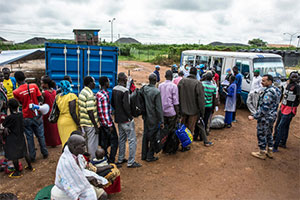 One Thousand Internally Displaced Persons (IDPs) Relocated from Tomping Camp in South Sudan. Credit: UN Photo/Isaac Billy
It took hundreds of thousands of years for the world’s human population to cross one billion in 1804. Approximately 200 years later, the population has multiplied sevenfold. In 2023, the global population crossed 8 billion, and is expected to reach 9 billion before 2050. With the planet more crowded than ever, it is essential to keep track of population trends, urbanization, migration, and reproduction across the world.
Life expectancy has seen significant strides in the past century, largely due to economic development and increased standards of living. On the contrary, trends in global fertility are shifting, with certain regions in Africa and Asia reporting higher rates, while parts of Europe and North America report stagnant or lower rates. This is in part due to differences in sexual and reproductive healthcare, as well as societal and economic conditions around the world. For example, child marriage is prevalent in certain societies, where childbearing is also considered a familial duty. Meanwhile, stagnating economies frequently experience lower marriage and childbearing rates.
The increase in migration and urban development around the world is also linked to global population trends. By 2050, it is expected that approximately 66 percent of all people will live in cities. Furthermore, global crises such as warfare and natural disasters also prompt transnational migration. Transnational migration is linked to a variety of socioeconomic issues in both host and receiving countries: migrants often leave developing countries with less access to educational and economic opportunities and arrive in developed countries where they are frequently the targets of ethnic, racial, and cultural discrimination, and economic exploitation. Recent crises in Europe and the United States demonstrate the importance of advocating for migrants worldwide. As migrants from the Global South are increasingly stripped of their legal and civic rights in unlawful deportations, or targeted in acts of identity-based violence, it is essential to keep track of population trends and protect the human rights of migrant populations. Climate-related disasters are now a major driver of displacement, with nearly half of all new internal displacements in 2025 being disaster-related.
IPS is devoted to covering issues surrounding population trends, migration, and reproduction through its compelling articles, which use both statistics and human stories to provide readers with robust and informative viewpoints.

The Week with IPS

NEXT STOP - SDGs
Tracking global progress towards a sustainable world
Tracking global progress towards a sustainable world
