Languages
Tuesday, September 29, 2026



News and Views from the Global South
Population

Climate Change (I)
Will the Middle East Become ‘Uninhabitable’?
This is not about any alarming header—it is the dramatic conclusion of several scientific studies about the on-going climate change impact on the Middle East region, particularly in the Gulf area. The examples are stark.
Innovations Boost Income for Women Rice Farmers
Salabanya Tabaitou no longer squints from the irritating wood smoke each time she has to parboil her rice paddy. Now Tabaitou feeds logs into a chute of a specially designed brick stove with a chimney that draws away the smoke. The stove with a stainless steel parboiling vessel cooks her rice in 20 minutes - something she would have spent two hours doing using the traditional method.
OPINION: Wake Up! We Need Statesman and Values but We Get Selfish Politicians and Cynicism…
A total indifference has accompanied the number of refugees injured by Macedonian police in Idomeni, where more than 12 000 people, including 4 000 children have been trapped, since Austria asked Macedonia, Serbia, Croatia and Slovenia, to prevent the continuing passage of refugees. Austria has now informed the Italian government that it will send several hundred troops to its border with Italy.
Not So Smart Idea
As Bhubaneswar experiences scorching heat of 43.2 degrees Celsius in early April, 5 degrees above normal, 44-year-old Prasanti Behera barely sleeps at night. Two summers ago, a fire charred 50 homes in her slum and burnt in seconds US$600 she had painstakingly saved over two years for her daughter’s marriage.
Land Tenure Still a Challenge for Women in Latin America
Rural women in Latin America continue to face serious obstacles to land tenure, which leave them vulnerable, despite their growing importance in food production and food security.Female Engineers Defy the Odds
Nearly every aspect of modern life is a result of the work done by engineers; from running water to the internet, sky-scrapers to smartphone apps that people use for dating. Sadly, in Tanzania this profession attracts only a few women due to prevalent attitudes that it is a man’s job.
Conserving the Hilsa
Bangladesh has decided to set up a Hilsa Conservation Trust Fund (HCTF) to protect this fish from over-exploitation due to population growth and effects of climate change.
Focusing on Future of Food: What’s Next for Global Agricultural Research?
Food security scientists from around the globe gathered in Johannesburg last week with one objective: to work towards the transformation of agriculture as engine for growth in developing regions of the world. The gathering was also an opportunity to examine what farmers need to prosper in the face of social and environmental challenges.
Failing States: Many Problems, Few Solutions
Regardless of whether they are called fragile, failed, or failing states, scores of countries around the globe are plagued by overwhelming problems with few solutions in sight. Moreover, the instability and dire straits of these countries are spilling across national borders, destabilizing neighboring countries and regions, while posing enormous challenges for international organizations and donors.
Turning to Agriculture
Facing an unprecedented economic crisis, South Sudan -- the newest nation of the world -- has urged its 12 million inhabitants to turn to agriculture instead of depending on declining oil revenues.
Sri Lanka Braces for Extreme Heat
Sri Lanka is facing the heat from a scorching sun for the past one month. In recent times, the country has imposed power cuts after almost a decade. The main reason was the stoppage at a coal power plant, but engineers at the Ceylon Electricity Board (CEB) admit that the island’s hydro-power generation capacity is at such a critical low that without additional coal, diesel and renewable generation, the country’s full demand for power cannot be met.
Saving Beira
Mozambique’s second largest city, Beira, is heading for climate change-induced disaster. Cyclones, floods, storm surges and the rising sea level are threatening to annihilate this important Indian Ocean coastal city; a city which is strategic for landlocked countries like Zimbabwe and Zambia.
Temple Tantrums
Women comprise nearly half of India's 1.2 billion population, yet gender bias and patriarchal mindsets continue to plague them well into the 21st century. Even holy places -- temples and mosques -- it seems aren't free from discriminating against the fair sex.
Climate Change Dries Up Nicaragua
A three-year drought, added to massive deforestation in the past few decades, has dried up most of Nicaragua’s water sources and has led to an increasingly severe water supply crisis.
Women Benefit From Simple Economic Ventures
Angelina Chiziane starts her day by getting her husband ready for work in a small village in the southern province of Gaza, Mozambique, some 216 kilometers away from the capital, Maputo.
Heavy Rains Once Again Scatter the Poor in Asunción
Néstor Colman, 69, remembers the river overflowing its banks nine times in Bañado Sur, the poor neighourhood in the Paraguayan capital where he was born and has lived all his life. “A record,” he jokes.
Opinion: World Bank Reinvents Tainted Aid Program for Ethiopia
I was taught that responsibility means admitting your mistakes and being accountable when you make a mistake. I still believe this to be true for individuals and institutions. So when a powerful group like the World Bank makes a mistake, I expect it to be accountable for its wrong-doings, and to do everything possible to make sure those mistakes don’t happen again.Yemen’s Health Crisis is “Critical,” Says WHO
The health situation in Yemen has severely deteriorated and is critical, the World Health Organisation (WHO) has reported.
The Rise of Investor-State Dispute Settlement in the Extractive Sectors
African countries have been active in concluding international investment treaties. According to the United Nations Conference on Trade and Development (UNCTAD), as of end 2013, 793 bilateral investment treaties (BITs) have been concluded by African countries, representing 27% of the total number of (BITs) worldwide.
Saving Children’s Lives Through Drones
The first successful test-flight of an unmanned aerial vehicle (UAV) or drone was an unhindered 10 km journey from a community health centre to the Kamuzu central hospital laboratory in the capital Lilongwe. Local community members watched with excitement as the drone rose into the sky, after being launched by the United Nations Children’s Emergency Fund (UNICEF) and government of Malawi at the area 25 health centre.
NGO Pledges $500 Million Towards Sustainable Development Goals
CMMB -Healthier Lives Worldwide– a leading international nonprofit health non-governmental organisation (NGO) – has pledged 500 million dollars to help implement the UN’s Sustainable Development Goals (SDGs)– with a specific focus on maternal, newborn, child and adolescent health.« Previous Page — Next Page »


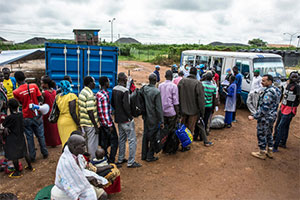 One Thousand Internally Displaced Persons (IDPs) Relocated from Tomping Camp in South Sudan. Credit: UN Photo/Isaac Billy
It took hundreds of thousands of years for the world’s human population to cross one billion in 1804. Approximately 200 years later, the population has multiplied sevenfold. In 2023, the global population crossed 8 billion, and is expected to reach 9 billion before 2050. With the planet more crowded than ever, it is essential to keep track of population trends, urbanization, migration, and reproduction across the world.
Life expectancy has seen significant strides in the past century, largely due to economic development and increased standards of living. On the contrary, trends in global fertility are shifting, with certain regions in Africa and Asia reporting higher rates, while parts of Europe and North America report stagnant or lower rates. This is in part due to differences in sexual and reproductive healthcare, as well as societal and economic conditions around the world. For example, child marriage is prevalent in certain societies, where childbearing is also considered a familial duty. Meanwhile, stagnating economies frequently experience lower marriage and childbearing rates.
The increase in migration and urban development around the world is also linked to global population trends. By 2050, it is expected that approximately 66 percent of all people will live in cities. Furthermore, global crises such as warfare and natural disasters also prompt transnational migration. Transnational migration is linked to a variety of socioeconomic issues in both host and receiving countries: migrants often leave developing countries with less access to educational and economic opportunities and arrive in developed countries where they are frequently the targets of ethnic, racial, and cultural discrimination, and economic exploitation. Recent crises in Europe and the United States demonstrate the importance of advocating for migrants worldwide. As migrants from the Global South are increasingly stripped of their legal and civic rights in unlawful deportations, or targeted in acts of identity-based violence, it is essential to keep track of population trends and protect the human rights of migrant populations. Climate-related disasters are now a major driver of displacement, with nearly half of all new internal displacements in 2025 being disaster-related.
IPS is devoted to covering issues surrounding population trends, migration, and reproduction through its compelling articles, which use both statistics and human stories to provide readers with robust and informative viewpoints.

The Week with IPS

NEXT STOP - SDGs
Tracking global progress towards a sustainable world
Tracking global progress towards a sustainable world
