Languages
Sunday, September 27, 2026



News and Views from the Global South
Population

Mexico Needs to Improve Control of Toxic Chemicals
A recent explosion at a petrochemical plant in southeast Mexico highlighted the need to strengthen monitoring of hazardous substances, step up inspections of factories and update regulations in this country.
Farmers Hold Keys to Ending Poverty, Hunger, FAO Says
With recent data showing that 793 million people still go to bed hungry, ending hunger and poverty in 15 years is the next development challenge that world leaders have set for themselves.
Seeking a New Farming Revolution
As the World Farmers' Organization meets for its annual conference in Zambia to promote policies that strengthen this critical sector, IPS looks at how farmers across the globe are tackling the interconnected challenges of climate change, market fluctuations, water and land management, and energy access.
A Region’s Eyes Turn to Healthy Nutrition
After its remarkable success in reducing hunger, Europe must now rise to the challenge of making sure food assures more than survival and furnishes healthy lives. As head of a global hunger-fighting organization, nothing gives me more satisfaction than to see a vast region of the world achieving food security for its people.
Is the System Broke or Broken?
Though the upcoming World Humanitarian Summit may seem timely, a debate ensues on an important question: is the world humanitarian system broke or broken?
Indian Women Worst Hit by Water Crisis
A staggering 330 million Indians, making up a quarter of the country's population (or roughly the entire population of the United States), are currently reeling under the effects of a severe drought, resulting in an acute drinking water shortage and agricultural distress.
El Nino-Induced Drought in Zimbabwe
Emaciated and with their ribs jutting out, Evans Sinyoro’s cattle lie on the ground overlooking a dry patch of land while the small earth dam nearby is also dry, thanks to the El Nino-induced drought wreaking havoc across Zimbabwe.Pakistani Deportees
In March 2016, the EU signed a far-reaching deal with Turkey to stem the flow of migrants into their union, which has spiked since September 2015. The hastily crafted deal, criticised by the UN for its disregard for human rights safeguards, requires Turkey to accept all migrants currently stranded in Greece, in return for visa-free travel for Turkish citizens to the EU, and a hefty sum of six billion euros.
Playing Ping Pong with Disability
Despite formally adopting progressive laws, such as Law Number 4, and ratifying the UN Convention on the Rights of People with Disability, Palestinian authorities still struggle to get beyond rhetoric when it comes to supporting the 7 to 11 per cent of the population that is affected by disability.
Choose Humanity: Make the Impossible Choice Possible!
We have arrived at the point of no return. At this very moment the world is witnessing the highest level of humanitarian needs since World War Two. We are experiencing a human catastrophe on a titanic scale: 125 million in dire need of assistance, over 60 million people forcibly displaced, and 218 million people affected by disasters each year for the past two decades.
Abortion Saga: Morality vs Choice
Malawi considers itself ‘a god fearing nation’ so much that any act ‘out of the ordinary’ is said to be either satanic, a sin or demonic. Even a drink or a walk could be satanic in the country if you are not careful!
Mauritian Farmers Go Smart
Fifty year-old Prem Kanoosingh rages against his peers who excessively apply chemicals, mostly pesticides and fertilisers, to their crops. "They make cocktails from several products and they use them on their crops. They are criminals", he shouted at a function where the Food and Agricultural Research and Extension Institute launched a bio-farming project in early March 2016.
Harvesting Rainwater to Weather Drought in Northeast Argentina
In a semiarid region in the northeast Argentine province of Chaco, small farmers have adopted a simple technique to ensure a steady water supply during times of drought: they harvest the rain and store it in tanks, as part of a climate change adaptation project.
Forced Closure of Bedouin Settlements
Despite ostensibly freezing the Prawer Plan -- a proposed bill to 'regulate Bedouin settlement in the Negev’-- in 2013, Israel continues to push for forced closure of unrecognised Bedouin villages in this southern region. The village of Umm al-Heran, near the Bedouin township of Hura, is amongst those slated for demolition.
Unsung Heroes of Rural Resilience
In scorching heat, Ellen Kacha, inspects her almost failed maize crop, which now looks promising after a rare occurrence this season -- normal rainfall for at least two weeks.
Climate: Africa’s Human Existence Is at Severe Risk
“Africa’s human existence and development is under threat from the adverse impacts of climate change – its population, ecosystems and unique biodiversity will all be the major victims of global climate change.”
HIV Time Bomb Ticks On
Radhika Banarjee, a 24 year-old CSW, listened carefully at an advocacy gathering in the heart of Dhaka, Bangladesh’s capital.
Champions of Hygiene
Lydia Abuya, a tenant living in the Kaptembwa informal settlement west of Nakuru town, leaves one of the six on-plot toilets. She returns with a pail of water to splash away the waste.
Climate Change and the Middle East (II)
No Water in the Kingdom of the Two Seas—Nor Elsewhere
There is an oil producing country situated in the Gulf region, made of a cluster of islands. It is small, surface and population wise. But it holds the dubious privilege of ranking top of the list out of the 33 countries most likely to be water-stressed in the year 2040.

Climate Change (I)
Will the Middle East Become ‘Uninhabitable’?
This is not about any alarming header—it is the dramatic conclusion of several scientific studies about the on-going climate change impact on the Middle East region, particularly in the Gulf area. The examples are stark.
Innovations Boost Income for Women Rice Farmers
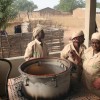
Salabanya Tabaitou no longer squints from the irritating wood smoke each time she has to parboil her rice paddy. Now Tabaitou feeds logs into a chute of a specially designed brick stove with a chimney that draws away the smoke. The stove with a stainless steel parboiling vessel cooks her rice in 20 minutes - something she would have spent two hours doing using the traditional method.« Previous Page — Next Page »


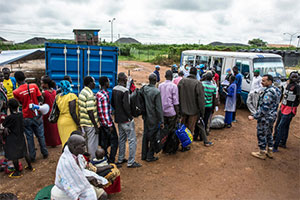 One Thousand Internally Displaced Persons (IDPs) Relocated from Tomping Camp in South Sudan. Credit: UN Photo/Isaac Billy
It took hundreds of thousands of years for the world’s human population to cross one billion in 1804. Approximately 200 years later, the population has multiplied sevenfold. In 2023, the global population crossed 8 billion, and is expected to reach 9 billion before 2050. With the planet more crowded than ever, it is essential to keep track of population trends, urbanization, migration, and reproduction across the world.
Life expectancy has seen significant strides in the past century, largely due to economic development and increased standards of living. On the contrary, trends in global fertility are shifting, with certain regions in Africa and Asia reporting higher rates, while parts of Europe and North America report stagnant or lower rates. This is in part due to differences in sexual and reproductive healthcare, as well as societal and economic conditions around the world. For example, child marriage is prevalent in certain societies, where childbearing is also considered a familial duty. Meanwhile, stagnating economies frequently experience lower marriage and childbearing rates.
The increase in migration and urban development around the world is also linked to global population trends. By 2050, it is expected that approximately 66 percent of all people will live in cities. Furthermore, global crises such as warfare and natural disasters also prompt transnational migration. Transnational migration is linked to a variety of socioeconomic issues in both host and receiving countries: migrants often leave developing countries with less access to educational and economic opportunities and arrive in developed countries where they are frequently the targets of ethnic, racial, and cultural discrimination, and economic exploitation. Recent crises in Europe and the United States demonstrate the importance of advocating for migrants worldwide. As migrants from the Global South are increasingly stripped of their legal and civic rights in unlawful deportations, or targeted in acts of identity-based violence, it is essential to keep track of population trends and protect the human rights of migrant populations. Climate-related disasters are now a major driver of displacement, with nearly half of all new internal displacements in 2025 being disaster-related.
IPS is devoted to covering issues surrounding population trends, migration, and reproduction through its compelling articles, which use both statistics and human stories to provide readers with robust and informative viewpoints.

The Week with IPS

NEXT STOP - SDGs
Tracking global progress towards a sustainable world
Tracking global progress towards a sustainable world
