Languages
Sunday, September 27, 2026



News and Views from the Global South
Population

Climate Change Compounds Humanitarian Crises in Global South
As the Global South works to overcome a history of weak institutions, armed conflict and poverty-driven forced exodus, key causes of its humanitarian crises, developing countries now have to also fight to keep global warming from compounding their problems.
Now 1 in 2 World’s Refugees Live in Urban Areas
It is true that millions of refugees, especially in Africa and the Middle East, reside in camps. But in all they represent only one-quarter of the total number of refugees. Meanwhile, more than 1 in 2 of all the world’s refugees live in slums or in informal settlements and on the fringes of cities, in overcrowded neighbourhoods and in areas prone to flooding, sanitation hazards and diseases.
A Precarious Fate for Climate Migrants in India
After the sea swallowed up her home and family in the Bangladeshi coastal district of Bhola along the Bay of Bengal, farmer Sanjeela Sheikh was heartbroken. Stripped of all her belongings, her fields swamped and her loved ones dead, she contemplated suicide.
Many Cities Don’t Know How Dangerous Their Air Pollution Is
China and India are not the only countries with an air pollution problem. Ninety-eight percent of cities in developing countries don’t meet World Health Organization (WHO) air quality standards, according to new research published by the UN body.
A Latin American Humanitarian Emergency Invisible to the World
“This is a humanitarian crisis,” said Bertha Zúñiga Cáceres, referring to the generalised violence in Mexico and in Honduras and other countries of Central America, which has claimed hundreds of thousands of lives and is a product of transnational crime, but is invisible to the international community.
Kenya’s Young Inventors Shake Up Old Technology
Emma Masibo and Lucy Bwire have many things in common.
A Refugee Crisis with No End in Sight
"We don't want charity, we want a long-term solution."
‘Human Suffering Has Reached Staggering Levels’
“Human suffering from the impacts of armed conflicts and disasters has reached staggering levels.”
Industrial-Level Aid Logistics in Colombia’s Decades-Long Humanitarian Disaster
“If you’re going to talk about Colombia and the peace process, do it somewhere else,” was heard at a regional preparatory meeting for the World Humanitarian Summit, according to Ramón Rodríguez, with the Colombian government’s Unit for Attention and Integral Reparation for Victims (UARIV).
OPINION: Fear Is not a Good Counsellor
A new spectre is haunting the world. It is not the spectre of communism, as Marx’s Manifesto famously proclaimed. It is the spectre of fear, which has increasingly become the rationale behind politics. And, as the old proverb says, fear is not a good counselor.
The Real Heresy of London’s New Mayor Is that He Is a Liverpool Fan?
Sadiq Khan is not just the new mayor of London, but happens to have individually won more votes than any other politician in British history. Prime ministers and members of Parliament run in their home districts, where the total number of ballots are fewer.
Middle East – The Mother of All Humanitarian Crises
When, in March 2015, delegates from the Middle East met in Amman for their regional consultations round in preparation for the May 23-24 World Humanitarian Summit in Istanbul, most likely what they had in mind is the fact that their region was --and still is-- the dramatic set of “the mother of all humanitarian crises.”
Bees and Silkworms Spin Gold for Ethiopia’s Rural Youth
Beekeeping and silkworm farming have long been critical cogs of Ethiopian life, providing food, jobs and much needed income.
Raising Walls Against the Sea
Facing the bleak prospect of millions of its citizens being displaced in coming years due to storms and sea level rise caused by climate change, Bangladesh is building up existing coastal embankments in a bid to protect coastal lands and people.
Breastfeeding Saves Lives But Can’t Compete With Aggressive Marketing
Despite its many lifesaving benefits breastfeeding still struggles to compete with the marketing used by the multi-billion dollar baby formula industry, according to a new report published this week.Refugees and Migrants: A Crisis of Solidarity
This September, the United Nations General Assembly will bring together world leaders to address one of the leading challenges of our time: responding to large movements of refugees and migrants.
Climate Change Leaves Kashmir’s Economy High and Dry
Trudging barefoot on his two-acre piece of land, 57-year-old Mukhtar Ahmad has little hope of growing any crops this year due to the sudden dry spell that has struck Kashmir’s winter.
WFO Calls for Farmer-Centred Sustainable Development
Over 600 delegates representing at least 570 million farms scattered around the world gathered in Zambia from May 4-7 under the umbrella of the World Farmers' Organisation (WFO) to discuss climate change, land tenure, innovations and capacity building as four pillars on which to build agricultural development.
In 2016 Islamophobia is a Political Tool
 When the blasphemous anti Islam cartoons published in 2006 by a Danish newspaper left 205 people dead, the then Secretary General of the Organization of Islamic Cooperation, Ekmeleddin Mehmet Ihsaoglu, went to see Javier Solana who was responsible for foreign affairs of the European Union. The position of the EU was that there was no islamophobia at all, and this was an isolated incident. Since then, this has been more or less the position of the European institutions.

Farmers Can Weather Climate Change – With Financing
Merian Kalala, a farmer in Solwezi, capital of the North-Western Province of Zambia, knows firsthand that climate change is posing massive problems for agricultural productivity.
No Farmers, No Food — True But Not Enough
Agriculture is the primary sector of all economies. It is the sector responsible for granting food and nutrition security to all human beings. Consequently it is responsible for social stability and health. And it provides work opportunities to families, men, women and youth, and largely contributes to the country Gross Domestic Product (GDP).« Previous Page — Next Page »


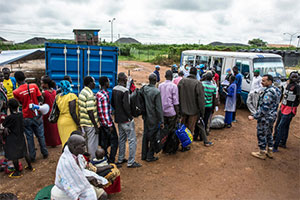 One Thousand Internally Displaced Persons (IDPs) Relocated from Tomping Camp in South Sudan. Credit: UN Photo/Isaac Billy
It took hundreds of thousands of years for the world’s human population to cross one billion in 1804. Approximately 200 years later, the population has multiplied sevenfold. In 2023, the global population crossed 8 billion, and is expected to reach 9 billion before 2050. With the planet more crowded than ever, it is essential to keep track of population trends, urbanization, migration, and reproduction across the world.
Life expectancy has seen significant strides in the past century, largely due to economic development and increased standards of living. On the contrary, trends in global fertility are shifting, with certain regions in Africa and Asia reporting higher rates, while parts of Europe and North America report stagnant or lower rates. This is in part due to differences in sexual and reproductive healthcare, as well as societal and economic conditions around the world. For example, child marriage is prevalent in certain societies, where childbearing is also considered a familial duty. Meanwhile, stagnating economies frequently experience lower marriage and childbearing rates.
The increase in migration and urban development around the world is also linked to global population trends. By 2050, it is expected that approximately 66 percent of all people will live in cities. Furthermore, global crises such as warfare and natural disasters also prompt transnational migration. Transnational migration is linked to a variety of socioeconomic issues in both host and receiving countries: migrants often leave developing countries with less access to educational and economic opportunities and arrive in developed countries where they are frequently the targets of ethnic, racial, and cultural discrimination, and economic exploitation. Recent crises in Europe and the United States demonstrate the importance of advocating for migrants worldwide. As migrants from the Global South are increasingly stripped of their legal and civic rights in unlawful deportations, or targeted in acts of identity-based violence, it is essential to keep track of population trends and protect the human rights of migrant populations. Climate-related disasters are now a major driver of displacement, with nearly half of all new internal displacements in 2025 being disaster-related.
IPS is devoted to covering issues surrounding population trends, migration, and reproduction through its compelling articles, which use both statistics and human stories to provide readers with robust and informative viewpoints.

The Week with IPS

NEXT STOP - SDGs
Tracking global progress towards a sustainable world
Tracking global progress towards a sustainable world
