Languages
Saturday, September 26, 2026



News and Views from the Global South
Population

Malawi’s Drought Leaves Millions High and Dry
It’s Saturday, market day at the popular Bvumbwe market in Thyolo district. About 40 kilometers away in Chiradzulu district, a vegetable vendor and mother of five, Esnart Nthawa, 35, has woken up at three a.m. to prepare for the journey to the market.
Traditional Mexican Recipes Fight the Good Fight
In a clay pot, Araceli Márquez mixes tiny Mexican freshwater fish known as charales with herbs and a sauce made of chili peppers, green tomatoes and prickly pear cactus fruit, preparing a dish called mixmole.
UNFPA Funding Cuts Threaten Women’s Health in Poorer Nations
The UN Population Fund (UNFPA), which has played a key role in ensuring maternal health and promoting reproductive rights of millions of women world-wide, is expected to suffer over $140 million in funding cuts by Western donors this year.
Poorest Countries Have Progressed but Fragile Countries Lag Behind
The world's poorest countries are making development gains, yet challenges remain, particularly for so-called fragile countries affected by conflict or other disasters.
The Humanitarian Clock Is Ticking, The Powerful Feign Deafness
The humanitarian clock is now ticking away faster than ever, with over 130 million of the world’s most vulnerable people in dire need of assistance. But the most powerful, richest countries—those who have largely contributed to manufacturing it and can therefore stop it, continue to pretend not hearing nor seeing the signals.
New and Old Vaccines Still Out of Reach for Many
While long-awaited new vaccines for malaria and dengue may finally be within reach, many of the world’s existing vaccines have remained unreachable for many of the people who need them most.
Least Developed Countries Still Face Significant Challenges
Since the establishment of the Least Developed Countries (LDCs) category in 1971, the international community has worked hand in hand to support its most vulnerable members.
Water Woes Put a Damper on Myanmar’s Surging Economy
The central plains of Myanmar, bordered by mountains on the west and east, include the only semi-arid region in South East Asia – the Dry Zone, home to some 10 million people. This 13 percent of Myanmar’s territory sums up the challenges that the country faces with respect to water security: an uneven geographical and seasonal distribution of this natural resource, the increasing unpredictability of rain patterns due to climate change, and a lack of water management strategies to cope with extreme weather conditions.
Humanitarian Summit, The Big Fiasco
The World Humanitarian Summit (WHS) held in Istanbul on May 23-24, managed to send a strong wake-up call to the world about the unprecedented human suffering now in course, but failed to achieve the objective of attracting the massive funds needed to alleviate the humanitarian drama, as none of the leaders of the Group 7 of the richest countries nor of the five permanent members of the UN Security Council attended, with the exception of the German Chancellor Angela Merkel.
Water Security Critical for World Fastest-Growing Economy
Lack of water management and limited access to data risk hindering Myanmar’s economic growth, making water security a top priority of the new government.
Economic Interests Harming Global Health: WHO Chief
Putting economic interests over public health is leading the world towards three slow-motion health disasters, Margaret Chan, Director-General of the World Health Organization’s warned the world’s health ministers on Monday.
Natural Capital Investment Key to Africa’s Development
Plugging Africa’s funding gaps to accelerate social and economic development requires a fresh approach to using its natural capital, environment experts said on Monday.
Prickly Pears Drive Local Development in Northern Argentina
Family farmers in the northern Argentine province of Chaco are gaining a new appreciation of the common prickly pear cactus, which is now driving a new kind of local development.
Humanitarian Summit: Too Big to Fail?
With a line up of heads of state or government telling all what they did to alleviate human suffering and promising to do more, along with leaders of civil society and humanitarian organisations denouncing lack of honest political will to act while governments continue spending trillions of dollars in weapons, the two-day World Humanitarian Summit kicked off today May 23 in Istanbul.
Bangladesh’s Urban Slums Swell with Climate Migrants
Abdul Aziz, 35, arrived in the capital Dhaka in 2006 after losing all his belongings to the mighty Meghna River. Once, he and his family had lived happily in the village of Dokkhin Rajapur in Bhola, a coastal district of Bangladesh. Aziz had a beautiful house and large amount of arable land.
Humanitarian Summit Aims to Mobilise Up to 30 Billion Dollars
The two-day World Humanitarian Summit (WHS), opening today May 23 in Istanbul, aims at mobilising between 20 and 30 billion dollars to face the on-gowing, worst-ever humanitarian crises, said Stephen O’Brien, UN Under-Secretary-General for Humanitarian Affairs andEmergency Relief Coordinator.
Africa: Resolved to Address African Problems Using African Solutions
The African Union (AU) representing 54 countries and home to 1,2 billion inhabitants, will be in Istanbul to participate in the May 23-24, 2016, first-ever World Humanitarian Summit (WHS) with two key demands—that the international humanitarian system be redefined, and a strong, firm own commitment to itself, to the continent and its people, anchoring on the primacy of the states.
Myanmar Seeks to Break Vicious Circle of Flood and Drought
It has been two weeks now since the village of Htita, with its few bamboo houses hemmed in by parched, cracked earth and dried-out ponds, has enjoyed the novelty of its first ever water well.
When Emergencies Last for Decades
For the millions of people whose lives have been uprooted by conflict and natural disasters the average amount of time before they can return home is now 17 years.
Refugees Bring Economic Benefits to Cities
Refugees are now more likely to live in cities than in refugee camps, bringing with them planning challenges but also opportunities for economic growth.
‘We Cannot Keep Jumping from Crisis to Crisis’
“We cannot keep jumping from crisis to crisis. We have to invest in long-term development that helps people cope with shocks so that they can continue to grow enough food for their communities and not require emergency aid.”« Previous Page — Next Page »


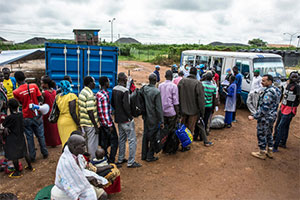 One Thousand Internally Displaced Persons (IDPs) Relocated from Tomping Camp in South Sudan. Credit: UN Photo/Isaac Billy
It took hundreds of thousands of years for the world’s human population to cross one billion in 1804. Approximately 200 years later, the population has multiplied sevenfold. In 2023, the global population crossed 8 billion, and is expected to reach 9 billion before 2050. With the planet more crowded than ever, it is essential to keep track of population trends, urbanization, migration, and reproduction across the world.
Life expectancy has seen significant strides in the past century, largely due to economic development and increased standards of living. On the contrary, trends in global fertility are shifting, with certain regions in Africa and Asia reporting higher rates, while parts of Europe and North America report stagnant or lower rates. This is in part due to differences in sexual and reproductive healthcare, as well as societal and economic conditions around the world. For example, child marriage is prevalent in certain societies, where childbearing is also considered a familial duty. Meanwhile, stagnating economies frequently experience lower marriage and childbearing rates.
The increase in migration and urban development around the world is also linked to global population trends. By 2050, it is expected that approximately 66 percent of all people will live in cities. Furthermore, global crises such as warfare and natural disasters also prompt transnational migration. Transnational migration is linked to a variety of socioeconomic issues in both host and receiving countries: migrants often leave developing countries with less access to educational and economic opportunities and arrive in developed countries where they are frequently the targets of ethnic, racial, and cultural discrimination, and economic exploitation. Recent crises in Europe and the United States demonstrate the importance of advocating for migrants worldwide. As migrants from the Global South are increasingly stripped of their legal and civic rights in unlawful deportations, or targeted in acts of identity-based violence, it is essential to keep track of population trends and protect the human rights of migrant populations. Climate-related disasters are now a major driver of displacement, with nearly half of all new internal displacements in 2025 being disaster-related.
IPS is devoted to covering issues surrounding population trends, migration, and reproduction through its compelling articles, which use both statistics and human stories to provide readers with robust and informative viewpoints.

The Week with IPS

NEXT STOP - SDGs
Tracking global progress towards a sustainable world
Tracking global progress towards a sustainable world
