Languages
Sunday, November 8, 2026



News and Views from the Global South
Poverty & SDGs

Power of Partnerships in the Fight Against Poverty
The 2030 Agenda is the most ambitious plan governments have ever developed to eradicate extreme poverty and safeguard our planet. While it is a global agenda, it will only be achieved by addressing the multidimensional aspects of poverty and through ensuring ownership on the part of communities, local authorities and individuals.
Inequality also Relates to Education, Health & Illiteracy, not Wealth Alone
Antipoverty group Oxfam International got a lot of attention for claiming that there’s a global “inequality crisis,” but a far more important point is entirely neglected: globally, income distribution is less unequal than it has been for 100 years.
China, Once the Final Resting Place for Half the World’s Trash, Bans Waste Products
China, once the final resting place for half the world’s trash, has just banned the import of certain plastic, paper and textile waste. Western countries are scrambling to shift ‘the problem’ elsewhere – but there could be another way. They could invest more in the circular economy, which would also help them achieve the 2030 Agenda. But what exactly is the circular economy?
One Migrant’s Brutal Odyssey Through Libya
Thirty-year-old Nazir Mohammed sits on one of the two sofas in his single room in Kwame Danso, a small town about 290 kilometres north of Ghana’s capital Accra, reflecting on life back in Libya.
Business Unusual will Drive Africa’s Quest to achieve Health Care for All
Africa’s quest for health continues to be held back by a combination of factors such as natural disasters and pandemics, prevailing high rates of communicable and rising incidence of non-communicable diseases, sedentary lifestyles, road accidents and greater population mobility.
Survival of Indigenous Tribes in Bangladesh Starts at School
Just before sundown on Jan. 30, a group of women day labourers from the Shantal indigenous community are in a rush to wind up their work harvesting potatoes in a field in the village of Boldipukur, some 15 km away from Rangpur district in northern Bangladesh.
Healthy Nutrition Spreads in El Salvador’s Schools
Eating healthy and nutritious food in schools in El Salvador is an effort that went from a pilot plan to a well-entrenched programme that has now taken off.
Climate Change is Hurting Children the Most: Here is How to Protect Them
In the United States, the 21 young people who are plaintiffs in the case Juliana v. United States will soon make their case against the government for failing to take action against climate change. Similar lawsuits have been filed in countries including Portugal, India, and Pakistan.
The Potential of School Meals to Change the Nutrition Landscape in Africa
Tackling malnutrition is essential for the realisation of the Sustainable Development Goals by 2030, and will be critical for the African continent to reach its full development potential.
Impact of Climate Change on Karachi May be One of Pakistan’s Biggest Threats
Historically a small fishing village, Karachi has now turned into Pakistan’s biggest commerce and industrial center that generates about half of the country’s tax revenue.
Wars, Crises and Catastrophes Drive Immigration to Brazil
The war in Angola, the earthquake in Haiti, Venezuela’s political crisis and shortages and the political repression in the Democratic Republic of the Congo are the main driving factors behind the recent waves of immigration to Brazil.
Gender Empowerment: What Will You Do in 2018 to make a Change?
In the last year, a women’s rights tidal wave flooded the world: over 4 million people marched in the first “Women’s March” in January 2017, and over a million marched a year later, from Washington DC to New York, from Sydney to Osaka, and from Rome to Nairobi.
Climate-Related Disasters Cost Nearly $400 Billion in 2017
I am pleased to be with you at this important and timely summit on climate risk and to discuss the opportunities that are there for us to seize through decisive climate action.
Are Grants For Losers?
Mark Ritchie, former Minnesota Secretary of State and former president of the Minneapolis-based Institute for Agriculture and Trade Policy, sent Felix an email about a very interesting interview with Kevin Watkins, the CEO of Save the Children Fund (UK). The interview and commentary was by Russell Hargrave in devex: “Save the Children CEO on a new era of competition for aid”.
Create “Sponge Cities” to Tackle Worsening Floods
With floods now causing more damage more frequently around the world, it is time to counter their effects by turning our towns into "Sponge Cities", a recent trend popularised by China to absorb rainwater through permeable roads and pavements, parks, rooftop gardens and other green spaces.
Why Humanitarian Assistance Needs Rigorous Evaluation
According to the United Nations Office for the Coordination of Humanitarian Affairs (UNOCHA) and the Financial Tracking Service (FTS), the number of people in need of humanitarian aid in 2017 rose to 141.1 million and they were located in 37 countries.
Latin America Makes Headway Against Land Degradation
Two-thirds of the 33 countries of Latin America and the Caribbean have already submitted or are preparing to submit to the United Nations their land degradation goals, to combat a problem that threatens agriculture and the lives of their people.
How Natural Disasters Undermine Schooling
In 2010, heavy monsoons led to devastating floods in Pakistan that destroyed 11,000 schools. Thousands of additional schools had to be used as community shelters, preventing them from operating as classrooms. In the immediate aftermath of climate-related events such as this, damage to schools and infrastructure often interrupt a child’s education.
Women on the Front Lines of Halting Deforestation
In Zimbabwe, the bulk of rural communities and urban poor still get their energy supplies from the forests, leading to deforestation and land degradation.
Tackling Inequality – The Myth that Davos Can Change the World
When the World Economic Forum (WEF) concluded in Davos, Switzerland last week, the outcome of the annual talk-fest was seemingly predictable—plenty of unrestrained platitudes but, surprisingly, less of the American populist, protectionist rhetoric.
Trump’s 1st State of the Union: Refugee Policy & What Will Likely Go Unsaid
It is unlikely that President Trump will reverse his policies toward refugees in his State of the Union address on 30 January. Despite his expected silence on the state of U.S. and global refugee policy, there is a lot to say about how refugee policy has changed and will change in the future.« Previous Page — Next Page »





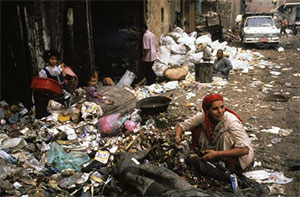 Romani people in Cairo, Egypt, forage through trash. Credit: UN Photo/Armineh Johannes
In 2015, the United Nations adopted the Sustainable Development Goals (SDGs) in an effort to promote “peace and prosperity for people and the planet.” To achieve that goal, it is essential to provide equal opportunities and access to basic services to all people. The 2025 UN SDG Report found that 35% of the 169 SDG targets are on track or making moderate progress, while 18% have reversed compared to the 2025 baseline. One in ten people still live in extreme poverty, one in eleven experience food insecurity, and over 1.1 billion people live in slums without access to clean water and sanitation. It is imperative to acknowledge the societal, technological, economic, and political issues that sustain poverty in countries around the world. Eradicating poverty will require significant frameworks in policy and governance on a national and international scale to ensure that all people will have equal access to basic services and economic opportunities by 2030. Furthermore, a dramatic reduction of United States foreign aid in 2025, including the termination of 83% of USAID programmes, threatens to erode years of fragile development gains.
Throughout the world, violent conflict and natural disasters also contribute to extreme poverty. The complete destruction of infrastructure and blockage of aid has significantly impoverished Palestine since October 7th. The destructive impact of Hurricane Maria in Puerto Rico left $91 billion in damage. An inadequate US government response also revealed significant and enduring questions within the issue of mitigating poverty: how do we rebuild infrastructure after its destruction? How do we restimulate economic development and bring in financial aid after disasters? Similar questions have been raised in the realm of regional cooperation, as devastating floods have wrecked hundreds of thousands of homes across multiple Southeast Asian nations in the past few years. Furthermore, the COVID-19 pandemic has greatly exacerbated the global poverty crisis, particularly in developing countries, setting back the United Nations goal of eradicating poverty by 2030.
IPS is committed to providing comprehensive features that focus on the persisting environmental, sociopolitical, and systemic issues that sustain poverty, and the steps taken worldwide towards poverty eradication.

The Week with IPS

NEXT STOP - SDGs
Tracking global progress towards a sustainable world
Tracking global progress towards a sustainable world

