Languages
Sunday, November 8, 2026



News and Views from the Global South
Poverty & SDGs

Decent Toilets for Women & Girls Vital for Gender Equality
This weekend marks World Toilet Day (November 19)-- and the news is disheartening. One in three people are still waiting for a toilet; still having to face the indignity and often fear of relieving themselves in the open or using unsafe or unhygienic toilets.
Climate Change: The World’s Poorest Will Judge us by Action
Two years ago, 197 parties came together in Paris and agreed to the historical Paris Framework. Since that December 2015, we all have seen countless pictures of utterly devastating floods, wildfires, hurricanes happening more and more frequently all over our planet mainly affecting the poorest among us.
Good to Know (Perhaps) That Food Is Being ‘Nuclearised’
It might sound strange, very strange, but the news is that scientists and experts have been assuring, over and again, that using nuclear applications in agriculture --and thus in food production—are giving a major boost to food security. So how does this work?
Girls in Afghanistan—and Everywhere Else—Need Toilets
"I never come here, just because of boys," Atifa says, pointing at the door of the stall. "They're opening the door." Atifa, a sixth grader in Kabul, Afghanistan, attends a school of 650 girls. Since they study in tents in a vacant lot, the only toilets the girls have access to are on the far side of the boys' school next door. The school is one of a very few for girls in the area, so some students walk over an hour each way to get there.
Vanuatu: Community Farms Helping Small Islands Adapt to Climate Change
Here in Vanuatu, the ocean has been getting warmer and more acidic. Scientists are predicting that cyclone patterns will change, we’ll see heavier rainfalls, a wetter wet season and a drier dry season. We’re already seeing the sea rising six millimeters per year in the capital, Port Vila; higher than the global average.
On Gender Day at Climate Meet, Some Progress, Many Hurdles
“Five years ago, when we first started talking about including gender in the negotiations, the parties asked us, ‘Why gender?’ Today, they are asking, ‘How do we include gender?’ That’s the progress we have seen since Doha,” said Kalyani Raj.
How to Ensure Farming is More Than Just a Footnote in Climate Talks
If change comes from within, then climate action in agriculture must logically start with farmers. They need to find ways to adapt to and mitigate climate change. But when that involves 800 million of the world’s poorest people, they are going to require systematic and dedicated support.
The Mekong, Dammed to Die
In Laos, the lush forests are alive with the whines of drills that pierce the air. On the Mekong, a giant concrete wall rises slowly above the trees. The Don Sahong dam is a strong symbol, not only for a power-hungry Asia but also for what critics fear is a disaster in the making.
The Harsh Plight of 152 Million Child Labourers
While trillions of dollars are being spent on exploring remote galaxies, Planet Earth is still home to harsh realities that could be easily –and much less expensively—resolved. One of them is that worldwide 152 million children are currently victims of child labour.
Are Prospects of Rural Youth Employment in Africa a Mirage?
Many recent accounts tend to dismiss productive employment of youth in rural areas in Africa as a mirage largely because they exhibit strong resistance to eking out a bare subsistence in dismal working and living conditions. We argue below on recent evidence of agricultural transformation that this view is overly pessimistic, if not largely mistaken.
How US Is Taking Climate Action Without Trump
Even after President Trump announced his intention to pull the United States out of the Paris Agreement, much of the country is moving forward with climate action anyway. According to new analysis, more than 2,500 non-federal actors representing more than half the U.S. economy—including cities, counties, states, businesses and more—have pledged their support for the Paris Agreement goals. If these actors were their own country, they’d be the world’s third-largest economy.
Economic Development vs. Climate Action: Rebutting Deniers and Wafflers
As negotiators meet in Bonn to put together a deal to implement the Paris Agreement, John Holdren, a professor of environmental policy at the John F. Kennedy School of Government, Harvard University, stressed that economic development and climate change mitigation and adaptation are not ‘either-or’ but must be pursued together.
Climate Change Poses Alarming Threat to Food Security in Pacific Islands
A high-level meeting of political leaders -– hosted by the Food and Agriculture Organisation (FAO) -– sounded an ominous warning: that climate change poses an “alarming threat to food systems and food security in the Pacific islands.”
Nations without Nationality – An ‘Unseen’ Stark Reality
Here’s another ‘unseen’ stark reality—that of millions of people around the world who are deprived of their identity, living without nationality. Their total number is by definition unknown and their only ‘sin” is that they belong to an ethnic, religious or linguistic minority in the country where they have often lived for generations.
SLIDESHOW: Two Models of Development in Struggle Coexist in Brazil’s Semi-arid Region
 Irrigated green fields of vineyards and monoculture crops coexist in Brazil’s semiarid Northeast with dry plains dotted with flowering cacti and native crops traditionally planted by the locals. Two models of development in struggle, with very different fruits.

“Refugees Are Nothing but Commodities”
As countless refugees arriving on Italy’s shores report torture, extortion and forced labour in Libyan detention centers, many say they never intended to make the journey to Europe until the chaos in Libya left them no other choice.
Will Policymakers Listen to Climate Change Science This Time Around?
Climate change is altering the ecosystem of our oceans, a big carbon sink and prime source of protein from fish. This is old news.
Pacific Communities Building Resilience in the Face of Climate Change
In the Pacific, climate change is an ever-present threat, undermining human rights, livelihoods, and security. Pacific Islanders are working with courage and resolve to build the resilience of their communities and to catalyse international actions towards ending global carbon pollution.
Fighting the Creeping Catastrophe of Climate Change
November 8 marks the fourth anniversary of Haiyan’s landfall in the Philippines. The super typhoon was the strongest ever to make landfall.
Conservation Agriculture: Zambia’s Double-edged Sword against Climate Change and Hunger
As governments gather in Bonn, Germany for the next two weeks to hammer out a blueprint for implementation of the global climate change treaty signed in Paris in 2015, a major focus will be on emissions reductions to keep the global average temperature increase to well below 2°C by 2020.
4 Reasons for Countries to Enhance Climate Commitments by 2020
The Paris Agreement was widely hailed for drawing all nations together to tackle climate change, based on bottom-up contributions that will be reviewed and strengthened over time. These contributions are aimed at achieving the ambitious but necessary long-term goals of limiting global temperature increase and building resilience to climate impacts.« Previous Page — Next Page »





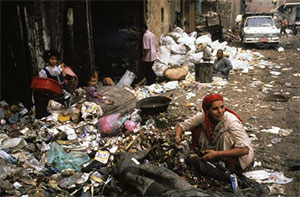 Romani people in Cairo, Egypt, forage through trash. Credit: UN Photo/Armineh Johannes
In 2015, the United Nations adopted the Sustainable Development Goals (SDGs) in an effort to promote “peace and prosperity for people and the planet.” To achieve that goal, it is essential to provide equal opportunities and access to basic services to all people. The 2025 UN SDG Report found that 35% of the 169 SDG targets are on track or making moderate progress, while 18% have reversed compared to the 2025 baseline. One in ten people still live in extreme poverty, one in eleven experience food insecurity, and over 1.1 billion people live in slums without access to clean water and sanitation. It is imperative to acknowledge the societal, technological, economic, and political issues that sustain poverty in countries around the world. Eradicating poverty will require significant frameworks in policy and governance on a national and international scale to ensure that all people will have equal access to basic services and economic opportunities by 2030. Furthermore, a dramatic reduction of United States foreign aid in 2025, including the termination of 83% of USAID programmes, threatens to erode years of fragile development gains.
Throughout the world, violent conflict and natural disasters also contribute to extreme poverty. The complete destruction of infrastructure and blockage of aid has significantly impoverished Palestine since October 7th. The destructive impact of Hurricane Maria in Puerto Rico left $91 billion in damage. An inadequate US government response also revealed significant and enduring questions within the issue of mitigating poverty: how do we rebuild infrastructure after its destruction? How do we restimulate economic development and bring in financial aid after disasters? Similar questions have been raised in the realm of regional cooperation, as devastating floods have wrecked hundreds of thousands of homes across multiple Southeast Asian nations in the past few years. Furthermore, the COVID-19 pandemic has greatly exacerbated the global poverty crisis, particularly in developing countries, setting back the United Nations goal of eradicating poverty by 2030.
IPS is committed to providing comprehensive features that focus on the persisting environmental, sociopolitical, and systemic issues that sustain poverty, and the steps taken worldwide towards poverty eradication.

The Week with IPS

NEXT STOP - SDGs
Tracking global progress towards a sustainable world
Tracking global progress towards a sustainable world

