Languages
Saturday, November 21, 2026



News and Views from the Global South
Poverty & SDGs

ZIMBABWE: One Million Casualties of Land Reform
The seizure of large commercial farms - almost all white-owned - has continued despite the formation of a unity government in Zimbabwe. The country's farm workers say they are the biggest losers.
DEVELOPMENT: Yemen to Lead South in U.N. Negotiations
The republic of Yemen, categorised by the United Nations as one of the world's "least developed countries" (LDCs), will lead the largest single coalition of developing nations this year: the 130-member Group of 77 (G77).
Q&A: “U.S. Should Invest in New U.N. Women’s Agency”
One year after U.S. President Barack Obama's inauguration, how has his administration fared in terms of advancing an agenda for women's rights around the world?
MAURITIUS: These Women Chose the Sea
She cannot swim, but Marie-Claite Hector is not afraid of the ocean. The 53-year-old pushes her small boat with all her strength towards the blue lagoon, starts the engine, and sets out to sea.
ZIMBABWE: Water Scarcity No Obstacle To Bulawayo Farmers
A project in Zimbabwe's second city, Bulawayo, is creatively using "marginal water" to ease water scarcity while helping residents provide food and earn a living.
GHANA: Quietly Extending Options to Women
Juliana Kweais has a small scar on her bottom lip, from the first time she witnessed an abortion. The sharp blow to her mouth was delivered by her grandmother, after the then-13-year-old Kweais had asked why her auntie had given "birth" to a bloody sack.
MALI: Small Farmers in the Carbon Market
Mohamed Abd Khibé is a caretaker at the acacia nursery in Dialoubé village, part of a project to sequester carbon in trees while simultaneously improving farmers' livelihoods.BRAZIL: ‘Colonisation Made Us Poor,’ Say Indigenous Peoples
"We weren't poor until colonisation made us poor," indigenous leader Marcos Terena said at the Rio de Janeiro launch of a United Nations report on the State of the World's Indigenous Peoples.
KENYA: Clash Over Abortion Rights in New Constitution
A harmonised draft constitution has now been handed over to Kenya's Parliamentary Select Committee. Influential Christian leaders are warning that the question of abortion could derail the constitutional review process.
MIDEAST: Will You Marry Poor Me
"If we had money we'd get married right away," says Samir*, 23. He has found his bride, but not the money to hold the wedding.LIBERIA: Paper Rights Flimsy Protection
Just a few metres outside the front door of a large white-washed courthouse in north central Liberia, Tete Garwo sells small plastic bags of cold water and passes time by pleading her case to thirsty customers. The 40-year old woman describes how she was forced out of her house by an abusive husband, then deprived of her half of the property.BIODIVERSITY: A Tipping Point on Species Loss?
Humanity is destroying the network of living things that comprise our life support system. While this sawing-through-the-branch-we're-perched-on is largely unintentional, world leaders can't say they didn't know what's going on: 123 countries promised to take urgent action in 2003 but have done little to stem the rising tide of extinctions in what's known as the extinction or biodiversity crisis.
Q&A: Sweden Vows to Sustain Aid Levels to Poorer Nations
Sweden has pledged to maintain its current level of development aid to the world's poorer nations - roughly at about one percent of gross national product (GNP) - despite the global financial crisis.
MALAWI: Green Belt Initiative Taking Shape
Let the rains fail, even for several successive seasons, and Malawi should still be able to produce enough to feed itself.
NIGERIA: Lake Communities Left High and Dry
The fittest are fleeing the shores of Lake Chad: Adamu Modu, a young fisherman, is joining a stream of able-bodied men heading south to find work in the southern part of the country.URUGUAY: Coming Together to Tackle Climate Change
Fighting the front line battle against global warming, with the participation of all sectors of society, is the cornerstone of a United Nations Development Programme (UNDP) pilot project in Uruguay that is drawing attention from the rest of the world.AGRICULTURE: Three-Quarters of Hungry Are Rural Poor
Climate change, associated with a four-fold increase in natural disasters in the last decade, and the growth of world population, which is expected to reach nine billion by 2050, pose new challenges for aid initiatives like those of the United Nations World Food Programme (WFP).
SPECIAL OP-ED: Why Women’s Reproductive Freedom Ensures Our Survival
Fifteen years ago in Beijing, then first lady, Hillary Clinton, stated firmly, "Women's rights are human rights." Today, after eight years of non-existent U.S. support for women's reproductive rights, Secretary of State Clinton is reviving women's hopes around the globe by affirming the Obama Administration's support for the International Conference on Population and Development Action Plan.CHILE: Eliminating Slums
Chile, touted as Latin America's great economic success story, has gone a long way towards reducing poverty and eliminating the country's slums. But a new study shows that disadvantages are still faced by 50,000 children living in shantytowns.
SOUTH SUDAN: Women’s Eyes on the Political Prize
January marks the fifth anniversary of the Comprehensive Peace Agreement (CPA) which ended a bitter north-south civil war in Sudan. With important elections scheduled for April, women are debating and fighting for an expanded role in the new institutions of government.SOUTH AFRICA: HIV Stigma Persists
HIV-related stigma and discrimination remain a key concern in South Africa, despite the multitude of HIV awareness campaigns that have been launched by government and civil society organisations throughout the years, health experts say.« Previous Page — Next Page »


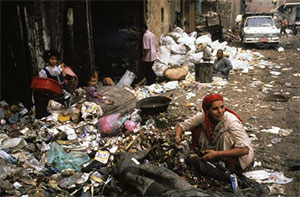 Romani people in Cairo, Egypt, forage through trash. Credit: UN Photo/Armineh Johannes
In 2015, the United Nations adopted the Sustainable Development Goals (SDGs) in an effort to promote “peace and prosperity for people and the planet.” To achieve that goal, it is essential to provide equal opportunities and access to basic services to all people. The 2025 UN SDG Report found that 35% of the 169 SDG targets are on track or making moderate progress, while 18% have reversed compared to the 2025 baseline. One in ten people still live in extreme poverty, one in eleven experience food insecurity, and over 1.1 billion people live in slums without access to clean water and sanitation. It is imperative to acknowledge the societal, technological, economic, and political issues that sustain poverty in countries around the world. Eradicating poverty will require significant frameworks in policy and governance on a national and international scale to ensure that all people will have equal access to basic services and economic opportunities by 2030. Furthermore, a dramatic reduction of United States foreign aid in 2025, including the termination of 83% of USAID programmes, threatens to erode years of fragile development gains.
Throughout the world, violent conflict and natural disasters also contribute to extreme poverty. The complete destruction of infrastructure and blockage of aid has significantly impoverished Palestine since October 7th. The destructive impact of Hurricane Maria in Puerto Rico left $91 billion in damage. An inadequate US government response also revealed significant and enduring questions within the issue of mitigating poverty: how do we rebuild infrastructure after its destruction? How do we restimulate economic development and bring in financial aid after disasters? Similar questions have been raised in the realm of regional cooperation, as devastating floods have wrecked hundreds of thousands of homes across multiple Southeast Asian nations in the past few years. Furthermore, the COVID-19 pandemic has greatly exacerbated the global poverty crisis, particularly in developing countries, setting back the United Nations goal of eradicating poverty by 2030.
IPS is committed to providing comprehensive features that focus on the persisting environmental, sociopolitical, and systemic issues that sustain poverty, and the steps taken worldwide towards poverty eradication.

The Week with IPS

NEXT STOP - SDGs
Tracking global progress towards a sustainable world
Tracking global progress towards a sustainable world

