Languages
Wednesday, November 25, 2026



News and Views from the Global South
Poverty & SDGs
INT’L WOMEN’S DAY-SOUTH AFRICA: A Fight Against Cultural Norms on Violence
International Women's Day, commemorated Thursday, is this year focused on bringing those who abuse women and girls to book. The theme is a pertinent one for South Africa, where the twin challenges of tackling domestic violence and ending impunity have topped the agenda of women's groups for years.INT’L WOMEN’S DAY: Major Lenders Urged to Enforce Gender Rights
Dozens of international civil society groups have endorsed a call to the World Bank and the International Monetary Fund (IMF) to require enforceable gender protections and equality for women as conditions for project financing in developing nations.INT’L WOMEN’S DAY-INDIA: Two Steps Forward, One Backward
A government report released as part of an extensive national family health survey has come as a rude shock for a state long regarded as progressive. It placed Tamil Nadu high on a list of states where wife-beating is common.BURMA: Women Take Brunt of Ethnic Minorities’ Struggles
At 17 she was in Geneva, not as a tourist but as an invitee speaker at the annual sessions of the United Nations Commission on Human Rights. In 2005, aged 24, she had a celebrated hour-long meeting with U.S. President George W. BushLABOUR-THAILAND/BURMA: Education May Limit Abuse of Migrant Children
Troubled by the exploitation of migrant child on the Thai-Burma border, a labour rights group is seeking an unusual pact with the Thai government. The Migrant Action Programme (MAP) wants support to help educate the victims.TRADE: EU in Dialogue of the Deaf with Poor Countries
The European Commission and a grouping of countries from Africa, the Caribbean and the Pacific are no nearer an agreement on trade liberalisation after their latest effort.LATIN AMERICA: A Few Women in Power, Millions Still Powerless
Appointing a woman as economy minister does not guarantee a gender approach to policies in this key area, traditionally handled by men. That at least is the conclusion from observing the work of women ministers in Argentina and El Salvador.INT’L WOMEN’S DAY-KENYA: Courts Far From a Safe Haven
As the world marks International Women's Day, Thursday, under the theme of 'Ending Impunity for Violence Against Women and Girls', activists in Kenya claim there is much to do in ensuring that abusers are punished.DEVELOPMENT-CAMEROON: Solar Power Starts Muscling Out Kerosene
For Merline Momo Azeufac, a teacher at Balefock village in western Cameroon, the days of fearing nightfall while correcting pupils' work are over. She's no longer hostage to the poor light provided by kerosene lamps.CUBA-VENEZUELA: Making Biofuels Without Wasting Food
The governments of Cuba and Venezuela are planning to move forward together on biofuels production, but they will rely on producing alcohol from sugarcane, in order to spare food crops.HEALTH-AFRICA: Making Policies for AIDS in the Workplace, Commonplace
With AIDS cutting a swathe through Africa's workforce, there is an urgent need for employers to set up policies that support HIV-positive staff - and ensure they are not victims of stigma. But, it's a need that often goes unaddressed.FOOD-CUBA: Anxious About What to Eat
One of the main worries of the average Cuban family is food, which costs about two-thirds of their income, according to several studies.CONGO-BRAZZAVILLE: Success Stories Amongst Growing Numbers of Street Kids
Sixteen-year-old Bamanandoki Pitchou hasn't finished his apprenticeship in hairdressing yet, but he already has a small business. A former street child who lives in Kinsoundi - a suburb in the south of the Congolese capital, Brazzaville - Pitchou trains in the morning, and attends to clients in the afternoon.PAKISTAN: NGOs Balk at Gov’t Prescribed Code of Conduct
Non-government organisations (NGOs) are bristling at a government proposal to impose a ‘code of conduct' on them that will put their activities under close scrutiny and, if found wanting, allow their funds to be frozen.ENVIRONMENT-SENEGAL: Setting Fire to the Future
It's the season for bush fires in Senegal, and there are once again concerns that vast tracts of fertile land could be set alight, and ravaged.ARGENTINA: Rolling Back Privatisation of Pensions
The Argentine Congress approved reforms of the pension system that will strengthen the role of the state, after the partial privatisation of the system that was carried out in the 1990s. Chile is also planning similar reforms.ENVIRONMENT-CHAD: Rats, Where There Once Were Elephants
Leaving the Chadian capital, N'Djamena, isn't what it used to be.
BOLIVIA: Floodwaters Besiege Amazonian Town
Seen from the air, the capital of the Bolivian department of Beni is surrounded by an enormous stretch of water. Local residents are hoping that the polluted floodwaters, only 40 centimetres below the level of the ring road which is acting as a dike, do not overwhelm it.ENVIRONMENT: The Niger River in Intensive Care
Stretching over more than 4,000 kilometres, the Niger is West Africa's longest river, and greatly threatened in the country of the same name by environmental degradation that is causing the water course to silt up.BRAZIL: Soap Opera Actors Stand Up for Amazon Jungle
An open letter demanding "an immediate halt to the deforestation of the Amazon jungle" has been released by Brazilian television stars taking part in the Globo Network series " Amaz- nia, de Galvez a Chico Mendes" (Amazonia, from Galvez to Chico Mendes).MEXICO: Discharge of HIV-Positive Troops Ruled Unconstitutional
Mexico's Supreme Court ruled that it is unconstitutional for the military to expel HIV-positive members, a practice that is habitually followed by the armed forces.« Previous Page — Next Page »


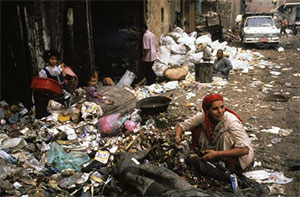 Romani people in Cairo, Egypt, forage through trash. Credit: UN Photo/Armineh Johannes
In 2015, the United Nations adopted the Sustainable Development Goals (SDGs) in an effort to promote “peace and prosperity for people and the planet.” To achieve that goal, it is essential to provide equal opportunities and access to basic services to all people. The 2025 UN SDG Report found that 35% of the 169 SDG targets are on track or making moderate progress, while 18% have reversed compared to the 2025 baseline. One in ten people still live in extreme poverty, one in eleven experience food insecurity, and over 1.1 billion people live in slums without access to clean water and sanitation. It is imperative to acknowledge the societal, technological, economic, and political issues that sustain poverty in countries around the world. Eradicating poverty will require significant frameworks in policy and governance on a national and international scale to ensure that all people will have equal access to basic services and economic opportunities by 2030. Furthermore, a dramatic reduction of United States foreign aid in 2025, including the termination of 83% of USAID programmes, threatens to erode years of fragile development gains.
Throughout the world, violent conflict and natural disasters also contribute to extreme poverty. The complete destruction of infrastructure and blockage of aid has significantly impoverished Palestine since October 7th. The destructive impact of Hurricane Maria in Puerto Rico left $91 billion in damage. An inadequate US government response also revealed significant and enduring questions within the issue of mitigating poverty: how do we rebuild infrastructure after its destruction? How do we restimulate economic development and bring in financial aid after disasters? Similar questions have been raised in the realm of regional cooperation, as devastating floods have wrecked hundreds of thousands of homes across multiple Southeast Asian nations in the past few years. Furthermore, the COVID-19 pandemic has greatly exacerbated the global poverty crisis, particularly in developing countries, setting back the United Nations goal of eradicating poverty by 2030.
IPS is committed to providing comprehensive features that focus on the persisting environmental, sociopolitical, and systemic issues that sustain poverty, and the steps taken worldwide towards poverty eradication.

The Week with IPS

NEXT STOP - SDGs
Tracking global progress towards a sustainable world

