Languages
Thursday, November 26, 2026



News and Views from the Global South
Poverty & SDGs
COLOMBIA: Murders Down, but Indigenous Group Still Hemmed In
"It is not only beautiful, but it is rich in livestock, minerals and water," says a man wearing a wide-brimmed hat who looks every bit the tough cowboy, looking out at the spectacular view of the Sierra Nevada de Santa Marta from the airport at the northern Colombian city of Valledupar.IMMIGRATION: Portugal Opens Doors, Bucks EU Trend
A decision reached Thursday by Portugal's Council of Ministers to facilitate the legalisation of undocumented migrants is a significant step towards integrating more than half a million foreign workers into society at large, and at the same time runs counter to the European trend of ever tighter border controls.NEPAL: Undying Hunger in the Hinterland
Here on the narrow trails carved into the steep, emerald hills that plunge into the winding Karnali River hundreds of metres below, villagers have one thing on their minds: emergency rice.RIGHTS: Native People Demand Self-Determination
Leaders of the world's 370 million indigenous people are calling for the United Nations General Assembly to recognise native peoples' right to self-determination.COLOMBIA: Kankuamo Indians Have Paid High Price in Blood
The killings have decreased but "in Rioseco and Murillo we still have problems caused by the war," says Jaime Arias, the leader of the Kankuamo Indians, referring to two of the 12 villages and towns inhabited by the ethnic group in the Sierra Nevada de Santa Marta mountain range in northern Colombia.HEALTH: Cautious Optimism on Eve of Global AIDS Meet
The world's largest gathering of HIV/AIDS experts and activists will meet in Toronto starting on Sunday with renewed hopes of halting the spread of this devastating disease, which an estimated 40 million people are currently living with.HEALTH: Groups Lobby U.N. to Face Diabetes Threat
In the last two decades, the number of people suffering from diabetes has increased almost seven-fold, straining health care systems around the world and leaving millions of families to struggle with the emotional and financial drain of a chronic disease.SOUTH AMERICA: Defining Women’s Fears to Tackle Them
Carolina, a 26-year-old Chilean woman, has recurring nightmares in which she is attacked by her ex-boyfriend. For several months after their break-up, he harassed her so much she had to go to the police.LABOUR-COLOMBIA: Flower Power – But Not for the Workers
The Free Trade Agreement (FTA) between Colombia and the United States that could be signed in October or November this year will maintain the tariff exemptions already enjoyed by Colombia's flourishing flower industry. But there are no plans for higher wages and better working conditions for the industry's 100,000 workers.AFGHANISTAN: Drought, Poppy Profits Cause Wheat Shortage
Millions of Afghans are facing hunger because of a food shortage that the government and aid agencies say is because of a prolonged dry spell in the country.LATIN AMERICA: Poverty Reduction Still Major – but Not Impossible – Challenge
Latin America and the Caribbean have made significant headway towards most Millennium Development Goals (MDGs). Poverty reduction, however, still looms as a major - yet surmountable - challenge for some countries.ARGENTINA: Residents Face Uranium Threat in Water Supply
Argentine judicial authorities are investigating cases of uranium contamination around the Ezeiza Atomic Centre, in Buenos Aires province. A married couple who have been diagnosed with cancer have been accepted as plaintiffs in a related lawsuit.ENVIRONMENT-EUROPE: Human Waste Threatens Sea Life
Human-made waste is poisoning the seas around Europe, according to a report by a French research institute.ENVIRONMENT-NIGER: City Takes Step to Protect Forest
As fears of its destruction mount, city authorities have taken steps to protect the forest, or the greenbelt, around Niamey and evict squatters living within its confines. The forest protects the city from encroaching desertification and the extremes of Niger's climate.DEVELOPMENT: Remittances Do More Than Investments
The British are not investing a great deal in the developing world, but remittances from Britain are emerging as a growing counter to poverty, a new survey shows.FINANCE: IMF Chief Previews New Focus on Poor Nations
The International Monetary Fund (IMF) says it is moving to give poor nations greater say and representation on its board of directors and to refocus its work to help prevent financial crises in those nations.COLOMBIA: Displaced Women Build New Lives, Brick by Brick
"The City of Women", in the northern Colombian municipality of Turbaco, 11 kilometres from the fortified walls of this tourist resort city, bears no resemblance to Federico Fellini's 1980 film by the same name, or to the similarly dubbed Buenos Aires neighbourhood of Puerto Madero, where almost all the streets and public spaces are named for famous women.PANAMA: Residents Evicted as Buildings Are Restored
The historic centre of Panama City has never looked better, thanks to the restoration of picturesque buildings, improved sidewalks and tighter security. However, thousands of residents have been forced to leave their homes as government and private investors have moved in.EDUCATION-AFGHANISTAN: Schools Shut Down on Taliban Orders
Lack of infrastructure and lawlessness have forced thousands of children out of schools in Afghanistan this year, according to news reports.BOLIVIA: Indigenous President Chalks Up Impressive Early Results
The "democratic and cultural revolution" launched by Bolivia's first indigenous president, Evo Morales, when he took office in late January hit its six-month mark with impressive economic and political indicators.MEDIA: Workshop Eyes Millennium Goals Through Gender Lens
Journalists participating in a recent workshop found themselves scrambling when asked to define the words sex and gender - despite having frequently used the terms in their articles.« Previous Page — Next Page »


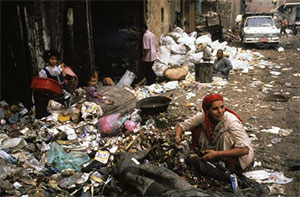 Romani people in Cairo, Egypt, forage through trash. Credit: UN Photo/Armineh Johannes
In 2015, the United Nations adopted the Sustainable Development Goals (SDGs) in an effort to promote “peace and prosperity for people and the planet.” To achieve that goal, it is essential to provide equal opportunities and access to basic services to all people. The 2025 UN SDG Report found that 35% of the 169 SDG targets are on track or making moderate progress, while 18% have reversed compared to the 2025 baseline. One in ten people still live in extreme poverty, one in eleven experience food insecurity, and over 1.1 billion people live in slums without access to clean water and sanitation. It is imperative to acknowledge the societal, technological, economic, and political issues that sustain poverty in countries around the world. Eradicating poverty will require significant frameworks in policy and governance on a national and international scale to ensure that all people will have equal access to basic services and economic opportunities by 2030. Furthermore, a dramatic reduction of United States foreign aid in 2025, including the termination of 83% of USAID programmes, threatens to erode years of fragile development gains.
Throughout the world, violent conflict and natural disasters also contribute to extreme poverty. The complete destruction of infrastructure and blockage of aid has significantly impoverished Palestine since October 7th. The destructive impact of Hurricane Maria in Puerto Rico left $91 billion in damage. An inadequate US government response also revealed significant and enduring questions within the issue of mitigating poverty: how do we rebuild infrastructure after its destruction? How do we restimulate economic development and bring in financial aid after disasters? Similar questions have been raised in the realm of regional cooperation, as devastating floods have wrecked hundreds of thousands of homes across multiple Southeast Asian nations in the past few years. Furthermore, the COVID-19 pandemic has greatly exacerbated the global poverty crisis, particularly in developing countries, setting back the United Nations goal of eradicating poverty by 2030.
IPS is committed to providing comprehensive features that focus on the persisting environmental, sociopolitical, and systemic issues that sustain poverty, and the steps taken worldwide towards poverty eradication.

The Week with IPS

NEXT STOP - SDGs
Tracking global progress towards a sustainable world

