Languages
Friday, November 13, 2026



News and Views from the Global South
Labour
Wild Seismic Predictions Disputed
Without in-depth scientific documentation of marine mammal strandings, natural history and animal behaviour, the prediction of seismic events based on behaviour of marine mammals is not widely accepted. Sceptics often dismiss such predictions as conjecture.TRADE: “Poor Countries Have Already Given Enough in Doha Round”
South Africa has expressed sharp concern over concerted attempts by leading industrialised countries, particularly the U.S. and the European Union (EU), to extract onerous commitments from developing countries as a condition to concluding the stalled Doha Round trade negotiations.
WORLD SOCIAL FORUM: Fisheries Need Transparent Regulation
Senegalese fishers participating in the 2011 World Social Forum (WSF) warned governments to "wake up to the ethical and transparent regulation of access to fisheries" to halt the overexploitation of this increasingly scarce resource.
EGYPT: Labour Unrest Feeds Growing Protests
President Hosni Mubarak's speech Thursday night in which he refused to quit has provoked anger and could spark further unrest. Massive demonstrations, and pitched battles between pro-democracy protesters and the regime’s security forces, have already been intensifying in every corner of the country.
SRI LANKA: Garment Industry Woos Women Workers
Sri Lanka’s garment industry has launched a multi-million rupee campaign to bring in female workers shunning the country’s most profitable sector for better paying jobs.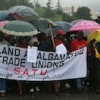
AFRICA: Swaziland in Crisis as Customs Union Revenue Is Slashed
Apart from the looming job losses in Swaziland’s public sector, small and medium enterprises (SMEs) have also warned of retrenchments following the government’s decision to suspend procurement from small businesses.
ZIMBABWE: Activists Seek WSF Solidarity Against Privatisation
Zimbabwean activists will raise the issue of privatisation at the World Social Forum, taking place Feb 6-11 in Dakar, Senegal, and seek solidarity from other activists to resist a renewed government attempt at selling Zimbabwe’s state- owned enterprises.SRI LANKA: Domestics Court Risks, Defying Age Bar
Sri Lanka has raised the age requirement for women wanting to leave the country to work as domestics abroad, but recruitment agents say this won’t prevent younger women from joining the exodus.
WORLD SOCIAL FORUM: Dakar to Dhaka
Is it more important to build links with African civil society groups or concentrate on existing networks in the South Asian region? That is the dilemma before Indian delegates heading for the World Social Forum in Dakar, Senegal, and some who have opted out.
Questions About China’s “Win-Win” Relationship With Angola
Crouched on their haunches on the edge of a crumbling pavement, a group of Chinese construction workers are eating noodles from tin bowls, wearing floppy straw hats under their green safety helmets to protect them from the aggressive midday sun.U.S.: Spate of Trade Deals Move Toward Passage
On the heels of U.S. President Barack Obama's State of the Union address Tuesday in which he focused squarely on resuscitating the economy, pressure is mounting in the nation's capital to move forward with free trade agreements (FTAs) whose passage would promote exports and create jobs.
DEVELOPMENT-UGANDA: Fair Trade Gives Coffee Farming a Lift
The cultivation of coffee beans for fair trade has turned the fortunes of this historical cash crop around in some poor rural areas on the slopes of Mount Elgon in eastern Uganda.GUATEMALA: High Staple Food Prices Drive Up Hunger
The rise in prices of corn, beans and other staple foods, driven up by damages to crops caused by extreme weather events, is making it even harder for the poor to afford a basic diet in Guatemala, which has the highest rate of child malnutrition in Latin America.MEXICO: Native Craftswomen Harness Their Skills
It took María de los Ángeles Carrillo, a native craftswoman from Mexico, eight months to weave a decorative junco reed basket, for which she won an 8,000 dollar prize from the Mexican government.Arab Regimes Fear Bread Intifadah
"Break my heart but don’t come near my bread," goes an old Arabic proverb. Failure to observe it has often come at a high political price.China Moves to End ‘Modern Slavery’
Authorities in remote Xinjiang province rescued a group of mentally ill men last month. The men had been sold by a shelter operator and forced to work in a factory. The rescue shone a light on the darkest side of China’s rapid economic growth – slavery.
LEBANON: Trashy Bag Gets Trendy
Wafa Saab, a high-powered executive at the leading Lebanese-manufactured paint company Tinol, is an environmentally friendly fashionista. On her arm hangs a pink and blue gym bag. It’s made of garbage.
ZIMBABWE: Protecting the Zambezi’s Kapenta Fish
"The fish are disappearing." The words and the world-weary gaze could belong to a fisherman from almost anywhere, as stocks come under pressure due to over-exploitation all over the world.
SRI LANKA: Media Freedom Still Distant
January is indelibly linked to the tumultuous recent history of the media in Sri Lanka. Two years ago, on Jan. 8 Lasantha Manilal Wickrematunge, editor of the The Sunday Leader newspaper, was murdered while on his way to work.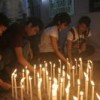
Suicides Rise Across India
"India has become the suicide capital of the world," says Daya Sandhu, a counselling psychology professor at the University of Louisville in the U.S.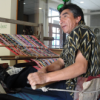
ECUADOR: Keeping Age-old Weaving Technique Alive
Outside the modest two-story adobe house, a flag of Ecuador flutters alongside a large sign that reads "Ikat: weaving demonstrations and sales." Hanks of yarn and colourful fabrics hang from the handrail running around the edge of the courtyard and balcony, and weaving looms can be seen inside.« Previous Page — Next Page »


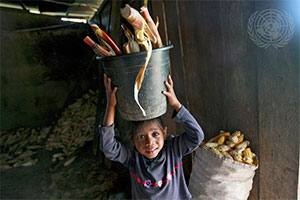 Timorese Girl with Fresh-Picked Corn. Credit: UN Photo/Martine Perret
A global common denominator is the need for a decent job. The economic realities of each country determine just how difficult it is to find one. Despite the labour movement's achievements, serious challenges persist: gender discrimination, child labour, worker migration, the digital divide and AI automation, evaporating pensions, unsafe workplaces, corporate pressure against union organising, negative impacts of trade agreements, and the precariousness of informal employment. The 2025 UN SDG Report identifies jobs and social protections as one of the six priority areas requiring urgent action, with progress either stalled or reversing in many developing nations.
In recent years, the fight to protect labour equality has taken on new dimensions with the rise of Environmental, Social and Governance standards. With the Social aspect aiming to promote equality and human rights, ESG principles have strengthened labour advocacy within corporate and governmental regulatory landscapes. In particular, ESG has become much more institutionalized in emerging economies such as Brazil and China. IPS follows the world’s workers as they confront these challenges - their setbacks and their successes.

The Week with IPS

NEXT STOP - SDGs
Tracking global progress towards a sustainable world
Tracking global progress towards a sustainable world
