Languages
Saturday, November 14, 2026



News and Views from the Global South
Labour
JAMAICA: Nursing Exodus May Only Get Worse
The shortage of nurses throughout the Caribbean has reached chronic proportions, in a region already struggling with an ailing health care system.
THAILAND: Bloody Crackdown Exposes Battle Lines in Class War
The morning after the Thai troops’ bloody crackdown on anti-government protesters here, the mood among them remained as it was after the guns had gone silent only hours before. The red shirts, called such because of their signature protest colour, appeared defiant, edgy and, in some cases, victorious.
PERU: Miners Call Off Protests for Talks; Six Killed in Clashes
In response to a government promise to negotiate, small-scale gold miners in southern Peru temporarily called off protests Wednesday in which six people were killed and as many as 30 injured when the police attempted to clear a roadblock.
EGYPT: Looking Away From the Disabled
Egyptians find it hard to see past Mahrousa Salem's wheelchair, so they look away.LATIN AMERICA-EU: Labour Pains
Trade with the European Union has not significantly improved the situation of workers in Latin America, in spite of its volume having doubled between 1990 and 2007, according to a study by two Chilean academics.TRADE: Something’s Rotten in European Supermarkets
The majority of European supermarkets failed to take adequate responsibility for labour conditions and fair-trade relationships in their food supply chains, a new report revealed.URUGUAY: Improving Conditions for Waste Pickers
"The time will come when 80 percent of the raw material used by industry in Uruguay will be recycled waste products," Marcelo Conde, a 40-year-old garbage sorter who has been digging through trash for recyclables "for as long as I can remember," says with some pride.SRI LANKA: Managing Overseas Workers A Tough Balancing Act
The extent of Sri Lanka’s dependence on its one million citizens who work abroad can be gauged from officials who gleefully count the dollars that come in to sustain the country’s economy.RIGHTS-GUATEMALA: ‘Our Lives Are Cut Short at a Stroke’
"This is a time of great tension because we know that at any moment, when we least expect it, our lives can be cut short at a stroke," Tito Gálvez, a leader in the Resistance Front for the Defence of Natural Resources and Rights of the Guatemalan Peoples (FRENA), told IPS.RIGHTS: Fewer Jobs, Less Money, Same Old Story
"What do I get from them? Nothing but bullsh*t," says Nupur Acharya, reflecting about how she is treated by her husband and two grown sons on daily basis.DEVELOPMENT-SRI LANKA: Water Woes Fall on Women’s Shoulders
As a wife of a rice farmer and mother of two children aged nine and two, Sanjeevani Bandara’s days are packed with chores. Yet while she used to be able to keep up with all she has to do in a day, this Sri Lankan mother now finds herself struggling to accomplish even the most basic tasks.THAILAND: Migrant Worker Law Hits Hurdle as 500,000 ‘Disappear’
Thailand’s labour ministry is on the hunt for half a million migrant workers from neighbouring Burma who have gone underground rather than join a new foreign workers’ programme, one that some critics have described as a "confusing" initiative.
MIDEAST: Occupation Turns Palestinian Women Into Breadwinners
Israel’s occupation of the Palestinian territories, with its ubiquitous closures, checkpoints, military raids and arrests, has decimated the Palestinian economy in the West Bank and Gaza.ENVIRONMENT-LEBANON: Coastal Pollution Threatens Fisherfolk
Pollution, oil spills and difficult living conditions are some of the challenges that fishermen in this eastern Mediterranean country face daily.
JORDAN: Where Iraqi Women Are Also Fathers
Back in Najaf, Iraq, Khayzaran and her family lived in a well-kept house. They had two cars and a small orchard. Her children, two girls and three boys, attended school and came home to modest feasts.SRI LANKA: Halt in EU Tariff Scheme Gives Workers the Jitters
For garment factory workers like Anoma Piyaseele, the European Union’s (EU) concessionary tariffs for imports from Sri Lanka meant little more than a vague term for policymakers to deal with – until news came that they would be suspended soon.RIGHTS-THAILAND: Fears of Mass Deportation of Migrants Rise
Dao, a migrant worker from Burma, is struggling to make a decision that could affect not only her but her family as well. "There are many things to worry about," sighed the Shan state native who works in the northern Thai city of Chiang Mai.
SOUTHERN AFRICA: Women Traders Demand Support
Support for regional trade is one of the cornerstones of the Southern African Development Community (SADC). But the focus has been on large scale trade in goods and services, ignoring one important group trading throughout the region.
ASIA: Through Art, A Look at Migrants’ Temporary State of Being
"Migrant workers are not aliens," sang a local music band here called Paradon. "Any kind of work that Thais don’t do, they do it for Thais. No matter how dirty, they do it for Thai. Which job is dangerous, they do. They do it for Thais. Though it is a demeaning job, they do it. They do it for Thais."DEVELOPMENT-ASIA: ‘Poverty Still Has a Woman’s Face’
Women and poverty still share an uncomfortable spot on the development matrix of countries across Asia-Pacific that are struggling to end deprivation, according to the newly launched third joint report of the United Nations and the Asian Development Bank (ADB) on the Millennium Development Goals (MDGs).
INDIA: Education as Empowerment Tool for Children of Sex Workers
"May I come in, Miss?" asks seven-year-old Ajmiri Khatun, her face beaming with her radiant smile. Her teacher, Pujo Roy, gladly welcomes her into the eight-square-foot educational facility designed for Indian children like her.« Previous Page — Next Page »


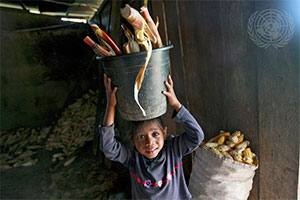 Timorese Girl with Fresh-Picked Corn. Credit: UN Photo/Martine Perret
A global common denominator is the need for a decent job. The economic realities of each country determine just how difficult it is to find one. Despite the labour movement's achievements, serious challenges persist: gender discrimination, child labour, worker migration, the digital divide and AI automation, evaporating pensions, unsafe workplaces, corporate pressure against union organising, negative impacts of trade agreements, and the precariousness of informal employment. The 2025 UN SDG Report identifies jobs and social protections as one of the six priority areas requiring urgent action, with progress either stalled or reversing in many developing nations.
In recent years, the fight to protect labour equality has taken on new dimensions with the rise of Environmental, Social and Governance standards. With the Social aspect aiming to promote equality and human rights, ESG principles have strengthened labour advocacy within corporate and governmental regulatory landscapes. In particular, ESG has become much more institutionalized in emerging economies such as Brazil and China. IPS follows the world’s workers as they confront these challenges - their setbacks and their successes.

The Week with IPS

NEXT STOP - SDGs
Tracking global progress towards a sustainable world
Tracking global progress towards a sustainable world
