Languages
Wednesday, September 30, 2026



News and Views from the Global South
Labour

Why Aren’t More Women Angry?
Why aren’t more women angry about their subordination, discrimination, and unequal treatment in the 21st century? Of course, some of the world’s women are angry, but they are comparatively few.
Small-Scale Fishers in Central America Demand Social Security Policies
At the pier, Salvadoran fisherman Nicolás Ayala checked the pocket of his pants to make sure he was carrying the hypertension pills he must take when he is at sea on a 24-hour shift. He smiled because he hadn’t forgotten them.
Assisting At-Risk Youth Becomes Life’s Work for Trafficking Survivor
Arien Pauls-Garcia’s journey to working with at-risk youth in California was long and dangerous and started at 19 when she found herself sold and exploited by traffickers.
Despite Unspeakable Hardships, Migrants Keep One Billion People Alive
Here goes another fact: 230 million migrant workers are now a major life-saving source for up to one billion people starving in the world’s poorest communities, as well as a vital lifeline for the economy of their countries of origin.
Child Labour Survivor Has a Dream of Freeing Others
Selimatha Dziedzorm Salifu was just seven years old when she went to work for the first time to support her family. Born in the fishing village, Kpando-Torkor, in Ghana, Salifu, was forced to go out and work in the local fishing industry when her father Seidu died, leaving her mother, Mary, with six children to feed, clothe and shelter. The industry is well documented for child slavery and trafficking.
All Africa Student Leader says Political Will, Collective Action, Education and Social Packages Can End Child Labour
Samuel Sasu Adonteng, programme officer for the All-Africa Students Union (AASU), believes that the recent 5th Global Conference on the Elimination of Child Labour has taken us closer to ending child labour for the first time because the voices of those affected were heard.
Former Child Labourer Says Free Quality Education Key to Ending Child Labour
Lucky Agbavor sleeps on a mattress in a church in Accra, Ghana sells juice to earn an income, and has been a child labourer since he was four. Now he has made an impact on the international stage when he participated in the 5th Global Conference on the Elimination of Child labour.
Employee-run Companies, Part of the Landscape of an Argentina in Crisis
"All we ever wanted was to keep working. And although we have not gotten to where we would like to be, we know that we can," says Edith Pereira, a short energetic woman, as she walks through the corridors of Farmacoop, in the south of the Argentine capital. She proudly says it is "the first pharmaceutical laboratory in the world recovered by its workers."
Fighting Inflation Excuse for Class Warfare
A class war is being waged in the name of fighting inflation. All too many central bankers are raising interest rates at the expense of working people’s families, supposedly to check price increases.
Reclaiming Our Future
The Asia-Pacific region is at a crossroads today – to further breakdown or breakthrough to a greener, better, safer future. Since the Economic and Social Commission for Asia and the Pacific (ESCAP) was established in 1947, the region has made extraordinary progress, emerging as a pacesetter of global economic growth that has lifted millions out of poverty.
Youth Survivors, Activists Will Hold Governments Accountable to Call to Action on Ending Child Labour
Governments of the world must focus on providing quality free education and prosecuting corrupt officials and people who siphon state and donor funds as crucial steps towards taking decisive action to fight child labour across the globe.
Youth Demand a Voice in Call-To-Action on Child Labour
Ashley has vast work experience. She has laboured by the sweat of her brow in the blistering sun on the streets of Guatemala, in the open fields on farmlands and indoors, toiling for long hours to the hum of a sewing machine. Her work resume might be impressive to some – street trader, farmworker and tailor – but she, like 160 million children around the world, is trapped in child labour, working desperately to support her impoverished family and provide for her education.
Former Child Labourer, now Lawyer, Passes Light of Freedom to Others
Amar Lai’s first memories are working alongside his parents and siblings in a quarry, breaking rocks. He was aged four. Now chatting to Lai, a confident 25-year-old human rights lawyer, it is hard to believe he was once a child labourer.
Technology for Tracing the Work of Child Labour Could Help End the Practice
Technology used to trace the origin and price of consumer goods to ensure farmers earn fair profits could easily be adapted as a tool to fight child labour Fair Trade living wage and income lead Isa Miralles told delegates at the 5th Global Conference on the Elimination of Child Labour.
Political Will and Partnerships Key to Ending Child Labour, says ILO’s Joni Musabayana
With a strong commitment from governments, businesses, labour and consumers, the scourge of child labour can be eliminated, says Dr Joni Musabayana, Director of the International Labour Organisation (ILO) in Pretoria, South Africa.
Africa Expected to Strongly Support Durban Call to Action on Child Labour
Global goals to eradicate child labour will not be achieved without a breakthrough in Africa, where most of the world’s 160 million children entrapped in child labour work in rural regions, mostly in agriculture with their families.
Call to Invest ‘Serious Resources’ in Education, to Stem Tide of Child Labour
"Education is the most powerful weapon you can use to eliminate child labour." So said Dennis Sinyolo, Director of Education International's African Regional Office in Accra, Ghana adapting liberation icon and late South African president Nelson Mandela's famous quote about how education can change the world.
From Child Laborer to Activist, Tara Banjara Asks World to Pledge to End the Scourge
Tara Banjara was four and a half years old when her parents put her to work on the roads, cleaning the garbage and rubble out of potholes to prepare for construction in Nemdi village, Rajasthan, India. She worked in the wind, cold, and rain with her mother, day in and day out, year in and year out. She would return home shattered, too exhausted to eat before falling asleep each night.
Child Labour: No Quick End to Children Trapped in Tobacco Production
Despite World Day Against Child Labour launched in 2002 by the International Labour Organization (ILO), little has changed over the past two decades for the millions of children who remain trapped.
When Saviours Are the Problem
Central bank policies have often worsened economic crises instead of resolving them. By raising interest rates in response to inflation, they often exacerbate, rather than mitigate business cycles and inflation.
It’s Time To Globalise Compassion, Says Nobel Laureate Kailash Satyarthi
A mere 53 billion US dollars per annum – equivalent to 10 days of military spending – would ensure all children in all countries benefit from social protection, Nobel Laureate Kailash Satyarthi told the 5th Global Conference on the Elimination of Child Labour.« Previous Page — Next Page »


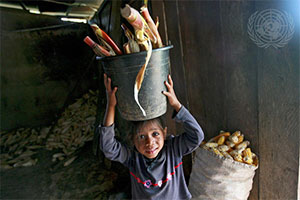 Timorese Girl with Fresh-Picked Corn. Credit: UN Photo/Martine Perret
A global common denominator is the need for a decent job. The economic realities of each country determine just how difficult it is to find one. Despite the labour movement's achievements, serious challenges persist: gender discrimination, child labour, worker migration, the digital divide and AI automation, evaporating pensions, unsafe workplaces, corporate pressure against union organising, negative impacts of trade agreements, and the precariousness of informal employment. The 2025 UN SDG Report identifies jobs and social protections as one of the six priority areas requiring urgent action, with progress either stalled or reversing in many developing nations.
In recent years, the fight to protect labour equality has taken on new dimensions with the rise of Environmental, Social and Governance standards. With the Social aspect aiming to promote equality and human rights, ESG principles have strengthened labour advocacy within corporate and governmental regulatory landscapes. In particular, ESG has become much more institutionalized in emerging economies such as Brazil and China. IPS follows the world’s workers as they confront these challenges - their setbacks and their successes.

The Week with IPS

NEXT STOP - SDGs
Tracking global progress towards a sustainable world
Tracking global progress towards a sustainable world
