Languages
Tuesday, October 27, 2026



News and Views from the Global South
Labour

As the World’s Population Hits 8 Billion People, UN Calls for Solidarity in Advancing Sustainable Development for All
The global population is projected to reach 8 billion on 15 November 2022, signalling major improvements in public health that have lowered the risk of dying and increased life expectancy. But the moment is also a clarion call for humanity to look beyond the numbers and meet its shared responsibility to protect people and the planet, starting with the most vulnerable.
COP27 Fiddling as World Warms
The latest annual climate conference has begun in the face of a worsening climate crisis and further retreats by rich nations following the energy crisis induced by NATO sanctions after the Russian invasion of Ukraine. Copping out again The 27th Conference of the Parties (COP 27) to the United Nations Framework Convention on Climate Change (UNFCCC) is now meeting in Sharm-el-Sheikh, Egypt, from 6 to 18 November 2022.
A World of 8 Billion: Population Growth Will Continue But it’s Slowing Down
Global population is about to reach 8 billion, a mere 11 years after it reached 7 billion. The official Day of 8 Billion is observed by the UN November 15, though it's hard to pinpoint exactly when we pass the actual milestone.
Developing Countries Need Monetary Financing
Developing countries have long been told to avoid borrowing from central banks (CBs) to finance government spending. Many have even legislated against CB financing of fiscal expenditure. Central bank fiscal financing Such laws are supposedly needed to curb inflation – below 5%, if not 2% – to accelerate growth. These arrangements have also constrained a potential CB developmental role and government ability to respond better to crises.
Macroeconomic Policy Coordination More One-Sided, Ineffective
Widespread adverse reactions to the UK government’s recent ‘mini-budget’ forced new Prime Minister Liz Truss to resign. The episode highlighted problems of macroeconomic policy coordination and the interests involved.
Government Indifference Deprives the Trafficked of Compensation
Fourteen-year-old Priti Pyne was returning from school in Basra village in South 24 Parganas, West Bengal, when she and a friend came across a cold-drink seller selling an attractive-looking drink. The moment the girls sipped it, however, they felt dizzy. When they woke up, it was on a Delhi-bound train at Sealdah station in Kolkata. With the help of other passengers, the girls managed to get off the train.
Stop Worshiping Central Banks
Preoccupied with enhancing their own ‘credibility’ and reputations, central banks (CBs) are again driving the world economy into recession, financial turmoil and debt crises.
Persons with Disabilities Integral Players in Determining Innovative Solutions to Fully Inclusive Societies
Ten years ago, the Asia-Pacific region came together and designed the world’s first set of disability-specific development goals: the Incheon Strategy to “Make the Right Real” for Persons with Disabilities. This week, we meet again to assess how the governments have delivered on their commitments, to secure those gains and develop the innovative solutions needed to achieve fully inclusive societies.
Agroecological Women Farmers Boost Food Security in Peru’s Highlands
Lourdes Barreto, 47, says that as an agroecological small farmer she has improved her life and that of Mother Earth. "I love myself as I love Mother Earth and I have learned to value both of us," she says in her field outside the village of Huasao, in the highlands of the southern Peruvian department of Cuzco.
Reform Needed As Big Business, Not Vulnerable Communities Benefit from Post-Pandemic Support
Governments and international financial institutions must adopt new ways of providing post-pandemic support, say campaigners after a report found that in many poorer countries, big business benefitted most from Covid-19 recovery funds. At the same time, vulnerable communities have been “left behind.”
Central Bank Myths Drag down World Economy
The dogmatic obsession with and focus on fighting inflation in rich countries are pushing the world economy into recession, with many dire consequences, especially for poorer countries. This phobia is due to myths shared by most central bankers.
Ideology and Dogma Ensure Policy Disaster
Central banks (CBs) around the world – led by the US Fed, European Central Bank and Bank of England – are raising interest rates, ostensibly to check inflation. The ensuing race to the bottom is hastening world economic recession.
Inflation Phobia Hastens Recessions, Debt Crises
Inflation phobia among central banks (CBs) is dragging economies into recession and debt crises. Their dogmatic beliefs prevent them from doing right. Instead, they take their cues from Washington: the US Fed, Treasury and Bretton Woods institutions (BWIs).
The Swedish Elections: A Victory for Populism
After general elections on the 12th September, Sweden is on the threshold of a new era. The Sweden Democrats (SD) won almost 21 percent of the votes and thus became the largest in a bloc of right-wing parties that now have a collective majority in the parliament. A nation that for a long time prided itself of being a beacon of tolerance and openness will now experience a historical transformation. The Sweden Democrats was once founded by Nazi sympathisers and for decades shunned by mainstream politicians. However, SD has now tipped the political scale in a country previously known for its stable and predictable politics, and some of the party’s former foes are now willing to co-rule with them.
Inflation Targeting Farce: High Costs, Moot Benefits
Policymakers have become obsessed with achieving low inflation. Many central banks adopt inflation targeting (IT) monetary policy (MP) frameworks in various ways. Some have mandates to keep inflation at 2% over the medium term. Many believe this ensures sustained long-term prosperity.
Equal Pay for Work of Equal Value
International Equal Pay Day, observed officially by the United Nations on 16 September, aims to draw attention to the gender pay gap – the difference between what a woman earns compared to a man for work of equal value – and the systemic inequalities it is rooted in.
Developing Countries Must Grow More Food
Climate change and war on Ukraine a wake-up call
As our planet continues to heat up, extreme weather has affected many of us. From the west coast of North America across Europe, the Middle East and Asia to Pakistan and New Zealand, wildfires and flash floods have destroyed homes and property and disrupted the daily lives of millions.

Sand Poachers Fueling Environmental Harm in Zimbabwe
In Chitungwiza, right next to the highway, 36-year-old Nesbit Gavanga and his five colleagues use shovels as they load trucks with sand. The six apparently are in the business of sand-poaching and openly explain that every other day they engage in running battles with environmental officials who seek to curtail land degradation here. The group’s informal sand quarry lies 25 kilometers southeast of the Zimbabwean capital Harare.
Eight International Development Priorities for the new UK Prime Minister
The UK’s new Prime Minister (and former Foreign Secretary), Liz Truss, enters Downing Street with a full and urgent in-tray, dominated by the highest inflation rate for 40 years and concerns across the country about the cost-of-living crisis.
The Right Policies Can Protect the Workers of Asia and the Pacific
Most of the 2.1 billion strong workforce in Asia and the Pacific are denied access to decent jobs, health care and social protection but there is an array polices and tools that governments can use to remedy these deficiencies and ensure that the rights and aspirations of these workers and their families are upheld and that they remain the engine of economic growth for the region.
Indian Workers Defend Their Steel with Their Lives
The long and distant epoch of pre-history, dated to the time before the start of the Common Era, is conventionally divided into three periods: the Stone Age, the Bronze Age, and the Iron Age. Subsequently, in the era of written history, we generally have not relied upon specific metals or minerals to define our periods. Too many metals and minerals, harnessed by new production techniques and new labour patterns, have contributed to our immense capacity to generate large surpluses. There is the Age of Industry but not, for instance, the Age of Steel, the core metal of our period.« Previous Page — Next Page »





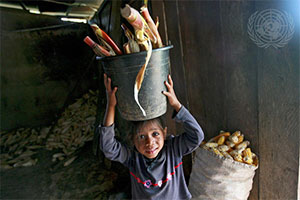 Timorese Girl with Fresh-Picked Corn. Credit: UN Photo/Martine Perret
A global common denominator is the need for a decent job. The economic realities of each country determine just how difficult it is to find one. Despite the labour movement's achievements, serious challenges persist: gender discrimination, child labour, worker migration, the digital divide and AI automation, evaporating pensions, unsafe workplaces, corporate pressure against union organising, negative impacts of trade agreements, and the precariousness of informal employment. The 2025 UN SDG Report identifies jobs and social protections as one of the six priority areas requiring urgent action, with progress either stalled or reversing in many developing nations.
In recent years, the fight to protect labour equality has taken on new dimensions with the rise of Environmental, Social and Governance standards. With the Social aspect aiming to promote equality and human rights, ESG principles have strengthened labour advocacy within corporate and governmental regulatory landscapes. In particular, ESG has become much more institutionalized in emerging economies such as Brazil and China. IPS follows the world’s workers as they confront these challenges - their setbacks and their successes.

The Week with IPS

NEXT STOP - SDGs
Tracking global progress towards a sustainable world
Tracking global progress towards a sustainable world
