Languages
Thursday, October 1, 2026



News and Views from the Global South
Labour

Youths’ Strident Voices Demand an End to Child Labour
Children's voices took centre stage at the 5th Global Conference on the Elimination of Child Labour, which kicked off in Durban, South Africa, on May 15, 2022. Their voices resonated with the saying: "Nothing about us without us."
Alarm Bells for Africa, Child Labour in Agriculture Requires Urgent Action
The Global Estimate on Child Labour estimates 160 million children are in child labour worldwide – an increase of 8.4 million children in the last four years – with millions more at risk due to the impacts of COVID-19.
Call to Freedom for Millions of Children Trapped in Child Labour as Global Conference Comes to Africa
Children washing clothes in rivers, begging on the streets, hawking, walking for kilometres in search of water and firewood, their tiny hands competing with older, experienced hands to pick coffee or tea, or as child soldiers are familiar sights in Africa and Asia.
More Students on the Move in an Increasingly Complex World: Podcast
 This is our third episode on the ongoing movements of people around the world. You can listen to the previous ones, the first about climate migrants and the second on remittances, on any podcast app.
Afghan Moms Receive a Fresh Start in the United States
It was a long, harrowing road for Freshta and Shabaneh, two mothers (their names are pseudonyms) who fled Kabul, Afghanistan, late last summer before eventually settling in the southern New Jersey township of Hamilton.
Black Women, the Most Oppressed and Exploited in Brazil
The Theater of the Oppressed helped her become aware of the triple discrimination suffered by black women in Brazil and the means to confront it, such as the Rio de Janeiro Domestic Workers Union, which she has chaired since 2018.
From Rags to Riches: Power and progress in Abu Dhabi
I recently visited Abu Dhabi and my impressions became intermingled with worries about the war in Ukraine. I also happened to read Livy’s The Early History of Rome, written around the beginning of CE, coming across these lines:
Tackling the Pandemic of Inequality in Asia and the Pacific
After two years of human devastation, the world is learning to live with COVID-19 while trying to balance the protection of public health and livelihoods. For countries in Asia and the Pacific, this is challenging not only because national coffers are heavily strained by record public spending to mitigate pandemic suffering, but also due to deeper structural economic issues.
Perils of Hunger, Food Insecurity in Southern Africa- Challenges & Opportunities
Food systems are under severe stress around the world now. The thresholds of tolerance are already exceeding limits with millions facing acute food and water scarcity throughout all continents. Over a quarter of Africa’s population are facing hunger and food insecurity. Conflict, droughts, flooding, rising unemployment, inequality, economic crises, and the impacts of Covid-19 pandemic have been ravaging the Continent on an unprecedented scale.
Deepening Stagflation: Out of the Frying Pan into the Fire
The world is sailing into a perfect storm as key leaders seem intent on threatening more war, albeit while proclaiming the noblest of intentions. By doing so, they block international cooperation to create conditions for sustainable peace and shared prosperity for all.
War or Peace, Barbarism or Hope
The spectre of ‘stagflation’ threatens the world once again. This time, the risk is the direct consequence of political provocations and war, and not simply due to inexorable economic forces. Stagflation? Stagflation is a composite word implying inflation with stagnation. Stagnation refers to weak, ‘near zero’ growth, inevitably worsening unemployment. Inflation refers to price increases – not high prices, as often implied.
India’s Gig Workers: Overworked and Underpaid
According to the Periodic Labour Force Survey (PLFS), the unemployment rate in urban India stood at 9.4 percent between January and March 2021, with an even higher proportion of youth unemployment (22.9 percent). In the same time period, more than 11 percent of the urban workforce reported working for less than 36 hours in a typical week.
Stagflation Threat: Be Pragmatic, Not Dogmatic
“If your only tool is a hammer, every problem looks like a nail”. Still haunted by the clever preaching of monetarist guru Milton Friedman’s ghost, all too many monetary authorities address every inflationary threat or sign they see by raising interest rates.
Informal Workers Face Up to the Crisis in Latin America
Doris Martínez was a cook in a Venezuelan restaurant that closed its doors; she emigrated to Colombia, got sick from working long hours standing in front of a stove, and returned to her country where, together with her husband and children, she runs a busy fast food kiosk on a road in Valles del Tuy, near the Venezuelan capital.
Over 60% of World Workers Not Recognised, Not Registered, Not Protected
More than 60 percent of the world’s adult labour force –or about 2 billion workers– work in the informal economy. “They are not recognised, registered, regulated or protected under labour legislation and social protection. The consequences can be severe, for individuals, families as well as economies.”
Lessons from Liberia for Scaling Poverty Reduction Globally
For the past three years, BRAC International has been piloting in Liberia an adaptation of its acclaimed Graduation approach, whose impact on reducing extreme poverty was first proven in Bangladesh. The success of the Liberia pilot, which I managed, provides not only further proof of impact but vital lessons that can enhance and accelerate scaling of the approach globally.
Inflation Targeting Constrains Development
All too many developing countries have been persuaded or required to prioritize inflation targeting (IT) in their monetary policy. By doing so, they have tied their own hands instead of adopting bolder economic policies for growth, jobs and sustainable development.
International Women’s Day, 2022
War, Want, Weather and Wellbeing: Where Are We Now?
WAR The world is currently facing a devastating war with dire prospects for our global security. Men are waging this war while women seek peace and security for their families, communities and our global society. Women are give birth and nurture while some men actively seek death and destruction. This is one of the fundamental differences between the sexes which underpins patriarchy and generates inequality on many levels. Women and girls bear the brunt of this unbalanced approach to life.

International Women’s Day, 2022
Women are the Answer to Sustainable Development
When countries improve their Global ranking, there is rejoicing within the community that progress has been made at last.. but has it and why does it matter ?

It’s Time to Step up for Street Vendors’ Rights
In the second week of January 2022, Purushottam—locally known as Prashant—a street vendor in central Delhi’s Connaught Place area, died by suicide. It was later discovered that the reason for his death was his inability to pay certain debts.
Young Argentine Women Forge a Future in Cooperative Factory
"We started making shampoos and soaps in the kitchen of a friend’s house in 2017. We were five or six girls without jobs, looking for a collective solution, and today we are here," says Letsy Villca, standing between the white walls of the spacious laboratory of Maleza Cosmética Natural, a cooperative that brings together 44 women in their early twenties in the Argentine capital.« Previous Page — Next Page »


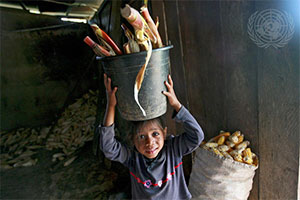 Timorese Girl with Fresh-Picked Corn. Credit: UN Photo/Martine Perret
A global common denominator is the need for a decent job. The economic realities of each country determine just how difficult it is to find one. Despite the labour movement's achievements, serious challenges persist: gender discrimination, child labour, worker migration, the digital divide and AI automation, evaporating pensions, unsafe workplaces, corporate pressure against union organising, negative impacts of trade agreements, and the precariousness of informal employment. The 2025 UN SDG Report identifies jobs and social protections as one of the six priority areas requiring urgent action, with progress either stalled or reversing in many developing nations.
In recent years, the fight to protect labour equality has taken on new dimensions with the rise of Environmental, Social and Governance standards. With the Social aspect aiming to promote equality and human rights, ESG principles have strengthened labour advocacy within corporate and governmental regulatory landscapes. In particular, ESG has become much more institutionalized in emerging economies such as Brazil and China. IPS follows the world’s workers as they confront these challenges - their setbacks and their successes.

The Week with IPS

NEXT STOP - SDGs
Tracking global progress towards a sustainable world
Tracking global progress towards a sustainable world
